
Venice Off the Beaten Path: Cannaregio, Sunsets & the Veneto Countryside
Venice has a quieter side that most visitors never find.

We spent five days in Venice between 19 and 23 August 2023 with two kids (then 10 and 14), and the rhythm that worked was simple: the postcard circuit (San Marco, Rialto, Burano) in the mornings, the quieter quarters from 18:00 on. This guide is the evening-and-edge-of-Venice half of that trip — Dorsoduro's Zattere promenade at sunset on 20 August, the residential back-canals twenty minutes later, Cannaregio's Fondamenta della Misericordia on 21 August, and a day in Maser and Asolo in the Veneto hills the day before we reached the lagoon.
The day-tripper crowds on the San Marco loop peak between roughly 10:00 and 17:00 in August. After 18:00 the cruise passengers are gone, the group tours have broken up, and two neighbourhoods in particular — Dorsoduro (south) and Cannaregio (north) — shift tempo. This is the window we worked with every evening, and what follows is the actual sequence: routes, timings, prices, and the specific spots we photographed.
Bookings: Some of the links in this article are affiliate links. This means that if you choose to make a booking, we will receive a small commission at no extra cost to you. Thank You!
The Zattere: Venice's Best Sunset Promenade
The Fondamenta delle Zattere runs 1.3 kilometres along the southern edge of Dorsoduro, facing the island of Giudecca across the 300-metre-wide Giudecca Canal. Access is easiest from Vaporetto stop Zattere (lines 2, 5.1, 5.2, 6); sunset in late August falls in the early evening, so we walked the full length from the Zattere stop eastward to the Punta della Dogana starting in the early evening on Sunday 20 August.
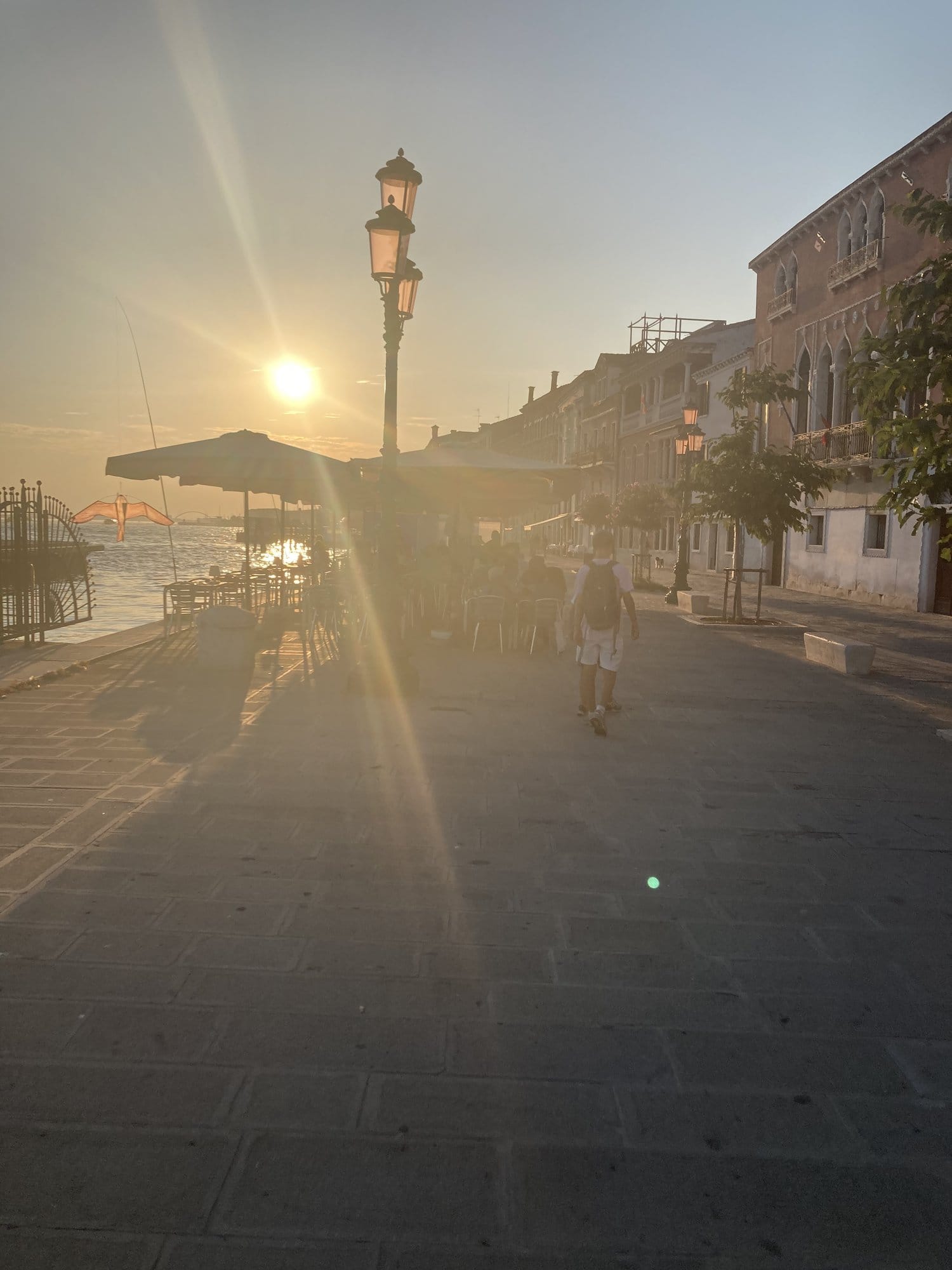
by the early evening the sun sits just above the Giudecca roofline. Two silhouettes walked the rail straight into the light, and we caught them at IMG_1959 — standard Zattere-at-sunset shot, but the light that evening was unusually warm (low cloud over the Dolomites was reflecting south over the lagoon). The far-shore dome of the Redentore (Palladio, 1577 — plague-thanksgiving church) sat in silhouette.
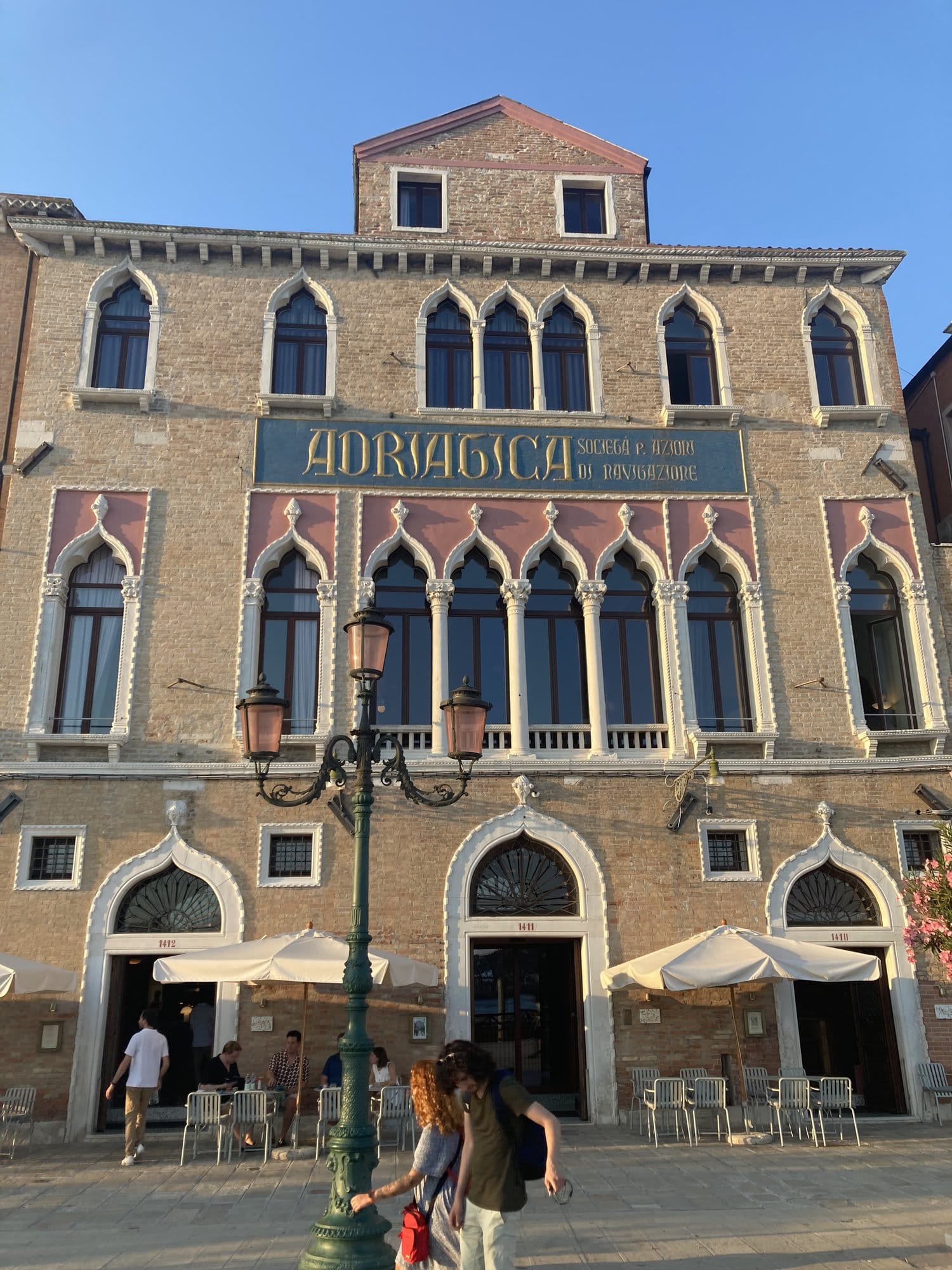
Three minutes later (19:21) we were at the Palazzo Adriatica, the old Società di Navigazione Adriatica office — a 1920s Stile Littorio / Venetian-Gothic mashup rather than true Art Nouveau, with pointed windows, a sgraffito frieze and a copper-green lamppost immediately in front. The building now houses apartments. The restaurant terraces on the quay opposite (Linea d'Ombra, La Piscina) are the priciest on the Zattere — €40+ for a basic pasta — but the view is the actual value proposition.
From 19:30 (about 45 minutes before full sunset) the quay's retro gas-era lampposts come on and the restaurant terraces catch the last straight light off the Giudecca. The entire walk — Zattere stop to Punta della Dogana — is free and doesn't require any ticket; the nearest toilet is at the Punta della Dogana museum café (€0.50 non-guest access).
Dorsoduro at Twilight
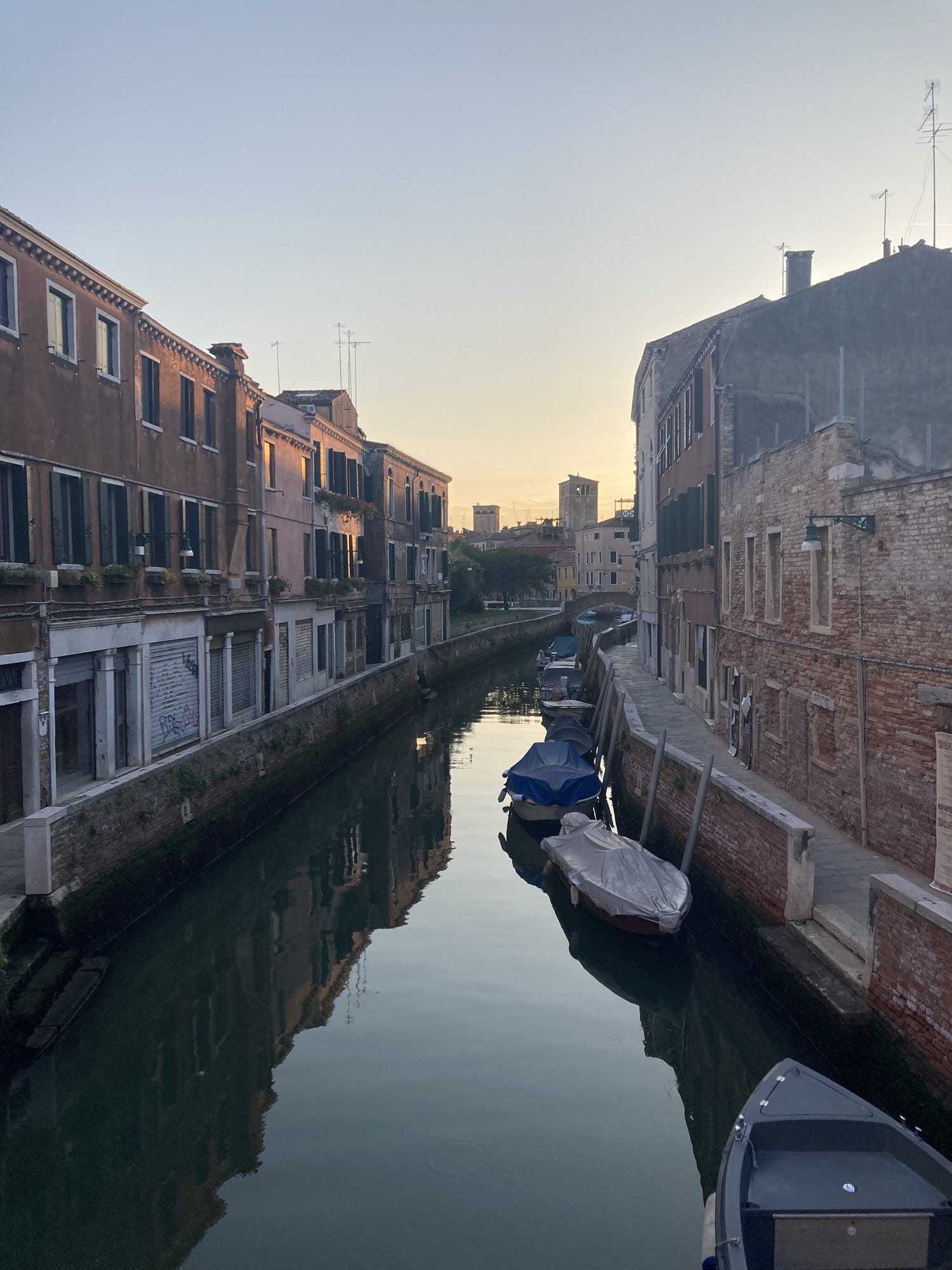
Cut inland off the Zattere at the Ponte agli Incurabili and walk north through the back calli of Dorsoduro. By 19:33 on 20 August we were in the residential stretch around the Rio de San Trovaso (IMG_1994) — a tight north-south canal with moored boats, ocher facades, and one of the last working squeri (gondola workshops, Squero di San Trovaso — visible from the Fondamenta Nani). At this hour the streets are mostly empty; the day-trippers are queuing for the late vaporetti off Piazzale Roma.
We walked four blocks east to the Rio di San Barnaba area by the early evening — the canal bends, the boats are moored close together, and the reflection symmetry lines up almost perfectly for about fifteen minutes a day around the 30-minutes-to-sunset mark. These are the Instagram shots every Venice feed replicates; they aren't staged, they're just what happens in the short window after the tour groups clear and before the blue hour fades to black.
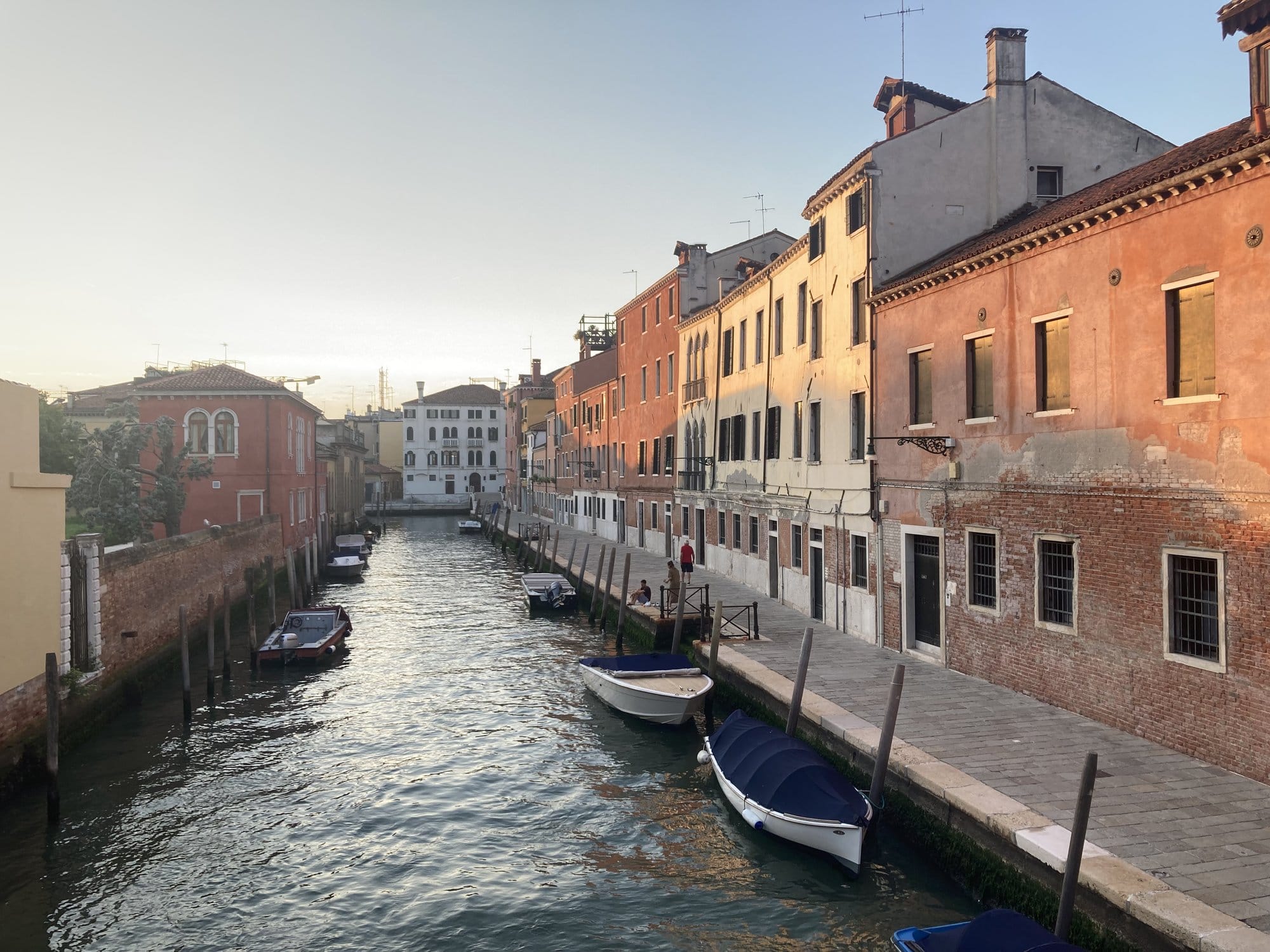
There's no agenda here. Just walk, look, and let the city do the work.
Cannaregio: Venice's Local Quarter
Cannaregio runs across the northern third of the main islands — its population is around 12,000 (of 50,000 total living in historic Venice), and it's the quarter where the weekday morning school run and the evening passeggiata still happen in recognisable form. Its centre is the Fondamenta della Misericordia, a 500-metre canalside promenade about 15 minutes' walk from Santa Lucia station. We arrived there in the late afternoon on Monday 21 August, straight from the Burano vaporetto return at Fondamente Nove.
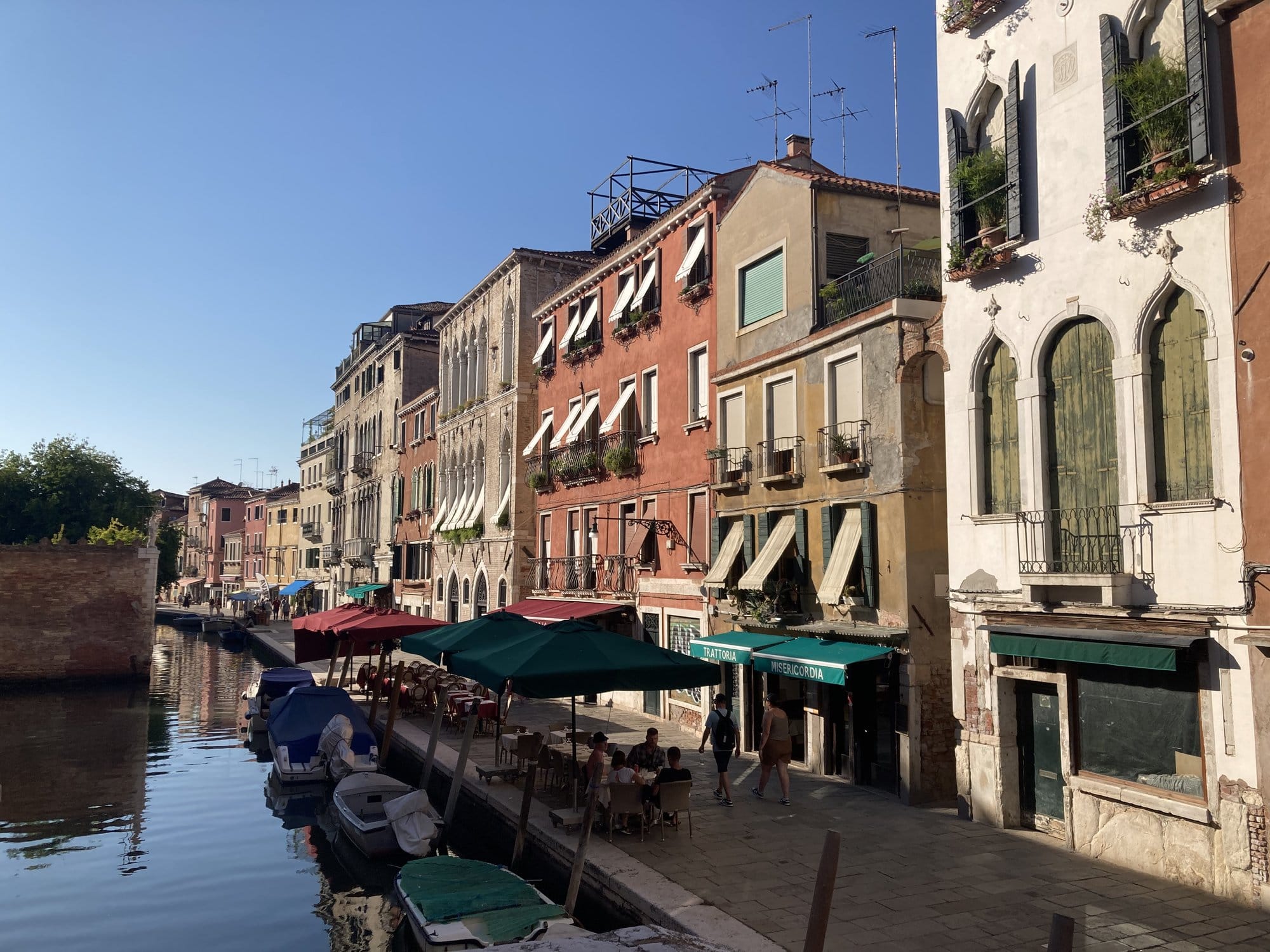
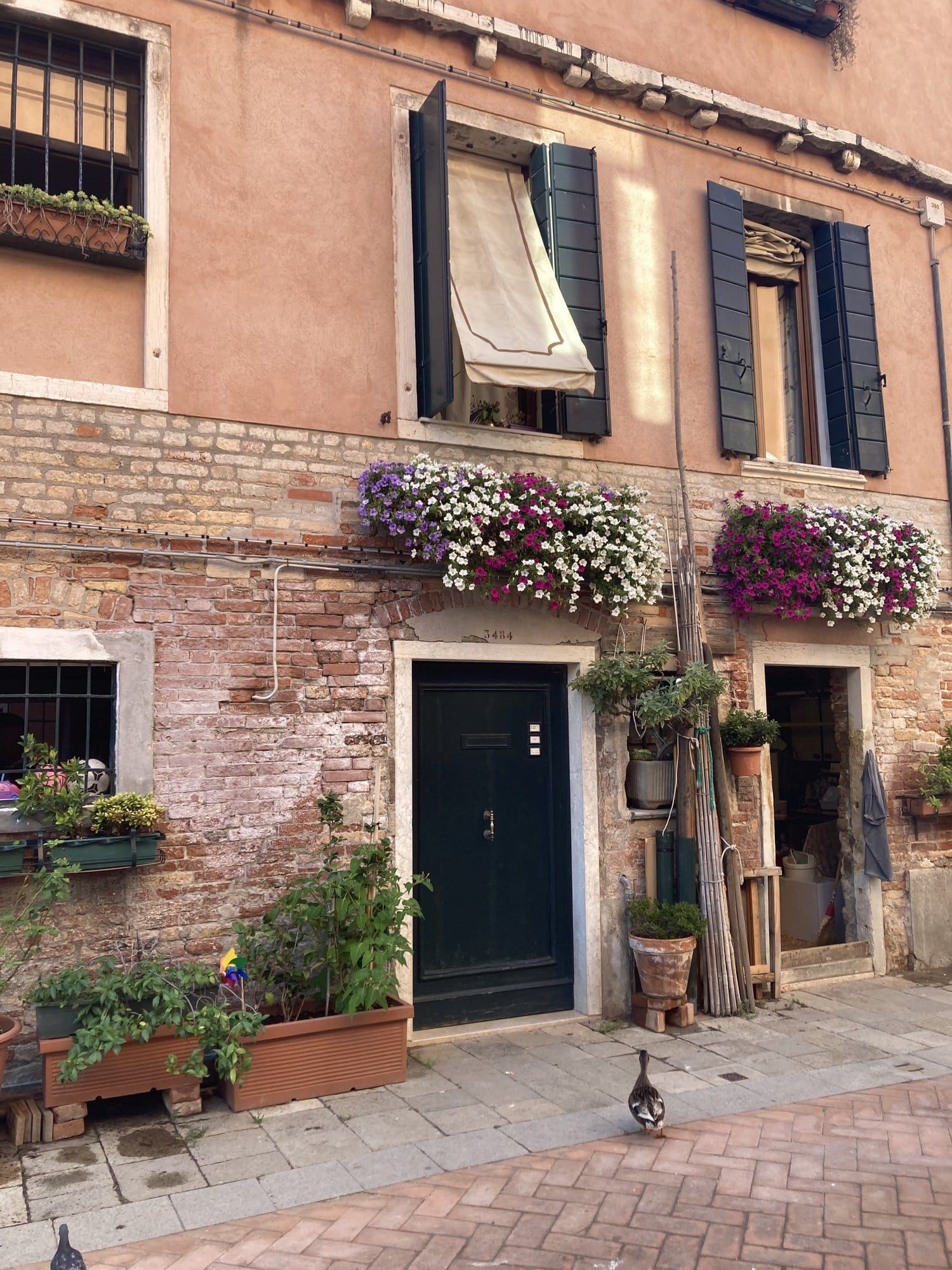
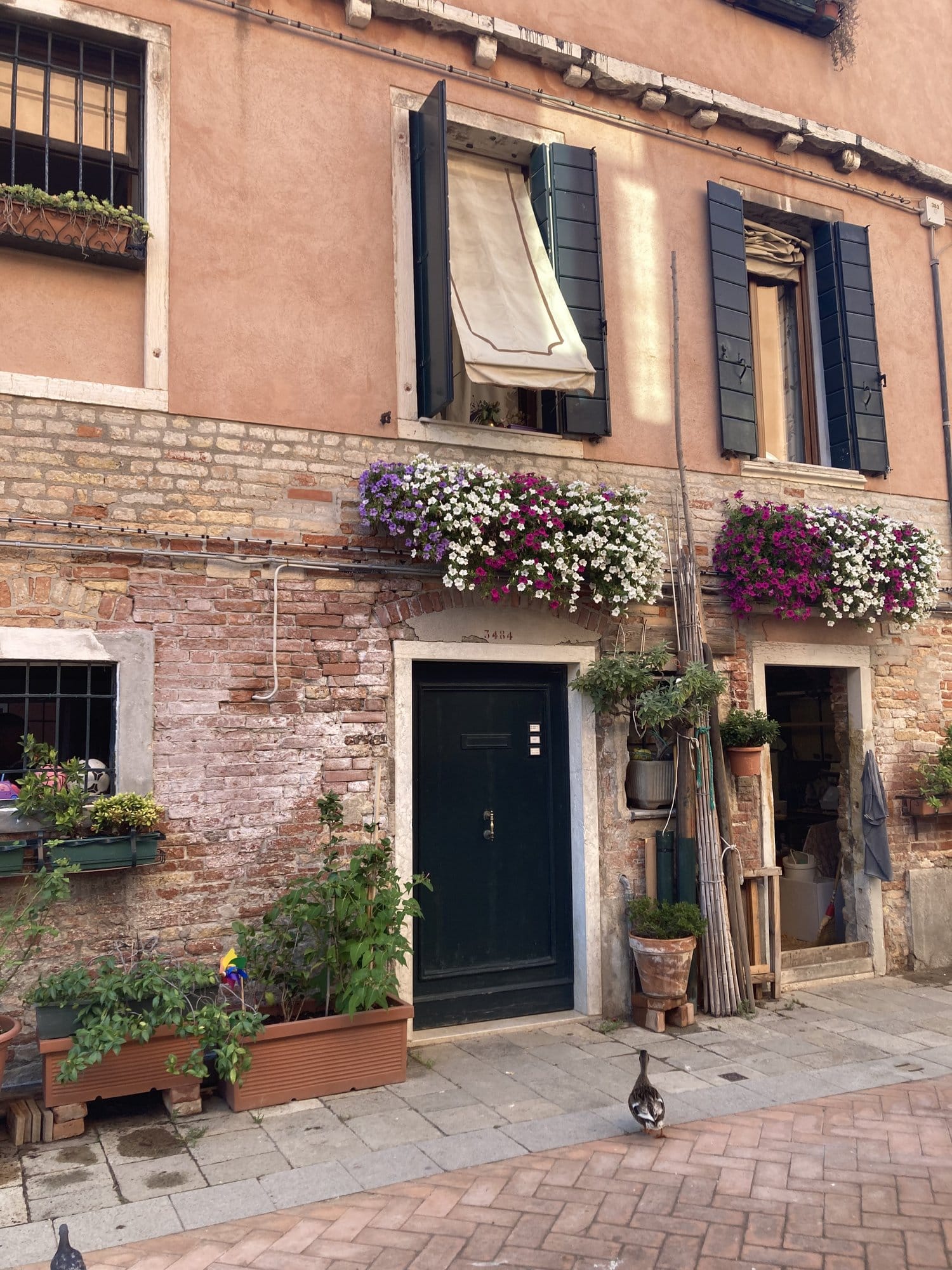
A ten-minute walk west off the Misericordia at 18:06 brought us to a brick facade on Calle del Capitello — purple and white petunias packed into window boxes under green shutters, a single pigeon on a sill that moved as I raised the phone. This is the image we kept from the whole evening, and it's the kind of frame Cannaregio offers constantly: nothing staged, just a quarter that's still lived in rather than performed.
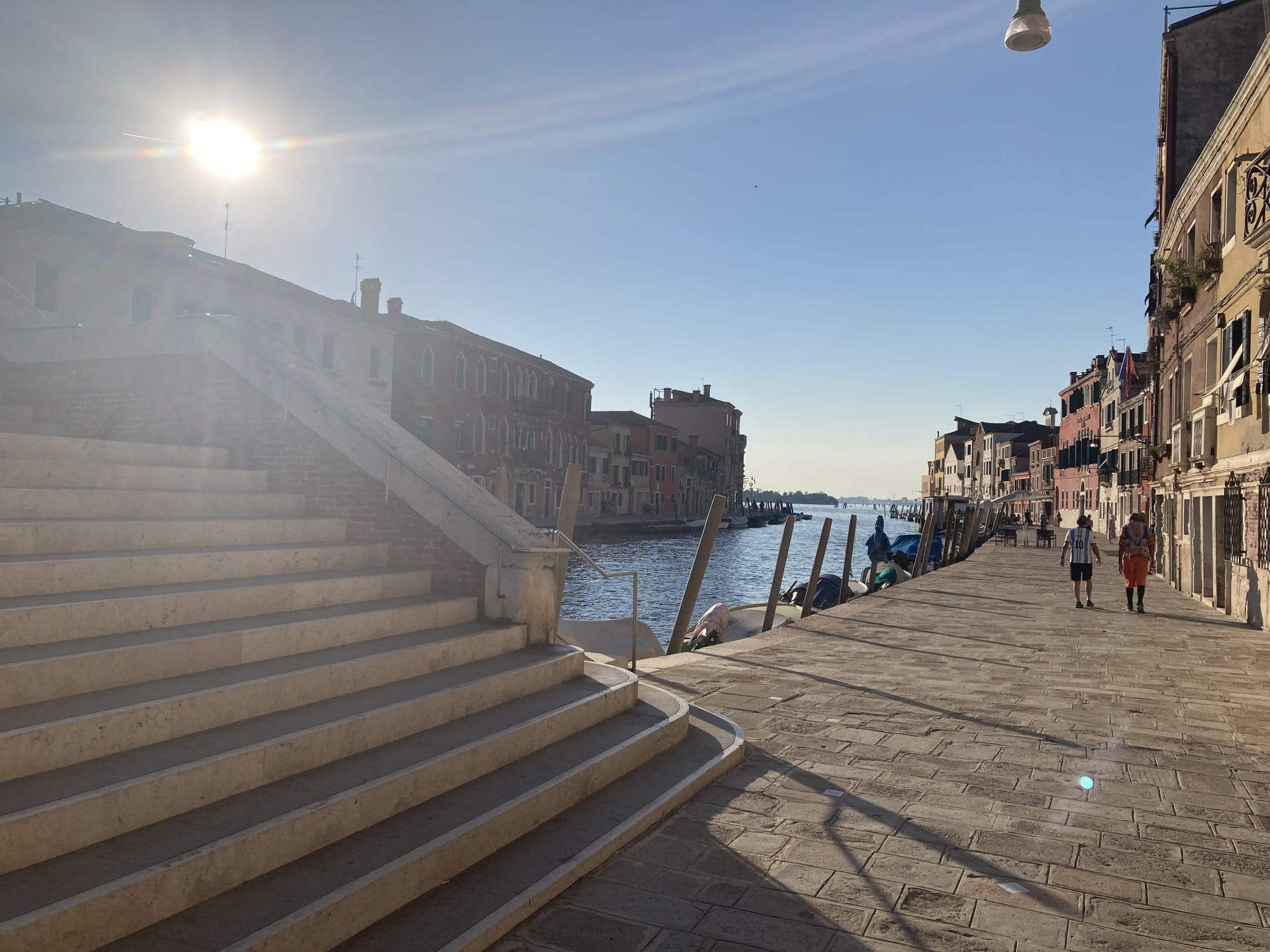
by the late afternoon we were on the wide stone steps of the Ponte dei Tre Archi — the only three-arched bridge in Venice, built 1688, crossing the Cannaregio canal where it joins the lagoon. From the crown, the low sun throws long reflections east toward the Ghetto and west toward the station. Unlike the Rialto, you won't queue for a spot on the railing at any hour. The Guglie, two bridges east, makes an alternative vantage but it's a flat bridge without the step-seats the Tre Archi gives you.
Aperitivo and Cicchetti: Venice's Food Culture
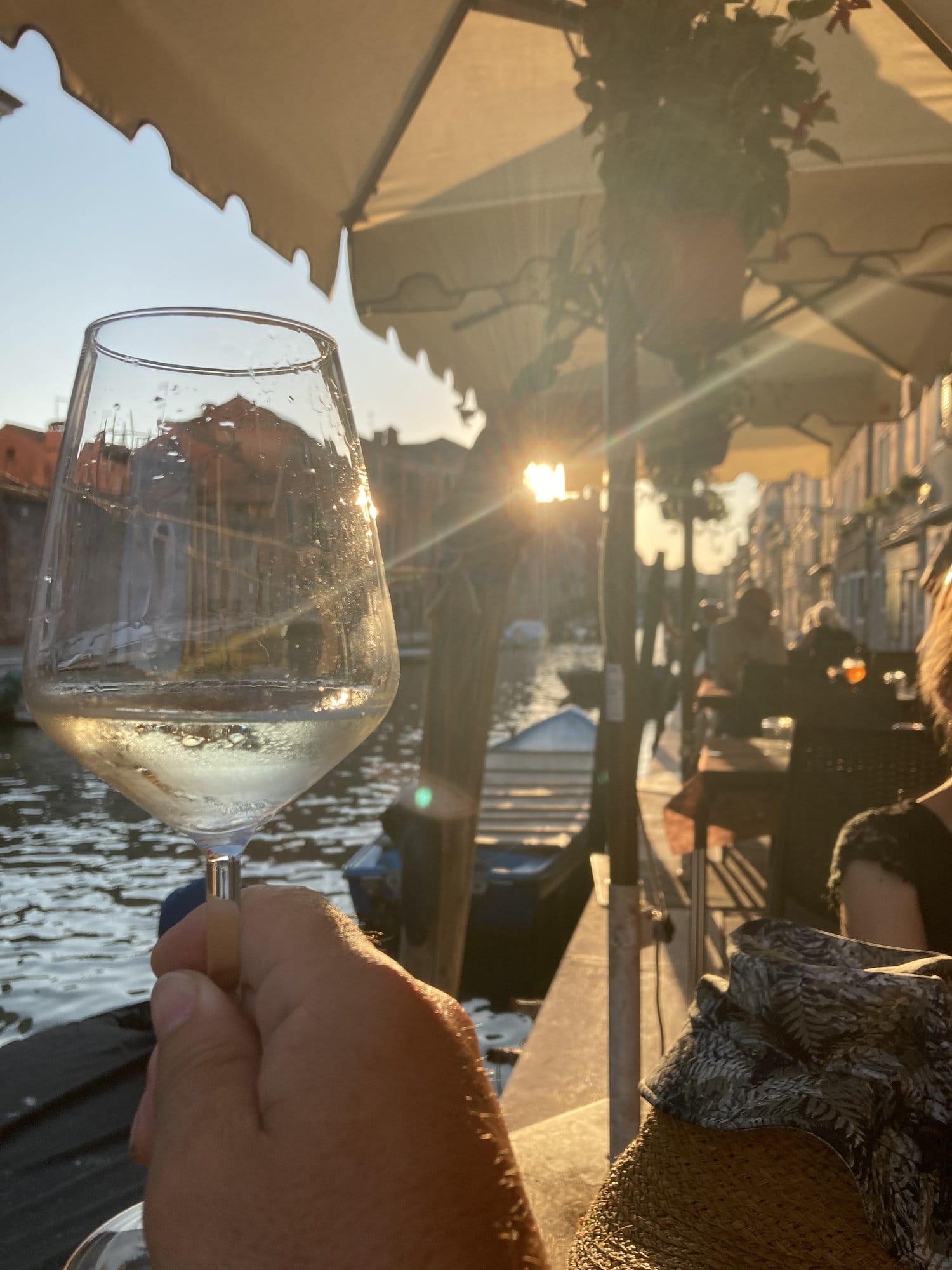
Aperitivo on the Fondamenta della Misericordia runs roughly 18:30-20:30. We sat at one of the canal-side tables at 19:22 — a glass of Tocai Friulano DOC was €5.50; an Aperol Spritz €4; a Hugo (Prosecco, elderflower, mint) €5. Bars to know: Paradiso Perduto (the loud one with live jazz some nights), Al Timon (traditional cicchetti outside seating along the canal), Il Santo Bevitore (quieter, better wine list). Our kids had Crodino (non-alcoholic bitter apéritif, €2.50) and adapted to Venetian tempo faster than I expected.
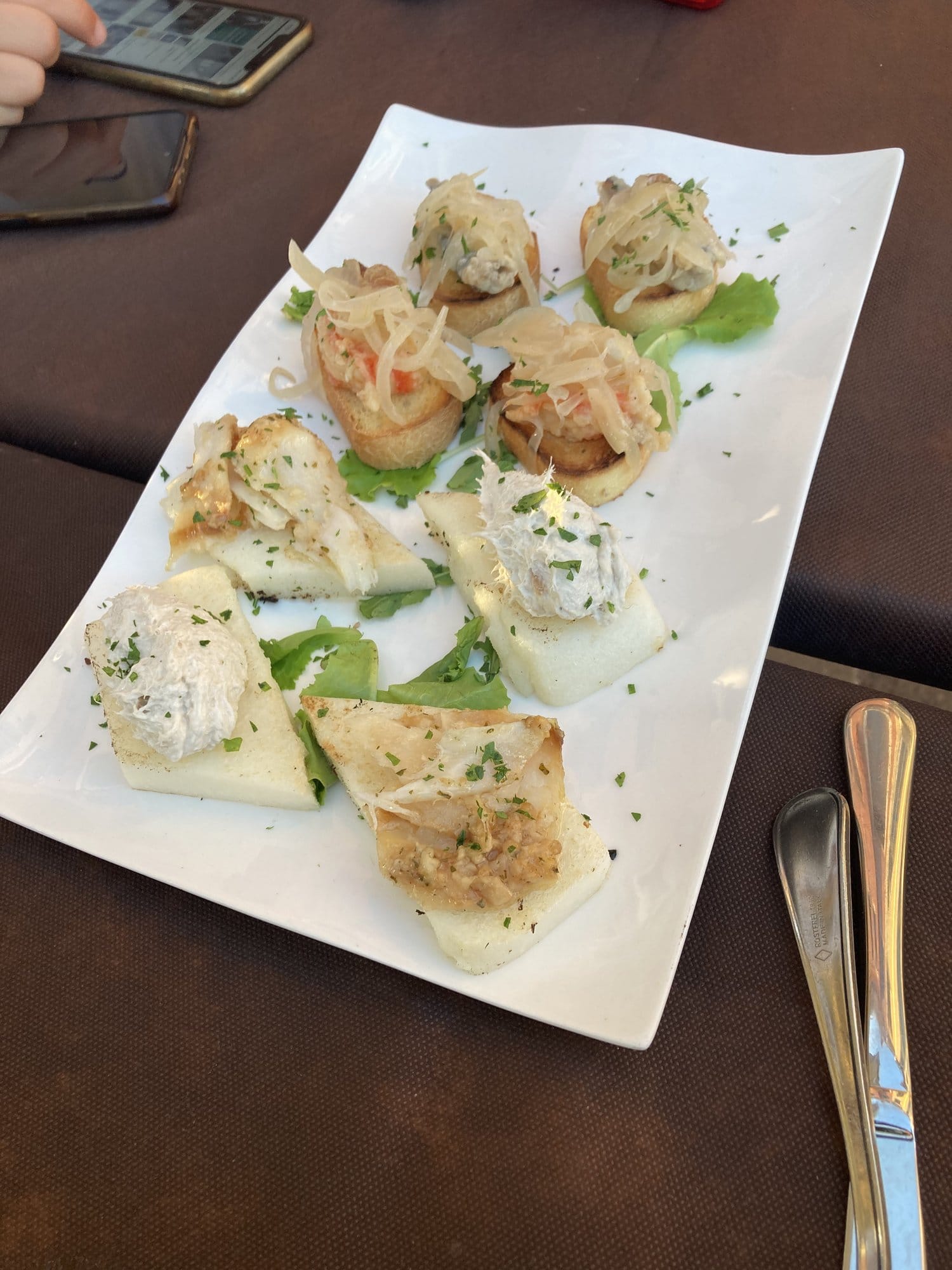
Cicchetti are the small-plate culture at the neighbourhood bacari. Baccalà mantecato (whipped salt-cod), sarde in saor (sweet-sour marinated sardines with onion, pine nuts and raisins), moeche (soft-shell crab, spring and autumn only), polpette (tuna/meat fried balls) — most run €1.50-3 per piece. Six or seven pieces plus a glass of ombra (small wine pour — literally "shadow," the old term for a quick glass in the shade of San Marco's campanile) runs €15-18 per person. Our family of four ate at Al Timon this way on 21 August for €62 total.
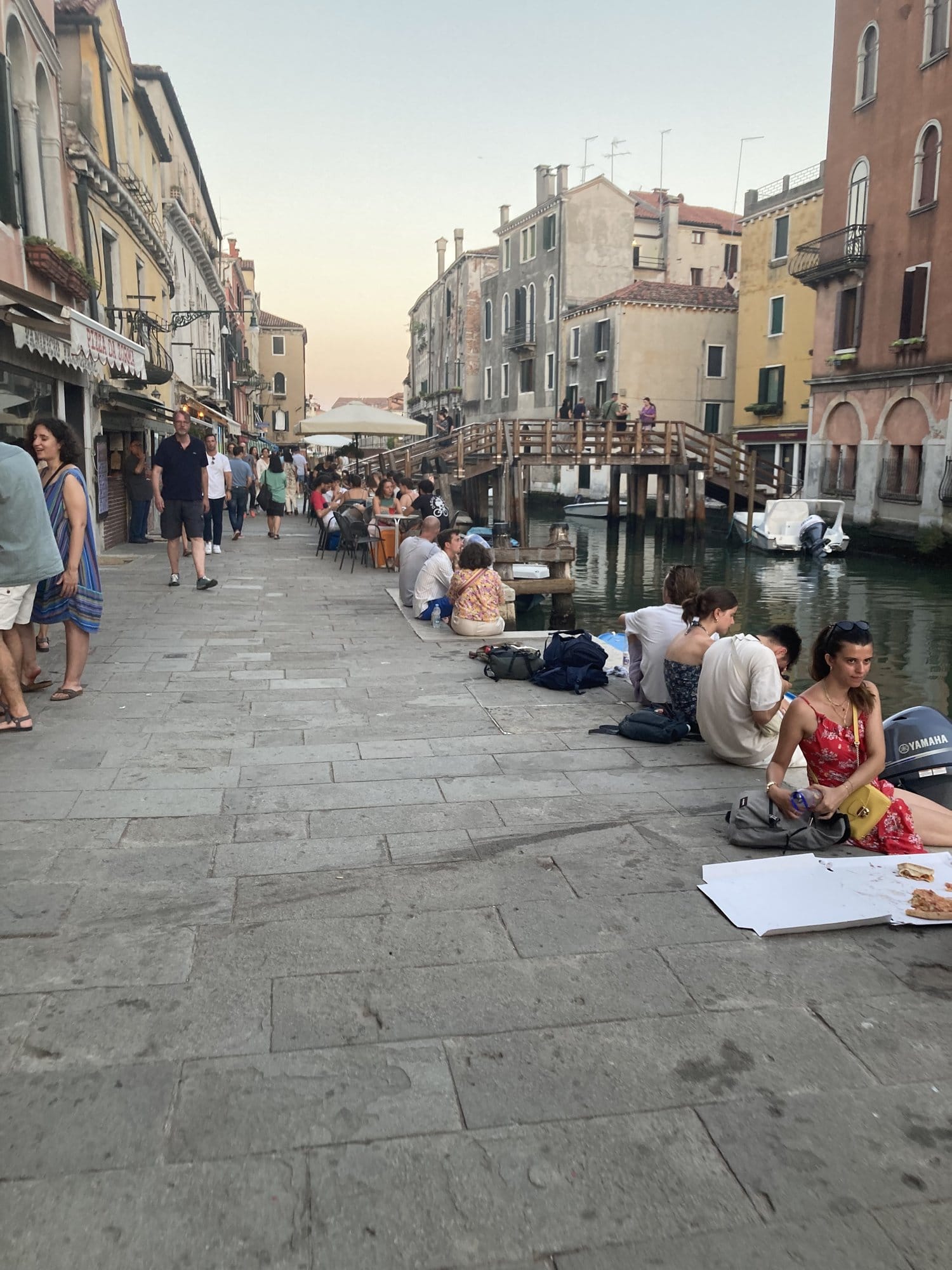
At 20:04 the Fondamenta della Misericordia hit its peak — every canal-edge kerb occupied by locals and visitors sitting with their feet hanging over the water, a few dozen bottles of wine being passed between groups. The small wooden bridge (Ponte Chiodo — one of only two bridges in Venice without parapets, the other is on Torcello) frames the scene from the east. This is the "real Venice nightlife" line the guidebooks overuse — except in Cannaregio it's genuinely populated by Venetians, not pass-through tourists.
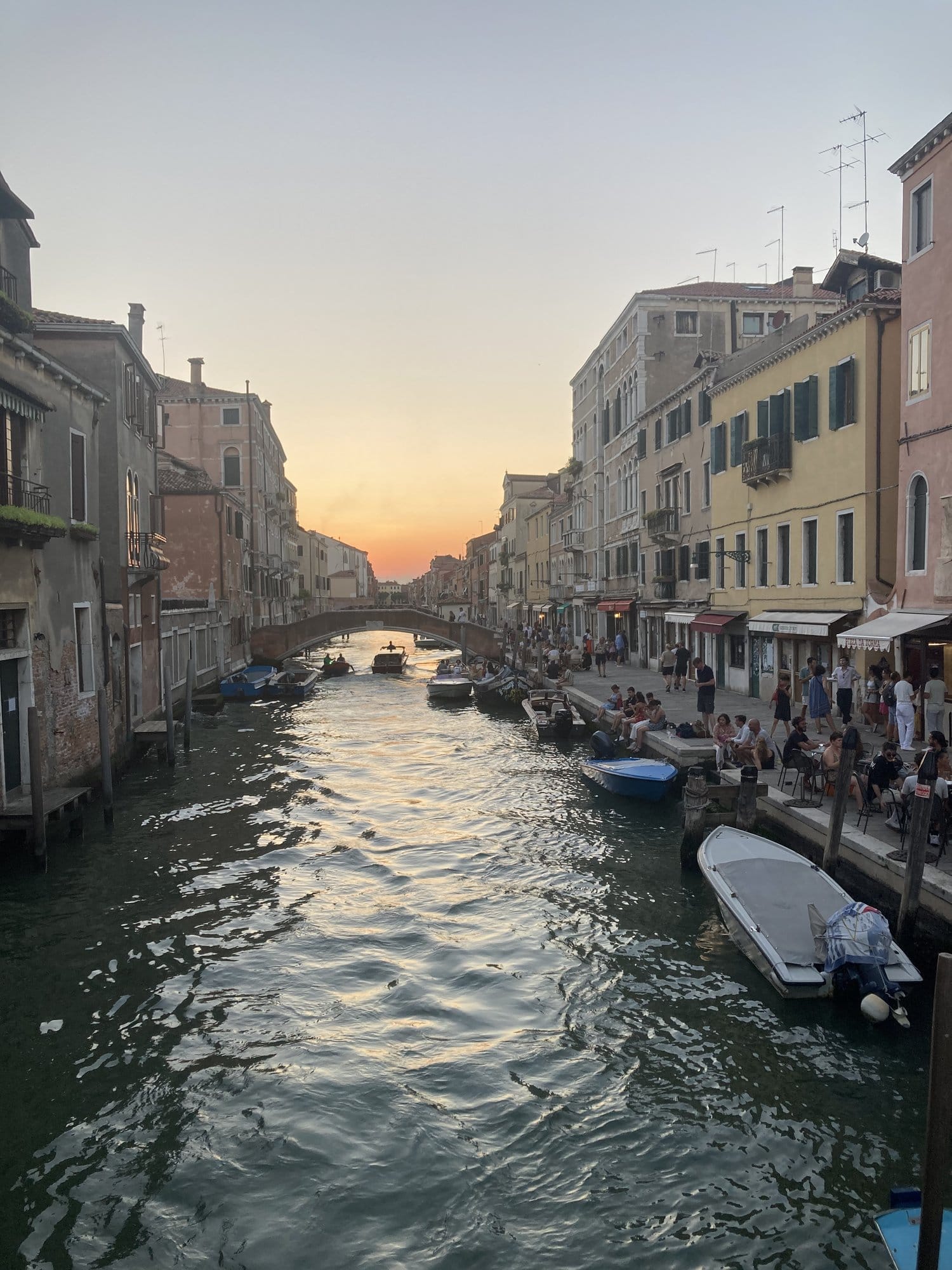
Cannaregio's narrow north-south canals catch sunset differently from the wide south-facing Zattere — the light is indirect, bouncing off the Misericordia's west facade and filling the canal for about 20 minutes after the sun has dropped behind the roofline. We caught that light in the early evening (IMG_2073): a single reflected orange strip down a 40-metre stretch of canal, restaurant lights starting to come on in the windows.
Cannaregio After Dark
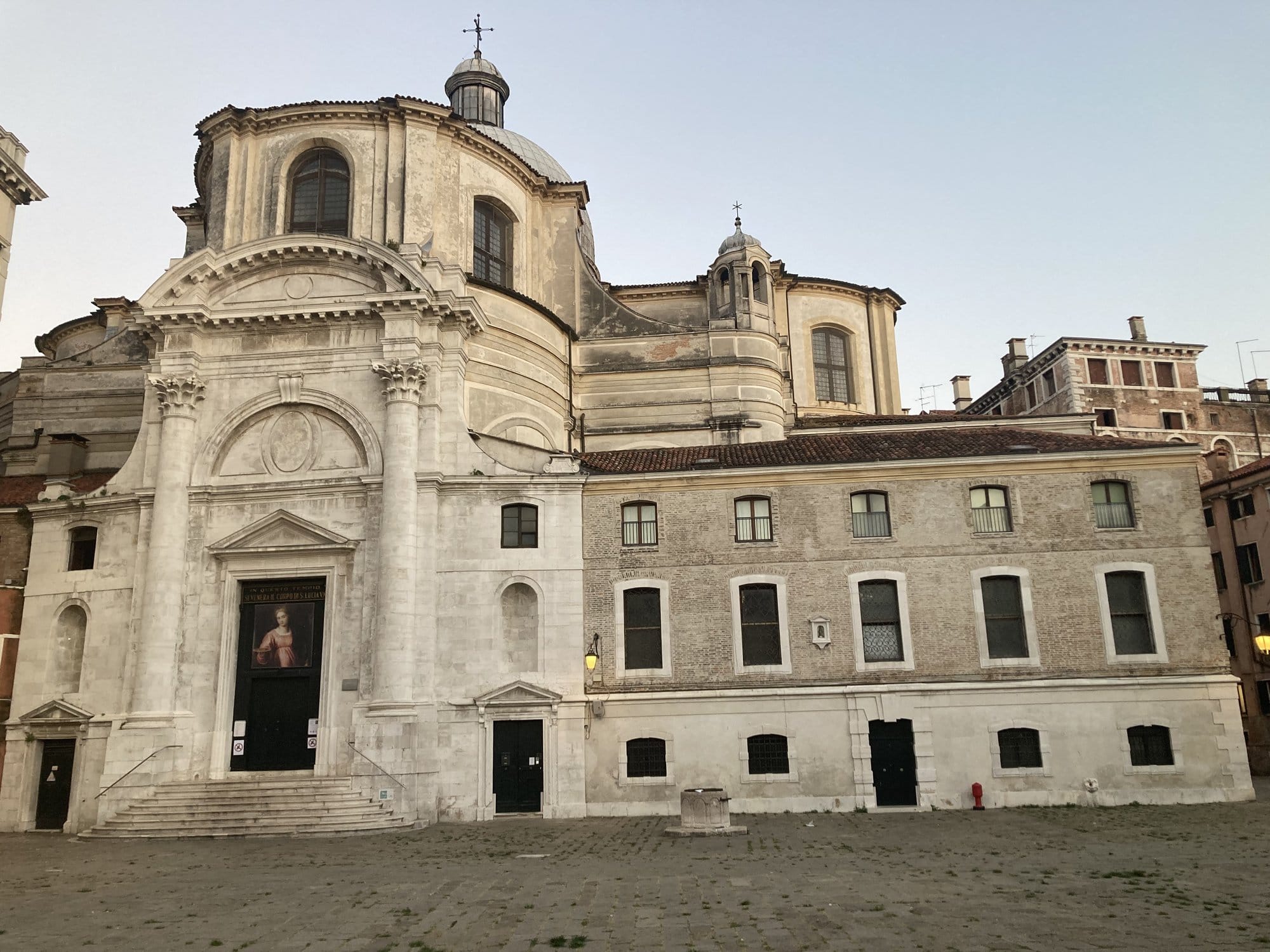
From the Misericordia, walk south 12 minutes toward the Grand Canal and you'll pass the Chiesa di San Geremia (where we paused in the early evening — the façade catches blue-hour light cleanly, the campo is usually empty after dinner). San Geremia houses the relics of Santa Lucia — moved here in 1861 from a church demolished to build the railway station. The rounded 18th-century facade reads almost Baroque rather than Venetian.
Three minutes on (20:19) you pass one of the handful of Aperol-branded storefronts around the station — the bright orange 3D signage is recent, part of Campari Group's Venice marketing push, and photographs uniquely well against the darkening salmon-pink plaster that's standard in this stretch. Aperol itself is older than most visitors think — the product was launched in Padua in 1919.
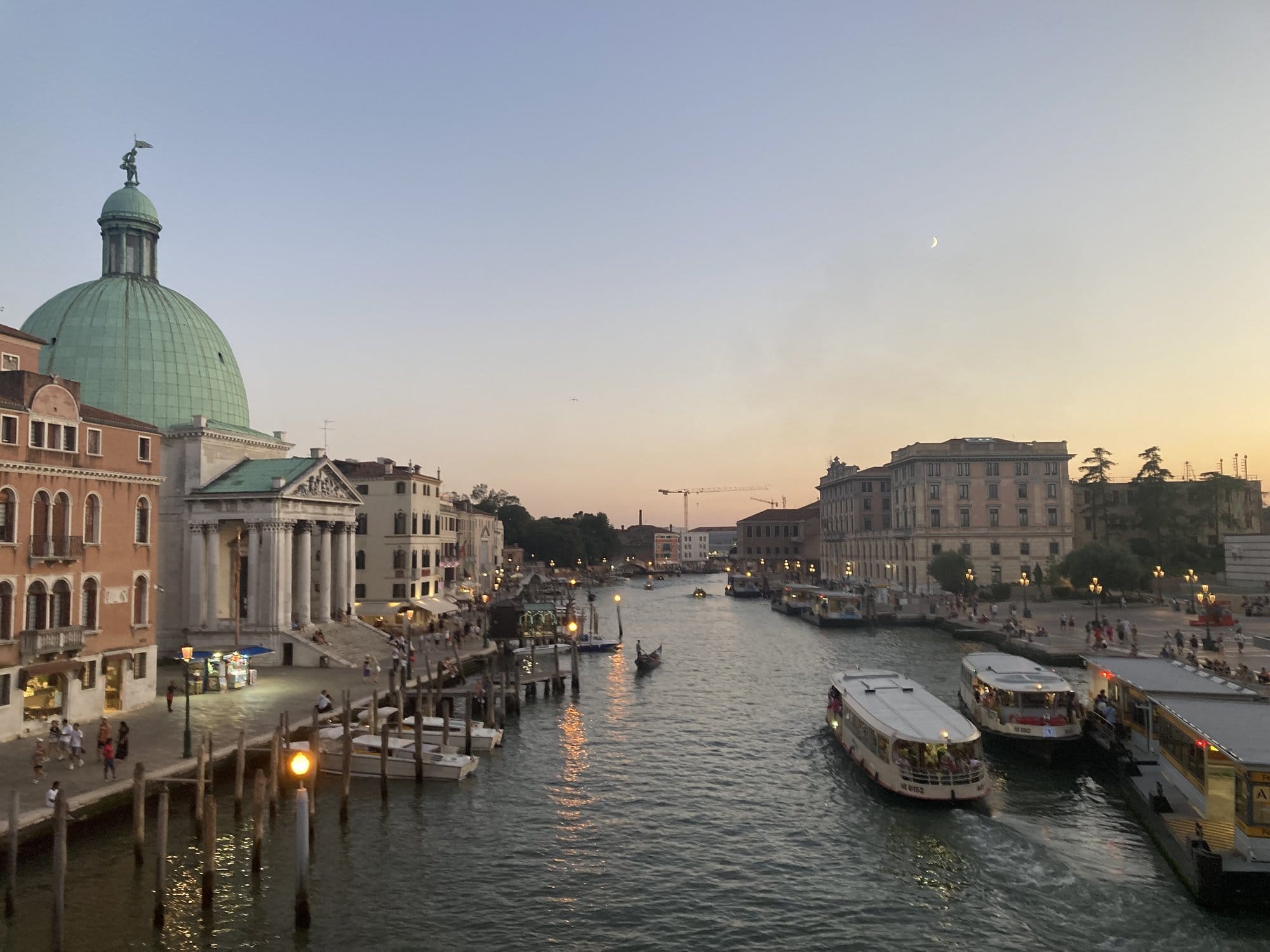
by the early evening we were on the Ponte degli Scalzi, the westernmost of the four Grand Canal bridges (just east of Santa Lucia station). From the crown you look east down the Grand Canal: the green copper dome of San Simeone Piccolo — a 1738 Antonio Scalfarotto design, loosely modelled on the Pantheon — sits directly opposite, the last vaporetti of the 5.1 line crossing in both directions, and the day's last blue-gold light painting the Rialto-bound palazzi. It's the end-of-day photograph we come back to.
Day Trip: Villa Barbaro and Asolo
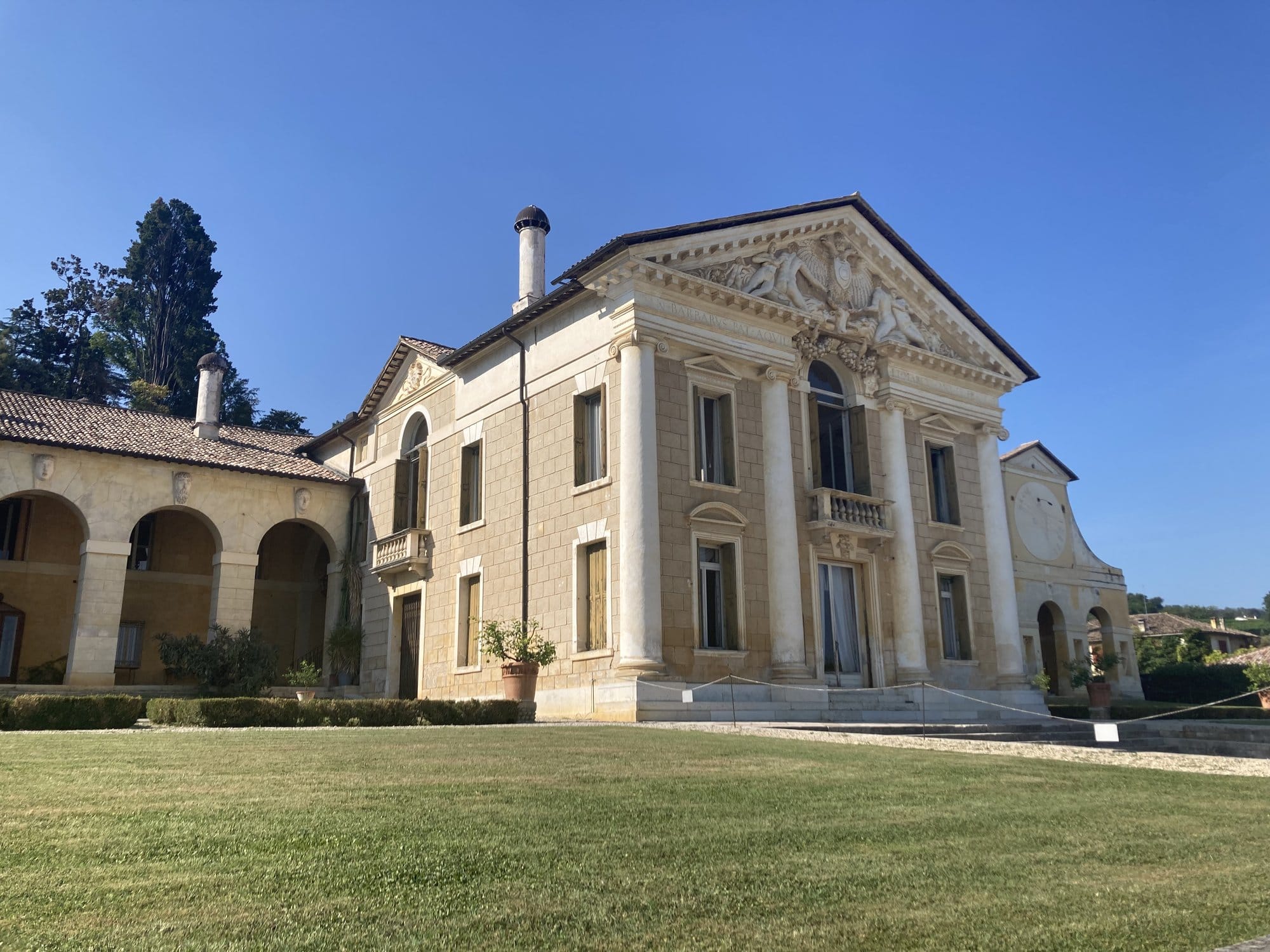
We did the Veneto hills on Saturday 19 August as the day before the Venice days, coming south from a campsite near Castelfranco Veneto. The two stops that made the afternoon were Villa Barbaro in Maser and the medieval hilltop of Asolo — 15 minutes between them, roughly 55 km (one hour via A27 Treviso Nord exit) from Venice's car ferry at Piazzale Roma / Tronchetto. Villa Barbaro (inscribed UNESCO 1996, as part of the City of Vicenza and the Palladian Villas of the Veneto) is the Palladio building most people haven't seen in photos — less famous than the Rotonda but arguably the one where Palladio and Veronese worked in closer collaboration.
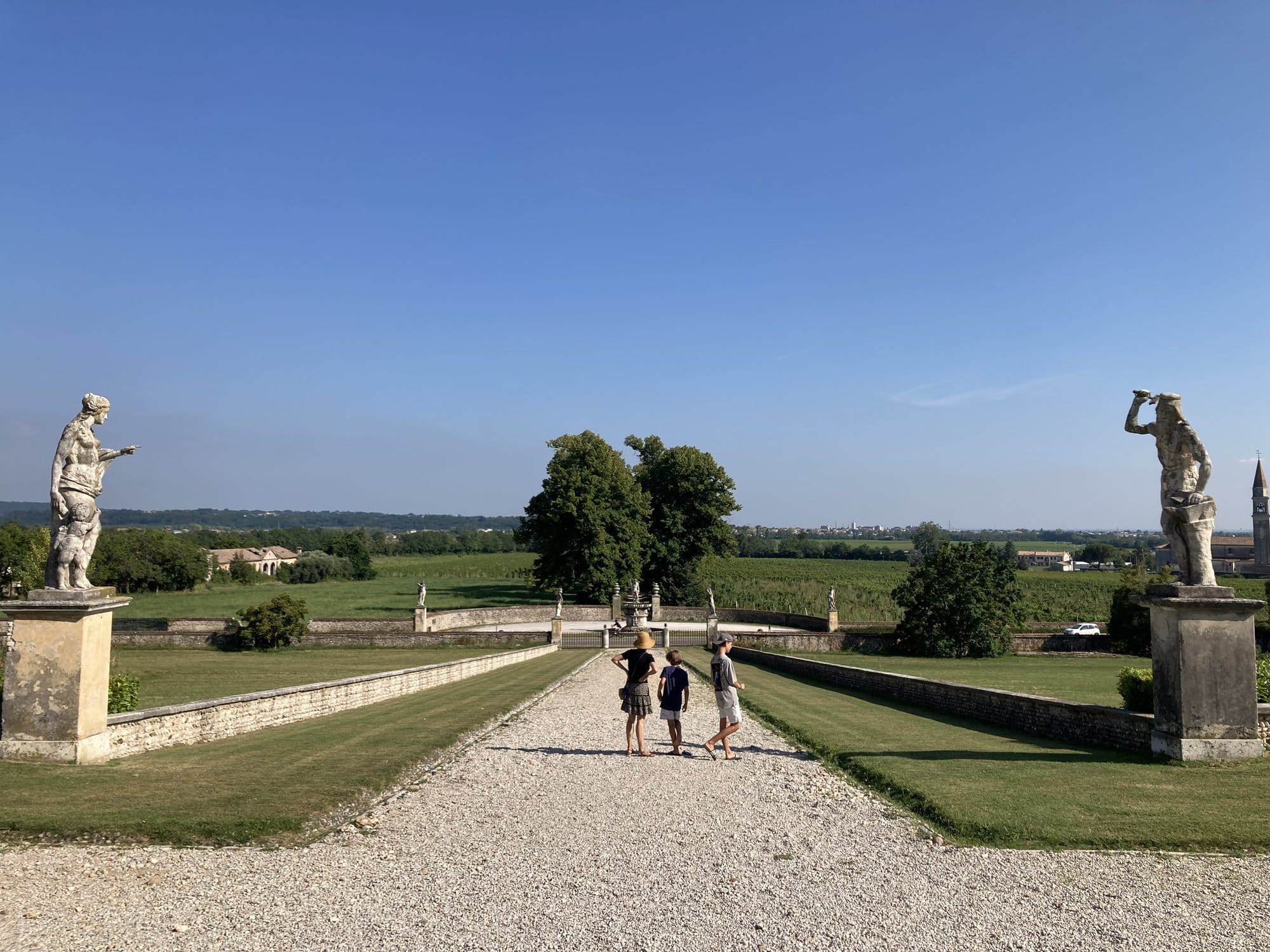
We arrived at the villa gates in the mid-afternoon and walked the gravel allée — statues by Marc'Antonio Barbaro himself (one of the patron-brothers, who commissioned the villa from Palladio in 1560) lining the approach. The Veronese fresco cycle inside the villa (completed 1561) is one of the densest single-artist cycles in any Palladian interior: trompe-l'œil landscape frames, mythological allegories, and the famous portrait of Giustiniana Barbaro with her son from a painted balcony. Entry was €10/adult in August 2023, €5 for children 13 and under; our 10-year-old got in free, our 14-year-old paid the adult rate. The villa opens Tuesday-Sunday 10:00-18:00 summer; it's closed Mondays.
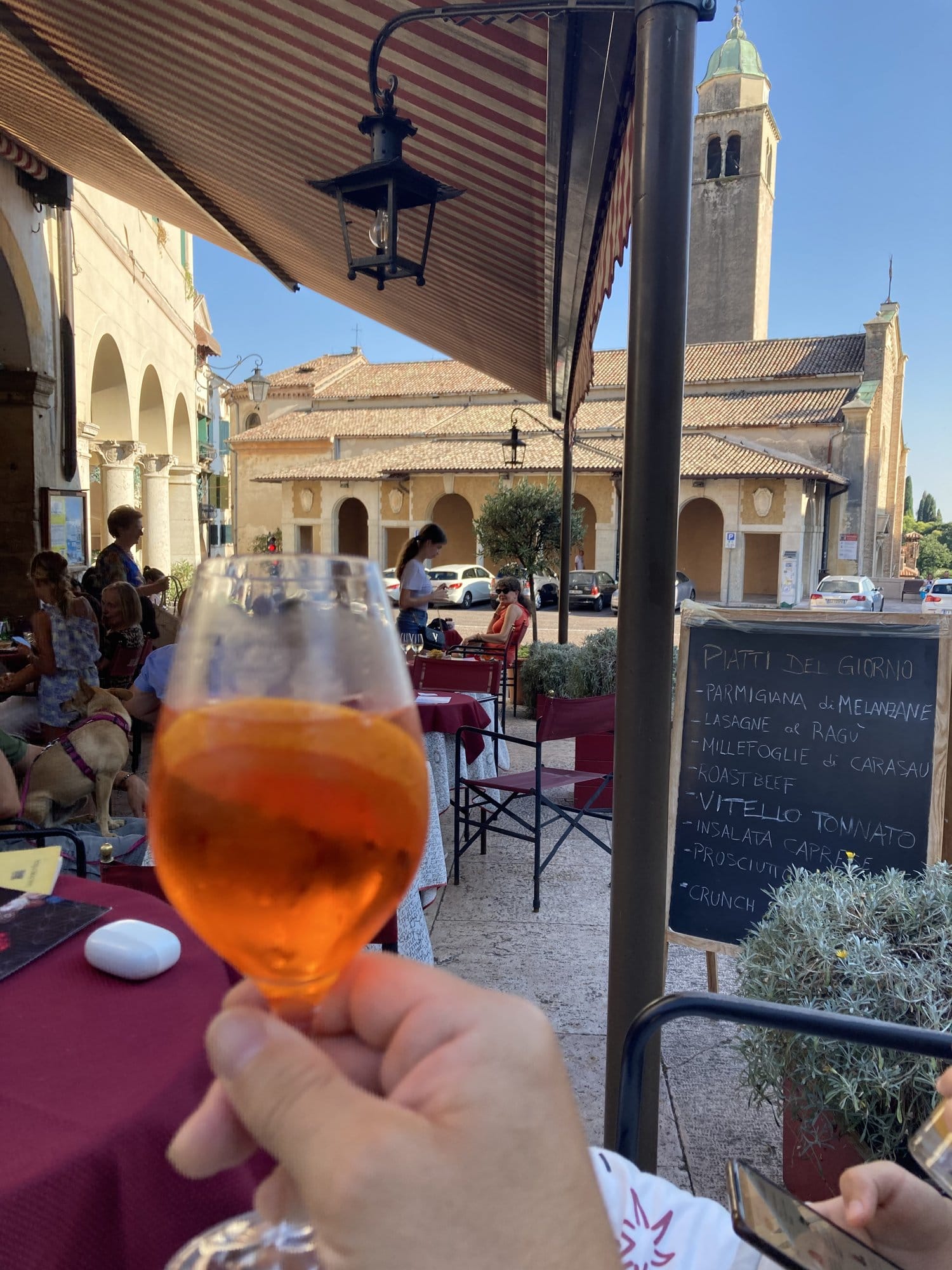
Asolo is 15 minutes west of Villa Barbaro via the SS248 and the climb up the hill — parking is at the base in the Piazzale dei Cadorin (€1.50/hour, pay-and-display). We walked up to the Piazza Garibaldi and were sitting at one of the café terraces under the arcades in the late afternoon with an Aperol Spritz (€6) and two Crodino (€3 each). The campanile is Romanesque-Gothic, the cathedral behind it is dedicated to Santa Maria Assunta, and most of the arcaded buildings on the square date from the 15th century.
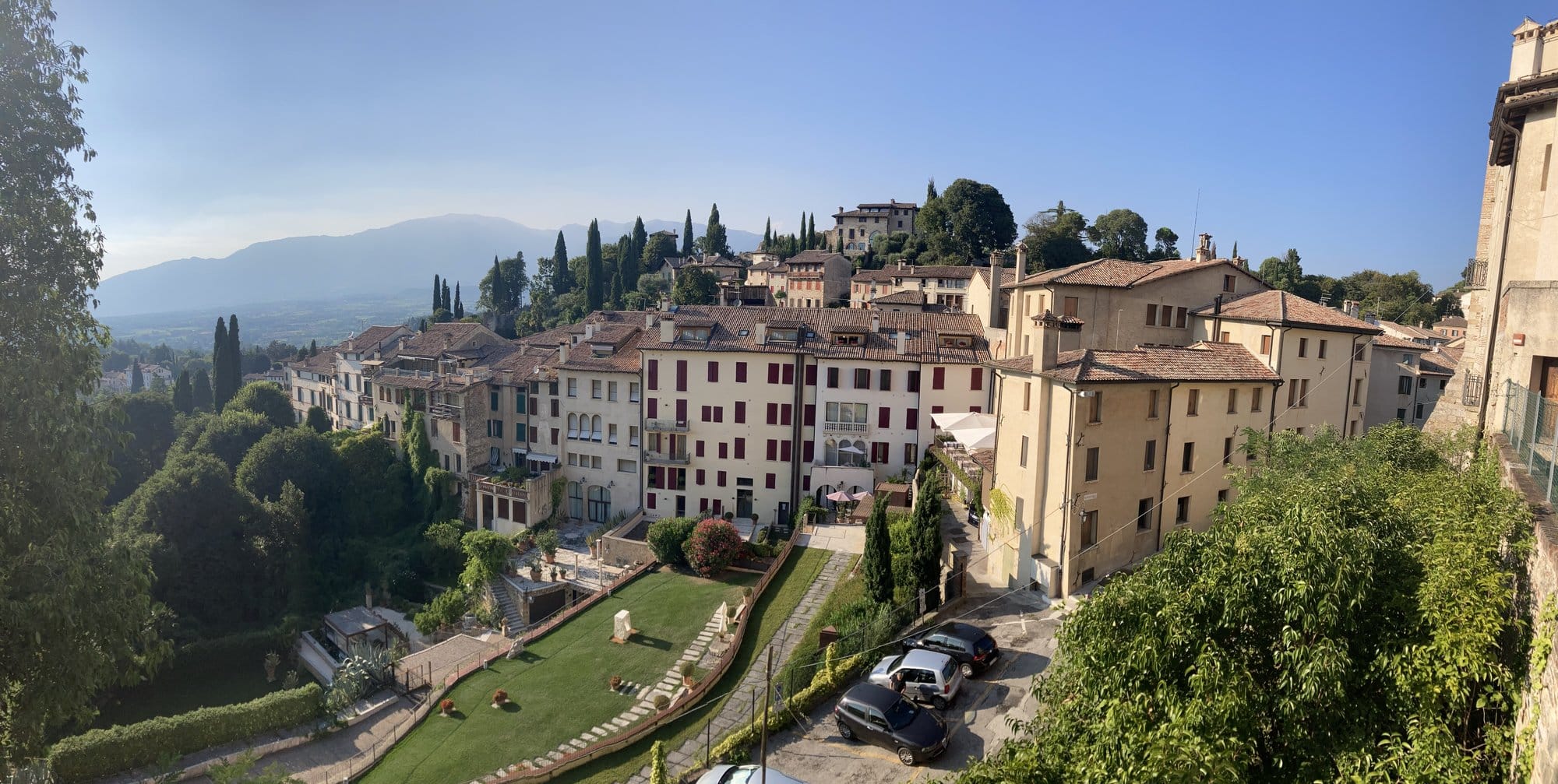
We walked up to the Rocca (the hilltop fortress, founded 12th century, ruined, freely accessible) for the panorama in the late afternoon — the full village of terracotta rooftops, cypresses, the Asolan hills to the south with the Monti Grappa rising behind. Robert Browning bought the house on the Piazza Garibaldi in 1889 and died in Venice four months after taking possession; the Asolo he loved had the slightly lyric melancholy the late-afternoon light still carries. Freya Stark lived in the same village from 1947 until her death in 1993 — her house (Villa Freia) is up the hill from Piazza Garibaldi.
Find the Best Place to Stay
For this side of Venice, staying in Cannaregio or Dorsoduro puts you right where the action is — local restaurants, sunset spots, and the kind of neighborhood atmosphere that San Marco can't match. Use our interactive map to find accommodation in these quieter quarters.
You can also browse Venice hotels on Trip.com — filter for Cannaregio or Dorsoduro to find the best options in these local quarters.
Getting there
Venice Marco Polo (VCE) sits on the lagoon's mainland edge — Alilaguna's water-bus puts you in Cannaregio in 50 minutes, no taxi or shuttle bus needed. We always pick the airline routing into VCE rather than Treviso (TSF) since the latter adds a 40-minute coach into the city.
Practical Information
How to Get to Cannaregio
Cannaregio is walkable from Santa Lucia station in 15 minutes (Ponte degli Scalzi → Strada Nuova → Fondamenta della Misericordia). From San Marco, it's a 25-30 minute walk north, or vaporetto line 4.1 or 4.2 from San Zaccaria to Fondamente Nove, then walk 8 minutes west. For Zattere in Dorsoduro: vaporetto 2 or 5.1 direct from Piazzale Roma or Santa Lucia, or a 15-20 minute walk from San Marco over the Accademia bridge.
Best Time for Sunset
Sunset on the Zattere in late August (we were there 20 Aug) is at 20:15; arrive by 19:00 for the full arc from straight light through golden into blue hour. In late October, sunset is at 17:00; in late June at 20:55. Cannaregio's sunset is effectively 15 minutes "longer" because the narrow north-south canals hold reflected light after the sun has dropped below the roofline — the actual last usable reflection on 21 August for us was 20:45.
How to Get to Villa Barbaro and Asolo
From Venice (Piazzale Roma / Tronchetto parking), take the A27 north toward Belluno, exit Treviso Nord (toll ~€2.60), then follow SP248 to Maser (Villa Barbaro) and then SP248 west to Asolo. Roughly 55 km, 60 minutes without traffic. Villa Barbaro opens Tuesday-Sunday in summer (10:00-18:00 April-October; reduced hours in winter) — always check the villamaser.it website on the day. Asolo's historic centre has no opening hours and is free to walk; the Rocca closes at 19:00 in summer.
Budget
Real prices from August 2023: cicchetti dinner four people at Al Timon €62 (six pieces each + house wine + water); aperitivo Misericordia €5-6/glass; Villa Barbaro €10 adult / €5 under-13 / free under-10; Asolo café Aperol Spritz €6; Piazzale Roma car parking €32/24h; vaporetto single trip €9.50 / 24-hour pass €25 / 72-hour pass €45 (buy at any ACTV ticket machine).
FAQ
Q: Is Cannaregio safe at night? A: Absolutely. Venice is one of the safest cities in Europe, and Cannaregio in the evening is busy with locals and diners. The Misericordia area is well-lit and lively until late.
Q: Is it worth visiting Asolo? A: If you have a car and a day to spare, yes. It's one of Italy's most beautiful hilltop villages and makes a perfect complement to Venice. Combine it with Villa Barbaro for a full day in the Veneto countryside.
Q: Where is the best sunset spot in Venice? A: The Zattere promenade in Dorsoduro is hard to beat — wide views, warm light, and the Giudecca island across the water. For a more local atmosphere, the Fondamenta della Misericordia in Cannaregio offers canal-level sunset views with an aperitivo in hand.
More to Explore
Venice's quieter side is just the beginning. If you're drawn to places that reward curiosity over checklists, these destinations deliver the same kind of authentic experience:
About the Author
Pierrick Jean and family (wife plus two kids, then 10 and 14) spent five days in the Veneto and Venice between 19 and 23 August 2023 — a day at Villa Barbaro and Asolo, then four in Venice basing in Cannaregio. Evening rhythms and real prices in this guide are from that week. More about how we build our travel guides on the About page.
This article is also featured on GPSmyCity. To download this article for offline reading or create a self-guided walking tour to visit the attractions highlighted in this article, go to Walking Tours and Articles in Venice.