
Oman's Wadis: Tiwi, Shab & Bani Khalid — A Family Swimming & Hiking Guide
Turquoise pools, hidden waterfalls, chain-assisted scrambles through narrow canyons — exploring Oman's wadis with the family was the photographic highlight of our road trip.


We started this guide the way most Oman trips should start — by climbing down a chain bolted into a wet limestone face with a 9-year-old in front of us. That was around midday on Monday 26 December 2022, halfway into Wadi Tiwi, and it answered in ten seconds a question we'd been sitting with for eighteen months: is Oman actually worth the flight? The answer, once you see the wadis, is that we kept extending our stay on the coast until we'd run out of days.
Oman's wadis are perennial canyon oases fed by ghayl springs inside the Al Hajar range — the 700-km mountain chain that runs from the UAE border down past Sur. Most of them cost nothing to enter (Wadi Shab charges a 1-rial boat crossing, Wadi Bani Khalid free, Wadi Tiwi free, Al Qābil's unnamed wadis free). Four days of our twelve-day trip ended up here, December 25 to 28, based out of a coastal hotel in Sur — and these four days produced the photos everyone at home asked us about.
Here's how the four wadi days broke down: Christmas afternoon (25 Dec) at Wadi Bani Khalid as a warm-up after the Wahiba Sands camp; all of Boxing Day (26 Dec) in Wadi Tiwi with the chain descents and stalactite grotto; 27 December in Wadi Shab from mid-morning at the boat landing to just after 1 pm back at the car; 28 December inland from Sur into the Al Qābil area for a wadi that isn't in any guidebook. This is the order we recommend.
Bookings: Some of the links in this article are affiliate links. This means that if you choose to make a booking, we will receive a small commission at no extra cost to you. Thank You!
Wadi Bani Khalid — The Easy Introduction
Wadi Bani Khalid was our Christmas Day afternoon — we left the Wahiba camp in the mid-morning, drove roughly 60 km east on Route 35 and Route 23, and pulled into the Bani Khalid car park in the early afternoon. The contrast was cinematic: five hours earlier we'd been on a dune at +4°C dawn, and soon after arriving the first of us (our oldest, 13) was stepping into the 20°C turquoise main pool. The kids described it as 'like teleporting to a different planet', which they never said about any of our other arrivals that trip.
Bani Khalid is the most accessible of the famous wadis — paved road all the way to the pools, ten-minute walk from the car, concrete paths between the first three pools, and shaded picnic spots if you want to ease in. The rope swing over the second pool has a rotating cast of kids; ours (9 and 13) queued twice and would have done it a third time if we'd let them. This is the wadi where you don't need to convince a nervous swimmer — once they see the teenagers sending themselves over the rope, they'll want in.
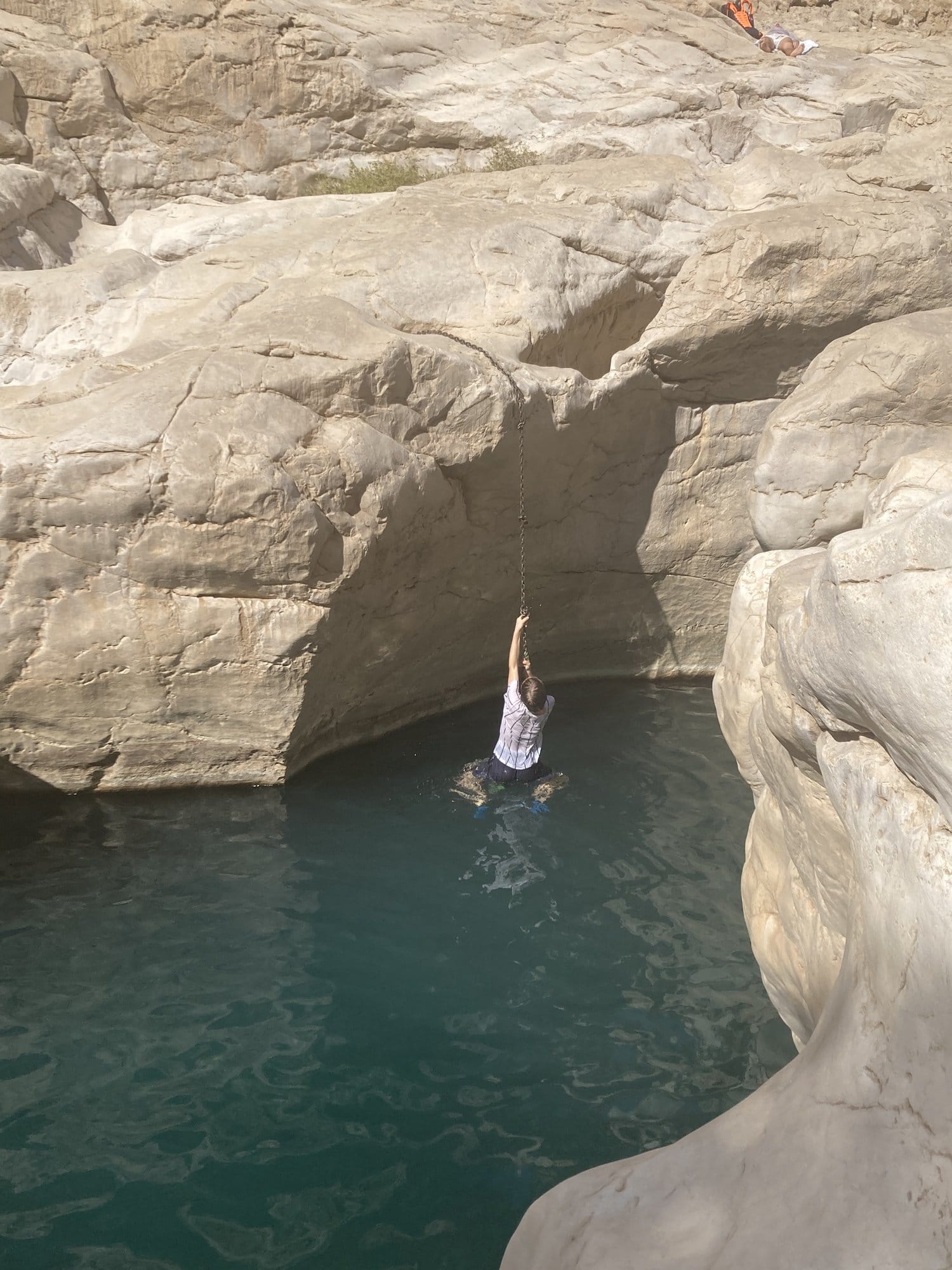
Walk 300 metres past the main pool and the canyon squeezes between house-sized boulders polished smooth by flash-flood water. Soon we reached a narrow passage (just wide enough to swim, emerald water underneath) where the light filtering down from above is genuinely cathedral-like. Three minutes further on, at 13:50, a natural rock arch frames the onward path — this is the spot everyone photographs, and the pool beneath it is deep enough to jump into.
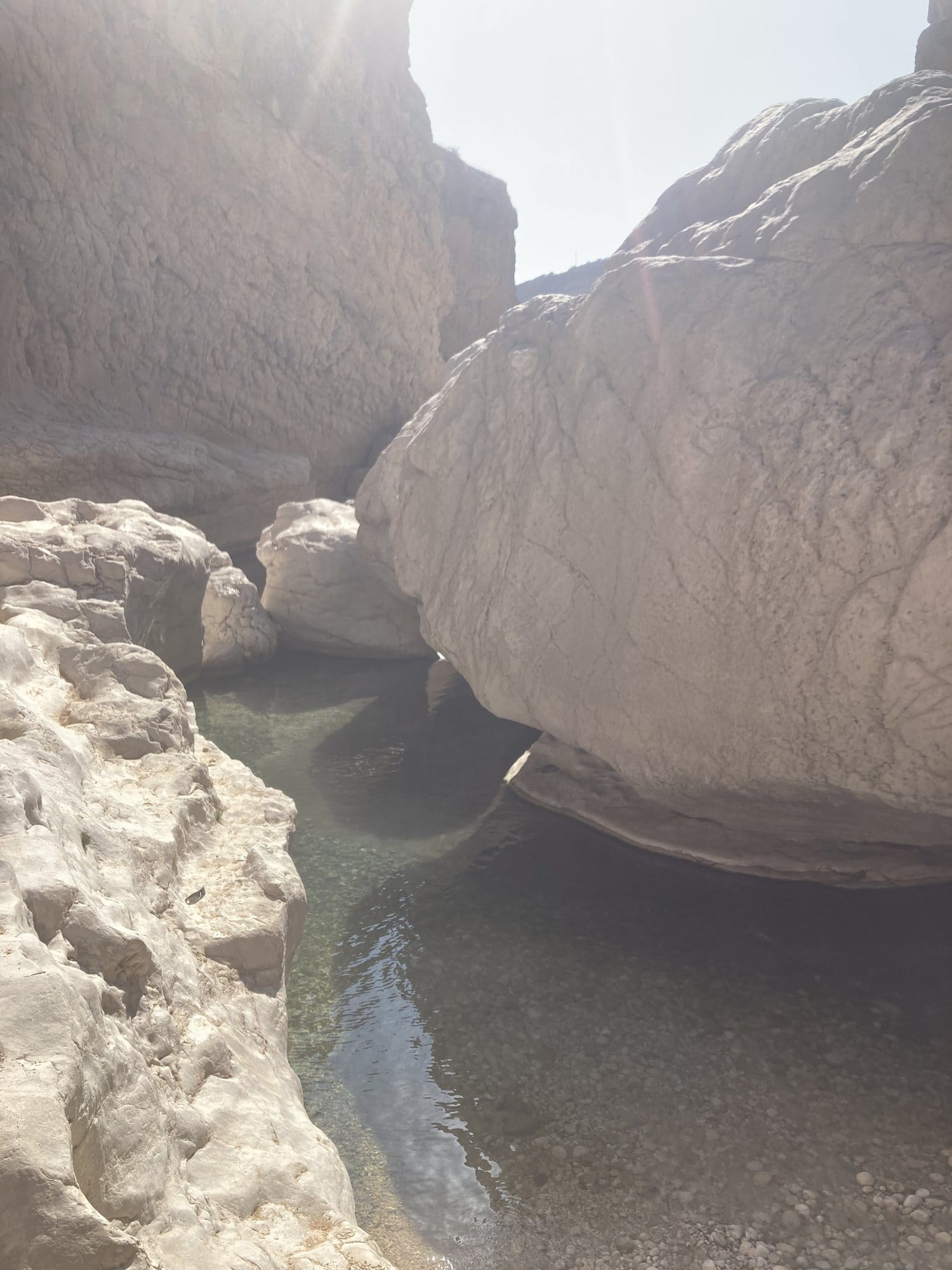
Two hours (13:37–15:40 for us) was the right dose for the warm-up wadi — long enough to let the kids swim to exhaustion, short enough to get back to the Wahiba Sur road before sunset. The morning tour buses were already gone by the time we arrived in the early afternoon; by mid-afternoon we had the back pools entirely to ourselves. If you're planning to visit multiple wadis, guided day trips from Muscat or Sur are bookable through GetYourGuide and let you skip the rental-car logistics, though we found the drive easy on the paved roads.
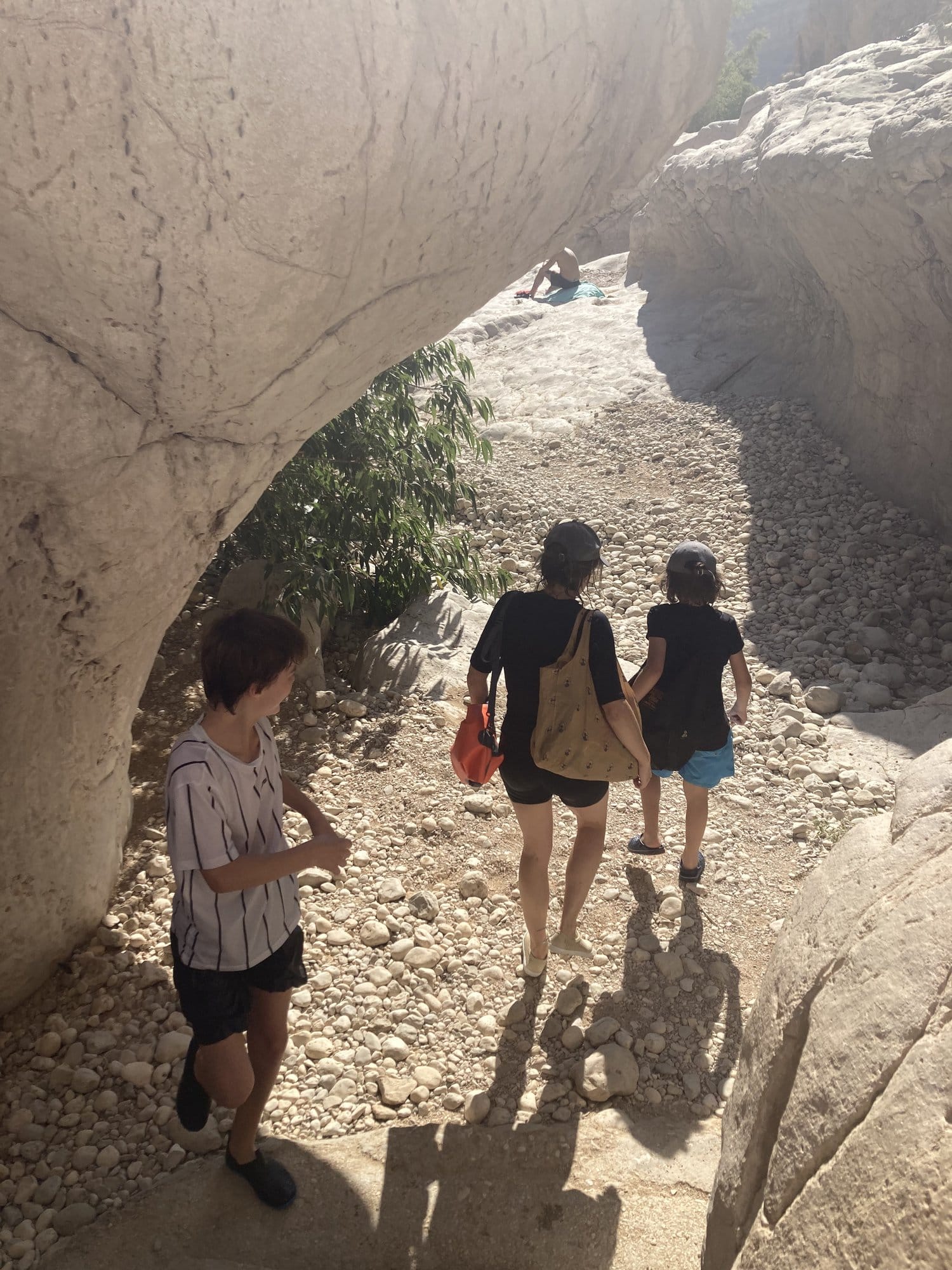
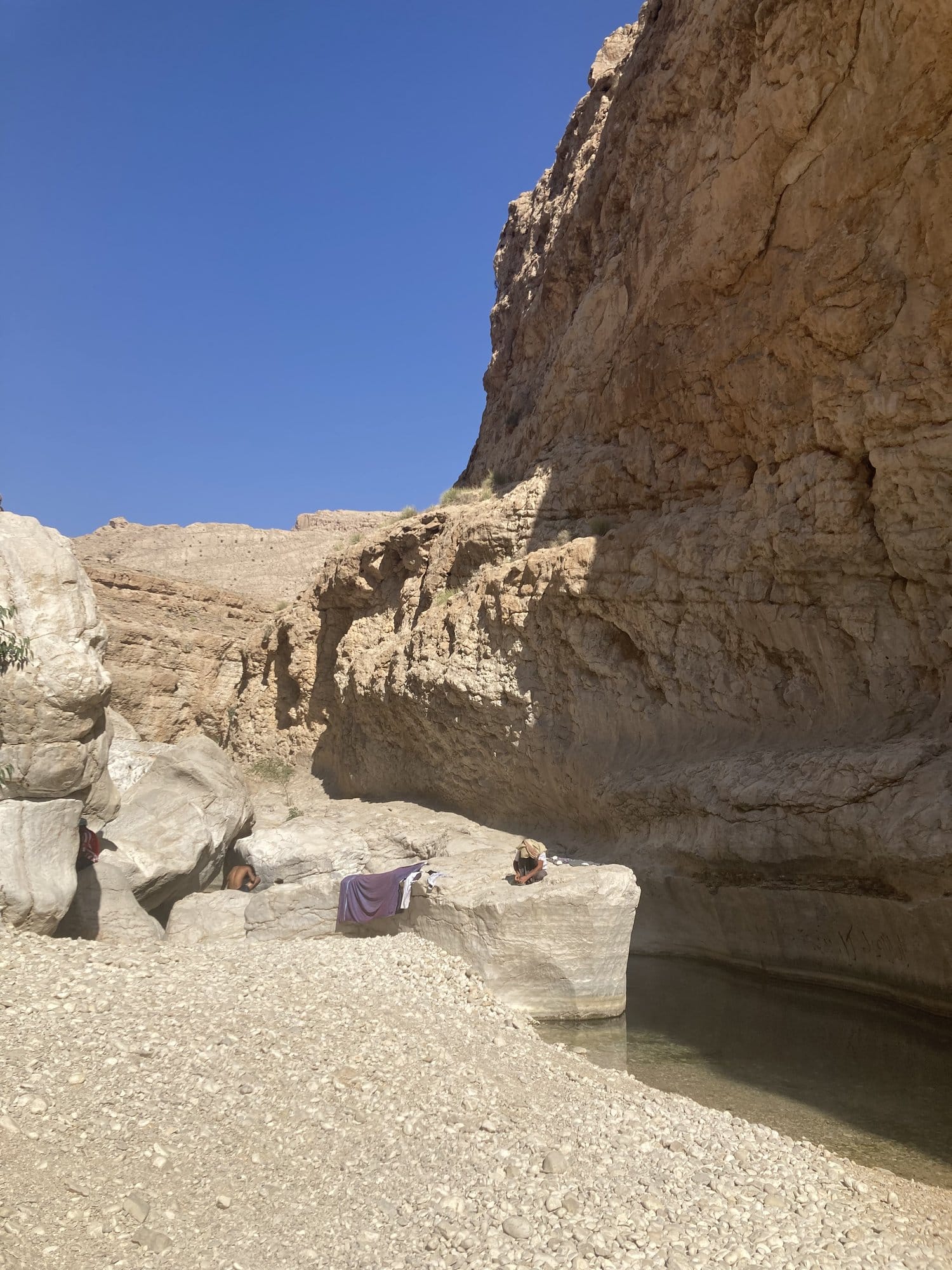
Practical: Free entry, free car park (about 200 metres from the first pool), basic toilets and a small café by the entrance (fizzy drinks ~0.3 OMR, water 0.1 OMR in December 2022). Tour buses arrive 09:30–11:30; we hit it at 13:37 on a Sunday in December and had space. All ages manage the front pools; the further pools past 300 metres need basic swim competence but no scrambling. Full visit: 2 to 3 hours.
Wadi Tiwi — The Unforgettable One
If you can only do one wadi in Oman, make it Tiwi. We spent 26 December 2022 here from around midday (first photo at the lookout above the village) to mid-afternoon (the end-of-canyon cascade), and the thirteen-year-old still brings up the stalactite cave two years later. This is the one where you come out tired, scraped, and already planning the return trip.
The approach alone earns the detour. The Muscat–Sur coastal highway (Route 17) sits on a plateau; a 3-km side road switchbacks down nearly 400 m into a valley full of date palms and banana plantations, with the oasis village of Mibam pressed against a wall of striated limestone that rises a full 600 metres from the wadi floor. Our first photo is from this lookout — the kind of view where you have to pull over immediately or you'll miss the turn.
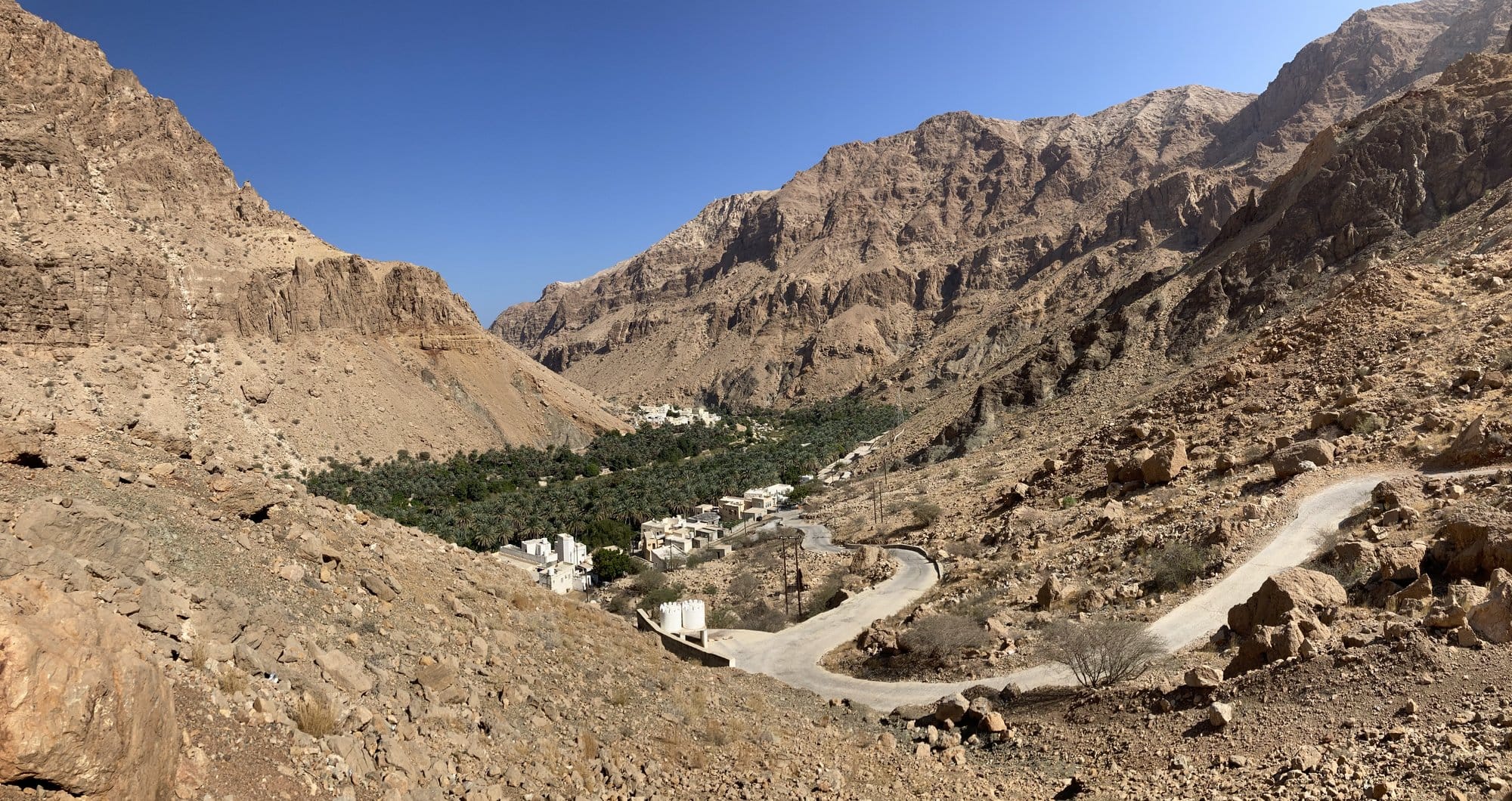
Park at the last widening in the village (free, informal; just don't block the falaj channel). The trail starts as a flagstone path threading between date palms, then turns into an earth track following the falaj — a 2,000-year-old gravity irrigation channel still watering the plantations. Soon we were deep into the tropical-feeling section: bananas, oleander in flower, reeds chest-high along the water, and the canyon already squeezing in on both sides.
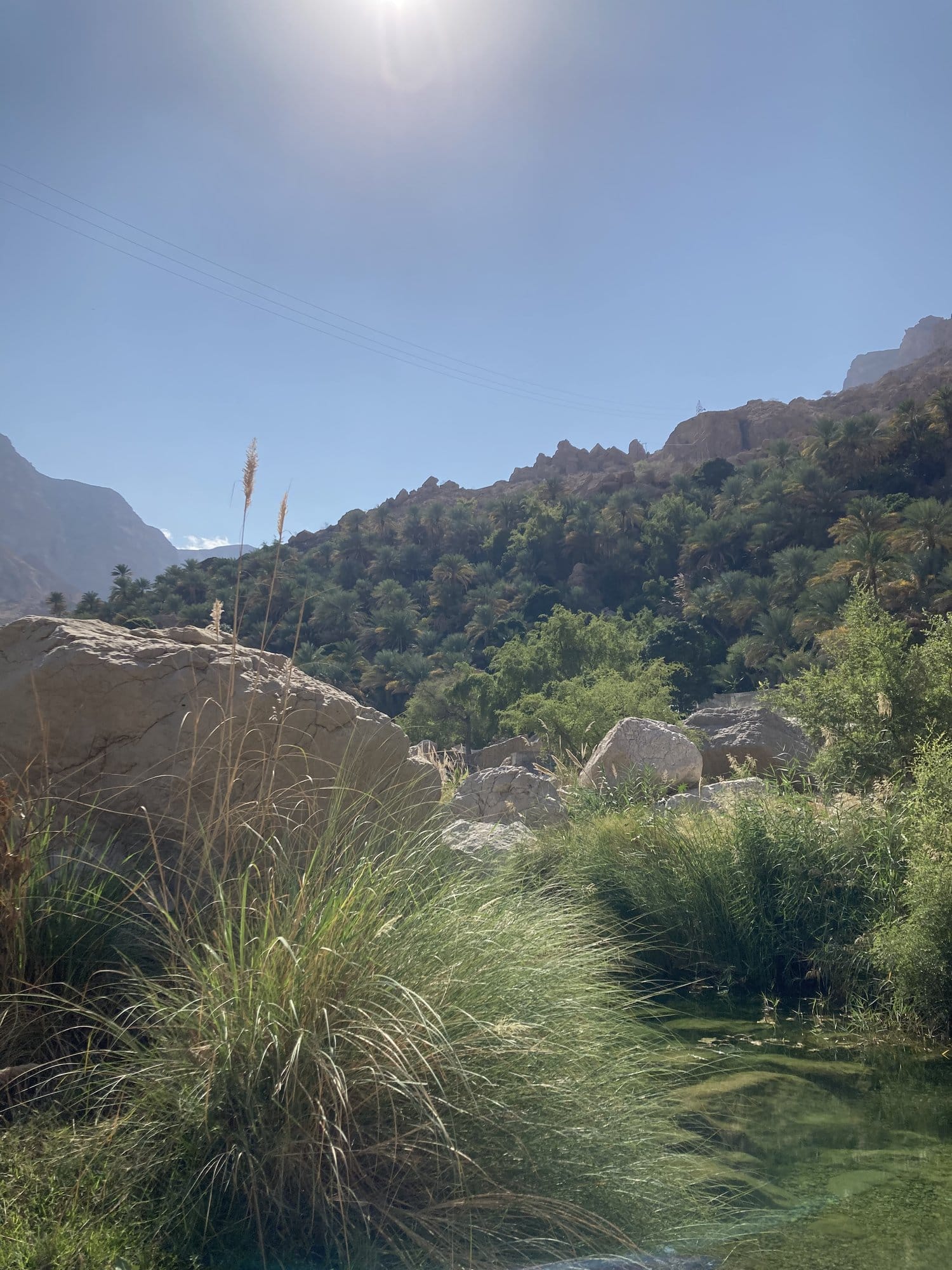
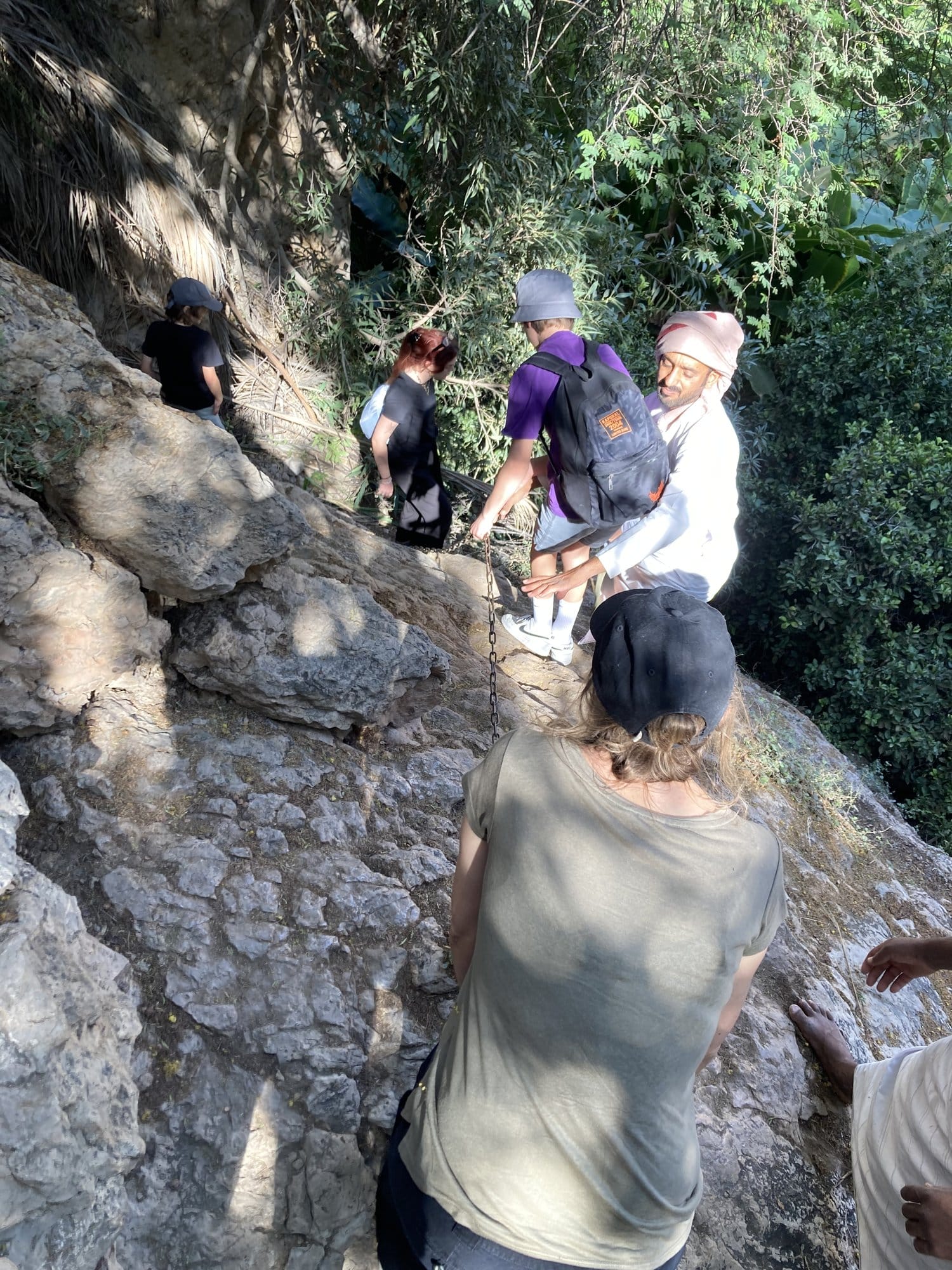
The mood shifts at the first chain descent. We reached it a little further on — a three-metre rock step dropping into pools, with two thick iron chains bolted into the limestone as handholds. Not technically climbing (you can face the rock and lower yourself hand-over-hand), but it's wet, slick in spots, and both kids had to commit. Our 9-year-old went first with one hand on the chain and one on the rock; the teenager wanted to try without the chain and was firmly talked out of it.
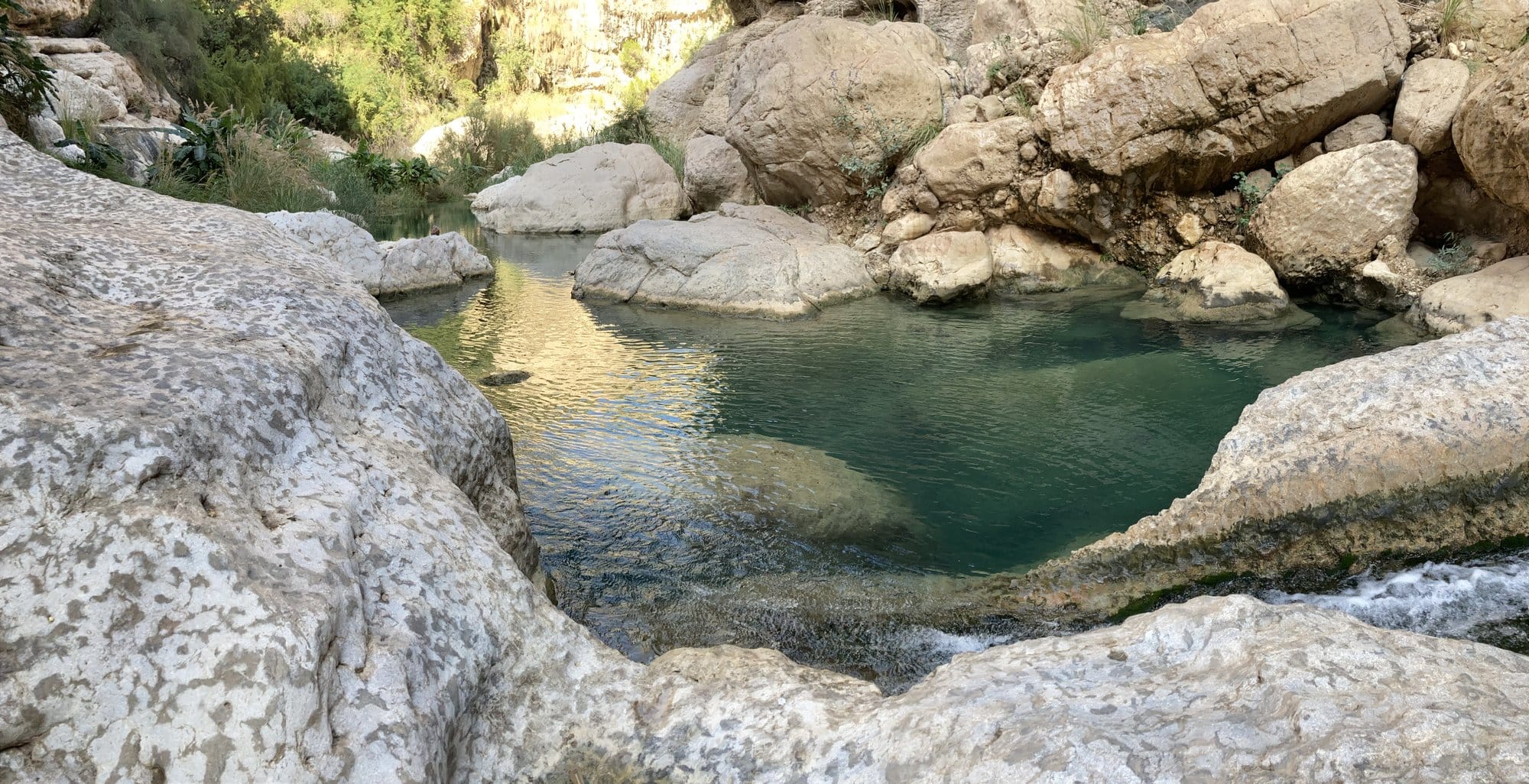
Past the chains, the canyon unfolds as a staircase of pools. Soon after, we were in the first big pool — turquoise over a white gravel bottom, maybe 15 metres long. Then a rock step, then a longer pool at 13:55 where the light goes emerald and the walls are high enough that direct sun only hits the water for about two hours a day. The swims between pools are short — three to eight metres each — but you're moving sideways through a canyon that's barely five metres wide at water level.
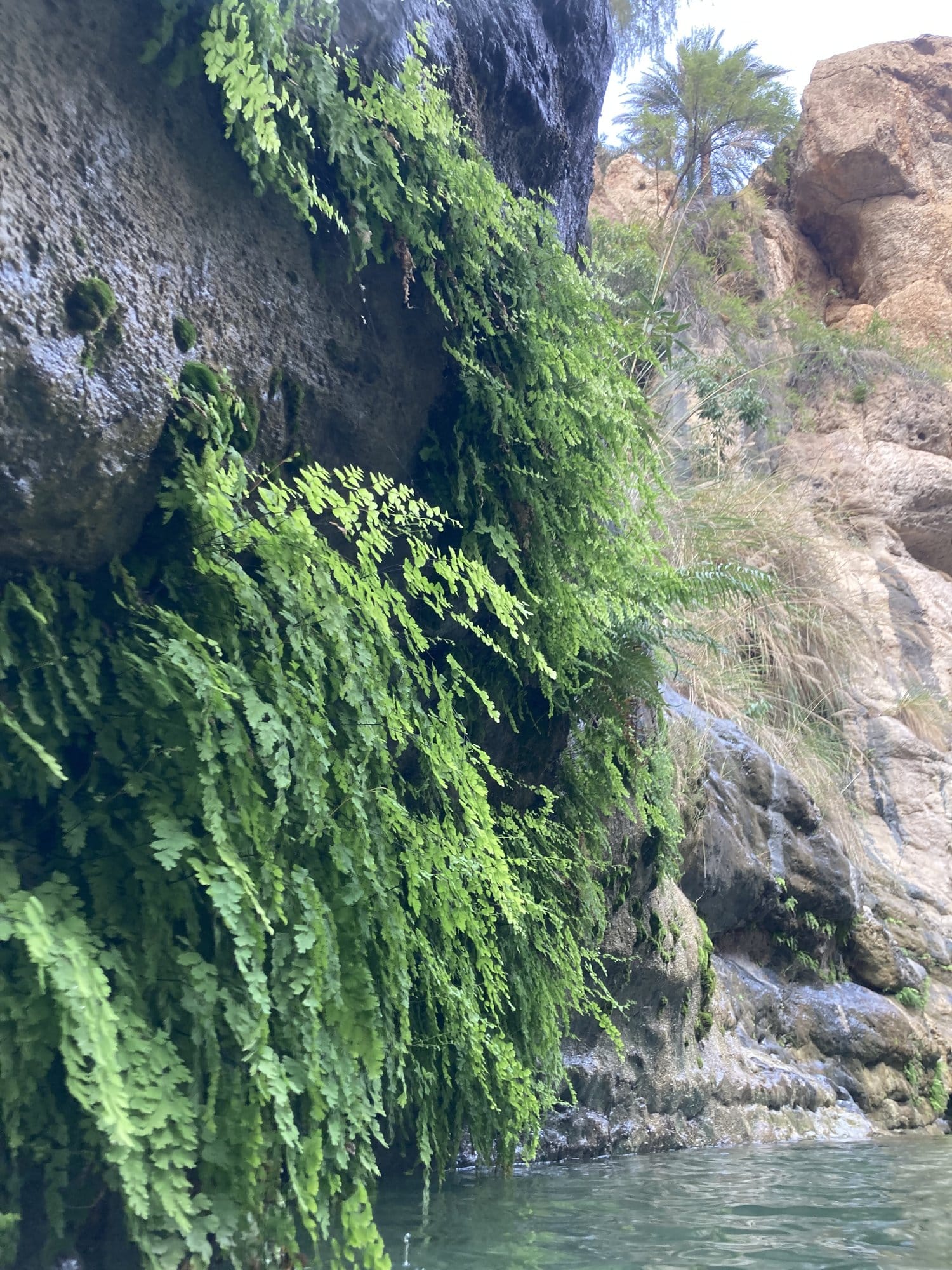
The canyon botany at this depth is the detail guidebooks miss. Here we photographed a wall upholstered in Adiantum capillus-veneris — common maidenhair fern — fed by a continuous seep of spring water that keeps the face wet year-round. Against the white limestone they read as a hanging green curtain. Further in, micro-ecosystems of moss and tiny flowering capers colonise every wet ledge.
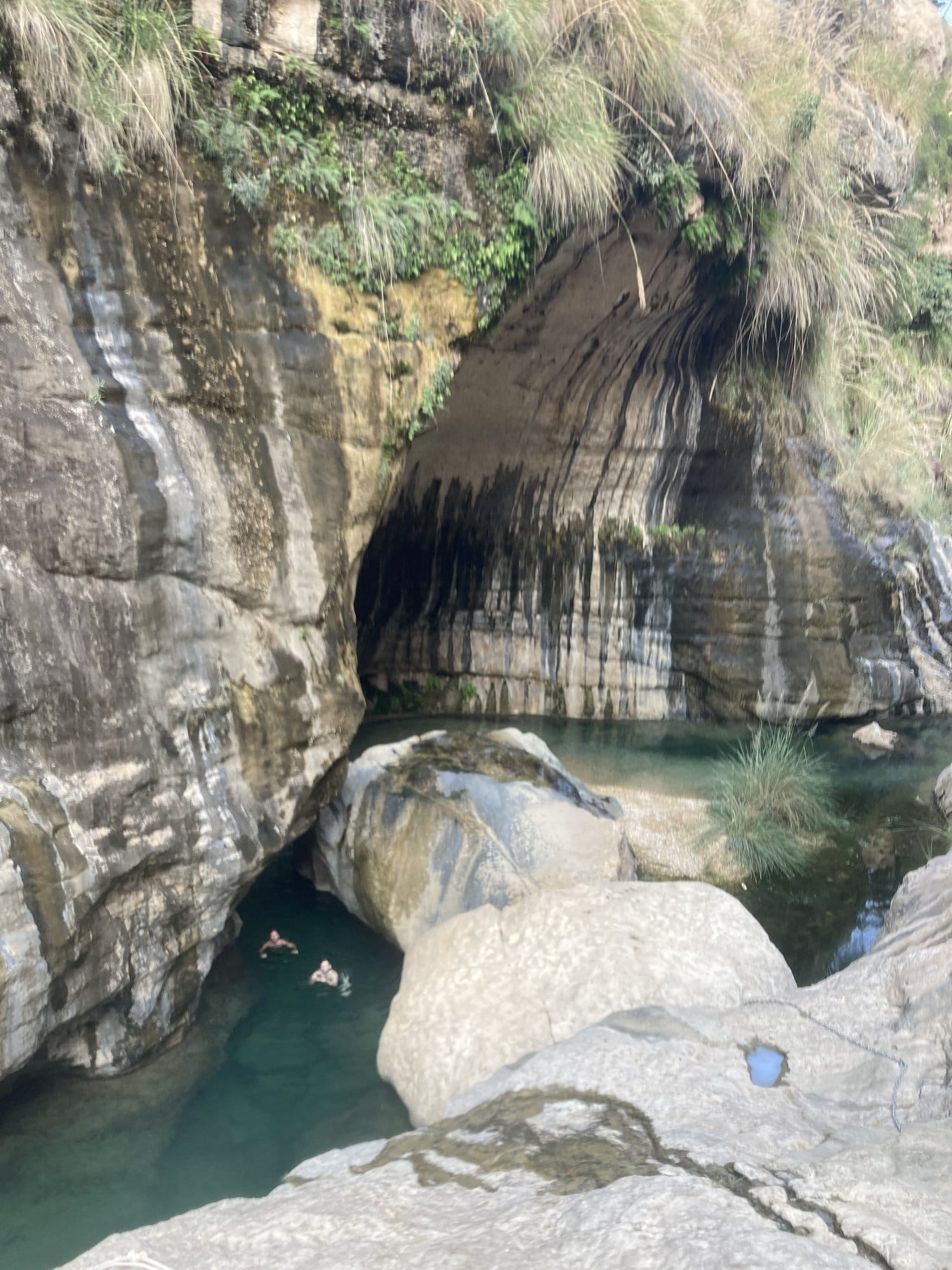
The stalactite grotto sits roughly an hour and a half in — we arrived in the mid-afternoon. A curtain of calcite stalactites up to 1.5 metres long drops from a roof overhang above a deep still pool, and the overhang is large enough that half a dozen swimmers can float beneath it without overlapping. The scale is what the photos don't convey: from the far side of the pool, an adult floating under the curtain looks like a coin. This is the turning-around point for most families.
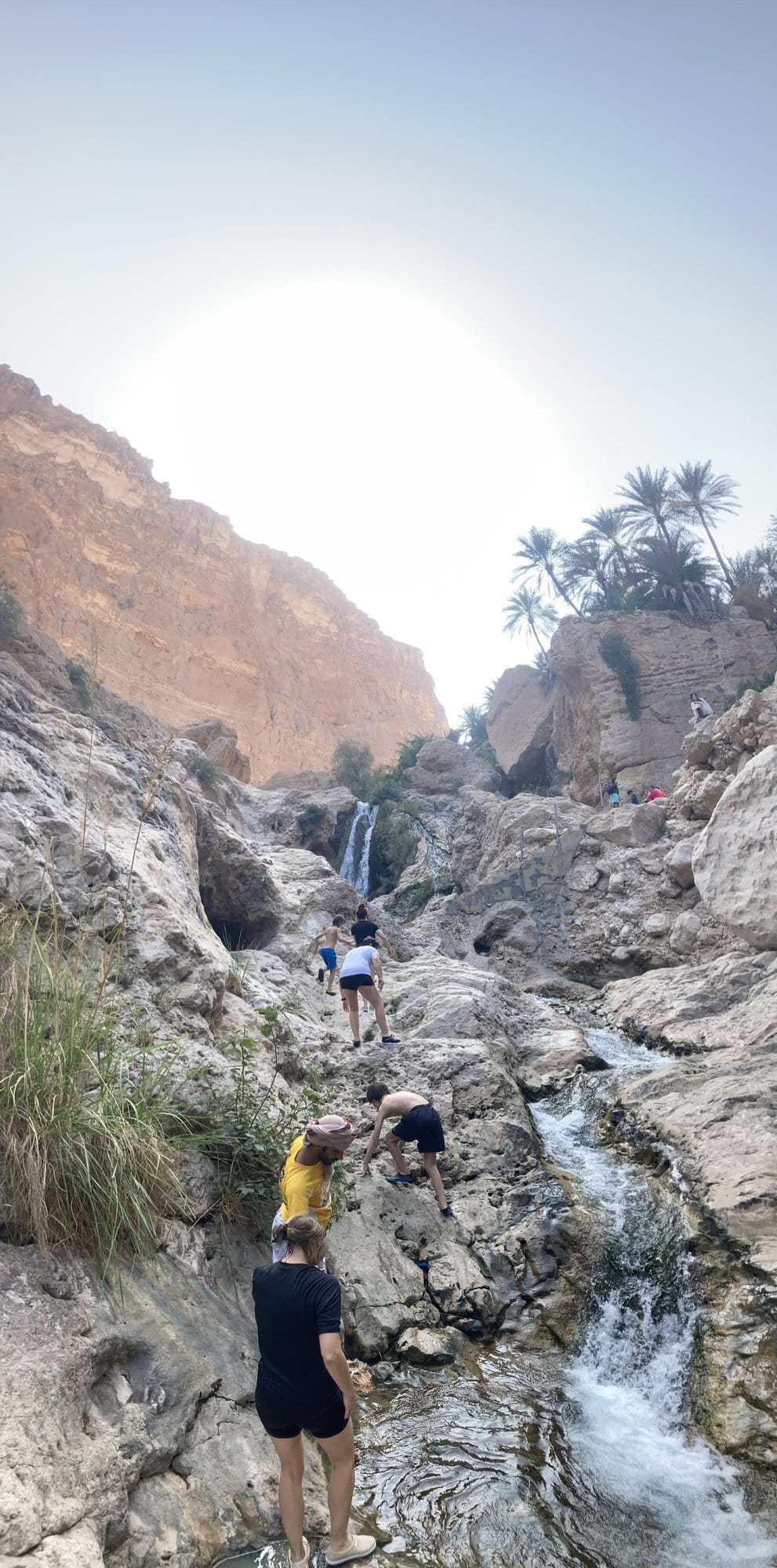
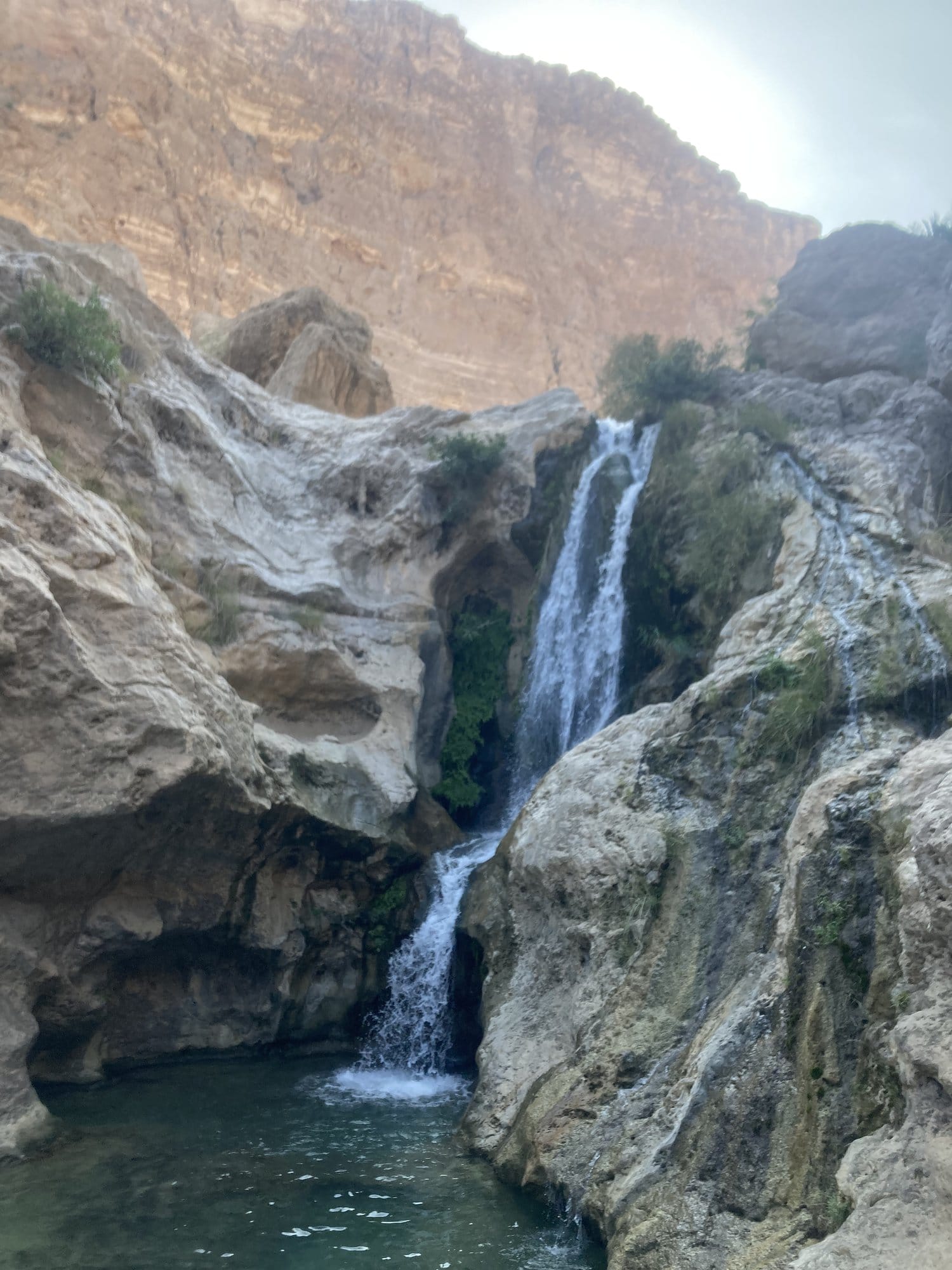
Beyond the grotto, the way out is a scramble up a polished rock ramp beside a cascade — we did it in the mid-afternoon with the kids ahead of us, and I have a photo that's dominated by the sound of the water echoing against limestone. The terminal cascade, reached in the mid-afternoon, drops about six metres into a deep circular pool ringed by palm trees. If you're feeling it, you can keep going; most don't. We turned around here and retraced our steps, arriving back at the car by mid-afternoon.
Tiwi is the day our kids still reference. The combination that did it: the chain descent around midday delivered a moment of actual nerves, the pool sequence from 13:35 to 13:59 gave them the 'I can't believe we're allowed to swim here' flow state, and the grotto at 14:16 is the photograph they've shown every classmate since. What made it unforgettable wasn't the landscape alone — it was that the landscape demanded something of them.
Practical: Free entry, informal parking in the village, no facilities past the car. We took 3h40 car-to-car (around midday start at the lookout, back at the car ~mid-afternoon); strong hikers do it in 3 hours, a slow family up to 5. Minimum kit: water shoes with real grip (Keen H2 or Teva Omnium worked for us; flip-flops are dangerous on the wet polished rock), a 10-litre dry bag for phone/camera/keys, swimwear worn from the car, and 1.5 litres of water per person. Our 9- and 13-year-olds managed fine; under 7 would be difficult because of the chain section's arm strength requirement.
Wadi Shab — The Postcard Canyon
Wadi Shab is Oman's most-Instagrammed wadi and for good reason — it's the most consistently photogenic from entry to end, with a palm-tree approach that's a walk in itself. We did it on Tuesday 27 December 2022, arriving at the boat landing in the mid-morning and back at the car just after 1 pm — about three hours ten minutes, of which ninety minutes was the walk in, forty minutes was the terminal pool swim, and the rest was photo stops and the return.
Entry is via a car park on Route 17 (paved, signposted 'Wadi Shab'), then a two-minute boat ride across the wadi mouth in a wooden skiff operated by a local cooperative — 1 OMR per person round-trip, paid when you return. From the far landing a well-defined flagstone path follows the canyon floor upstream. You can't really get lost: there's only one trail, and it stays above the water.
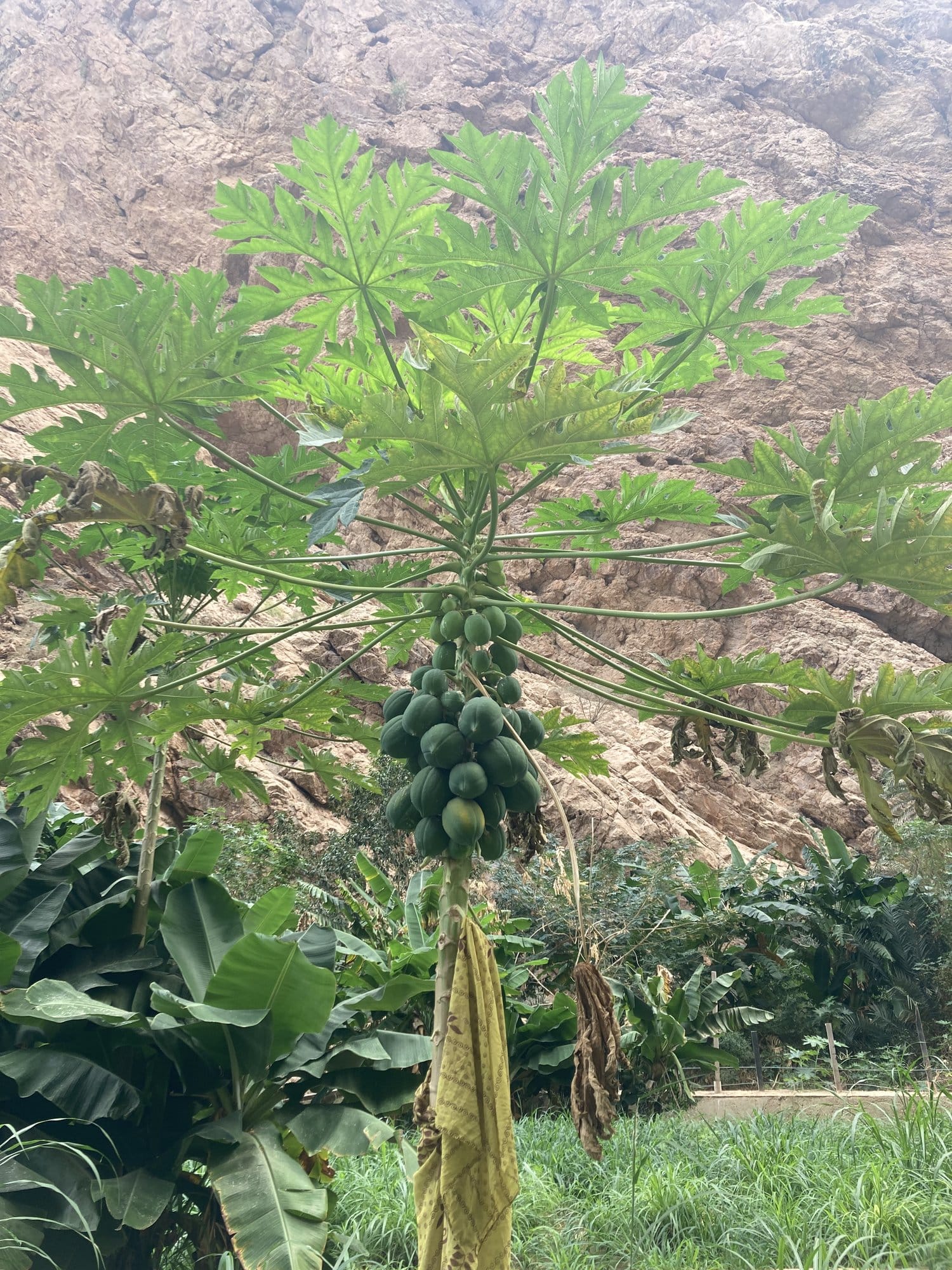
The walk in takes about 45 minutes and functions as a slow reveal. The first ten minutes cross a date-palm plantation with a falaj running alongside; in the mid-morning we photographed a papaya tree loaded with green fruit just off the path. After the plantation the canyon narrows and the walls rise steadily — by mid-morning we were deep in limestone country, with cliffs 150+ metres high on either side.
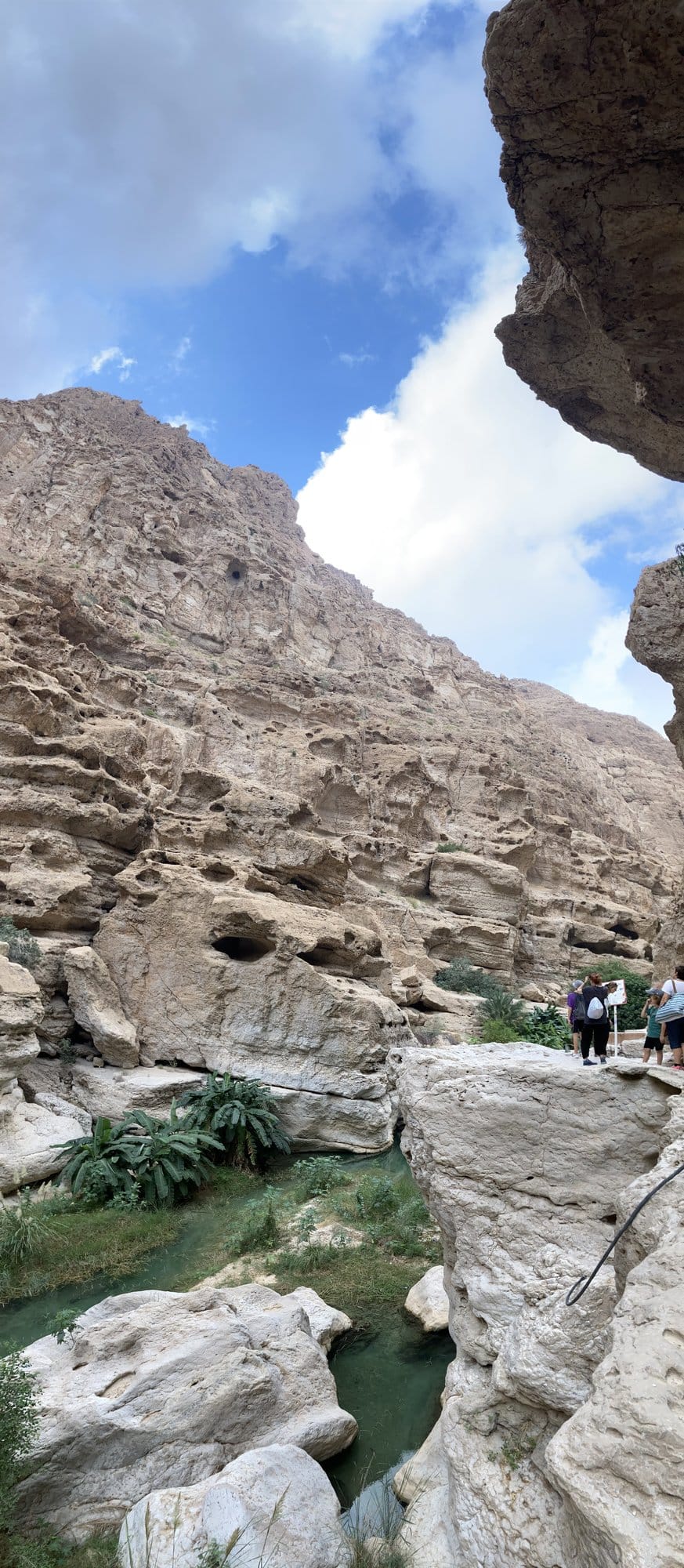
The canyon proper begins roughly 30 minutes from the boat landing, and the scale reset is sudden. Walls of grey-white limestone rise 200 metres on both sides, and the first large emerald pool opens up at 10:42. The shallows show a gravel bottom like glass; the depths run dark blue and you can see the water column change colour as the canyon bends. This is the stretch that produces the postcard shots.
The deeper you go, the narrower it gets. About 45 minutes past the canyon proper begins, the only way forward is by swimming — there's a rock ledge where everyone leaves their bag (bring a dry bag or leave anything irreplaceable at the car), and from there you swim through a corridor of pools, each slightly tighter than the last. The popular end-point is a narrow flooded slot with a small waterfall visible at the far end; some strong swimmers squeeze through to the hidden cave beyond, but it's not for everyone.
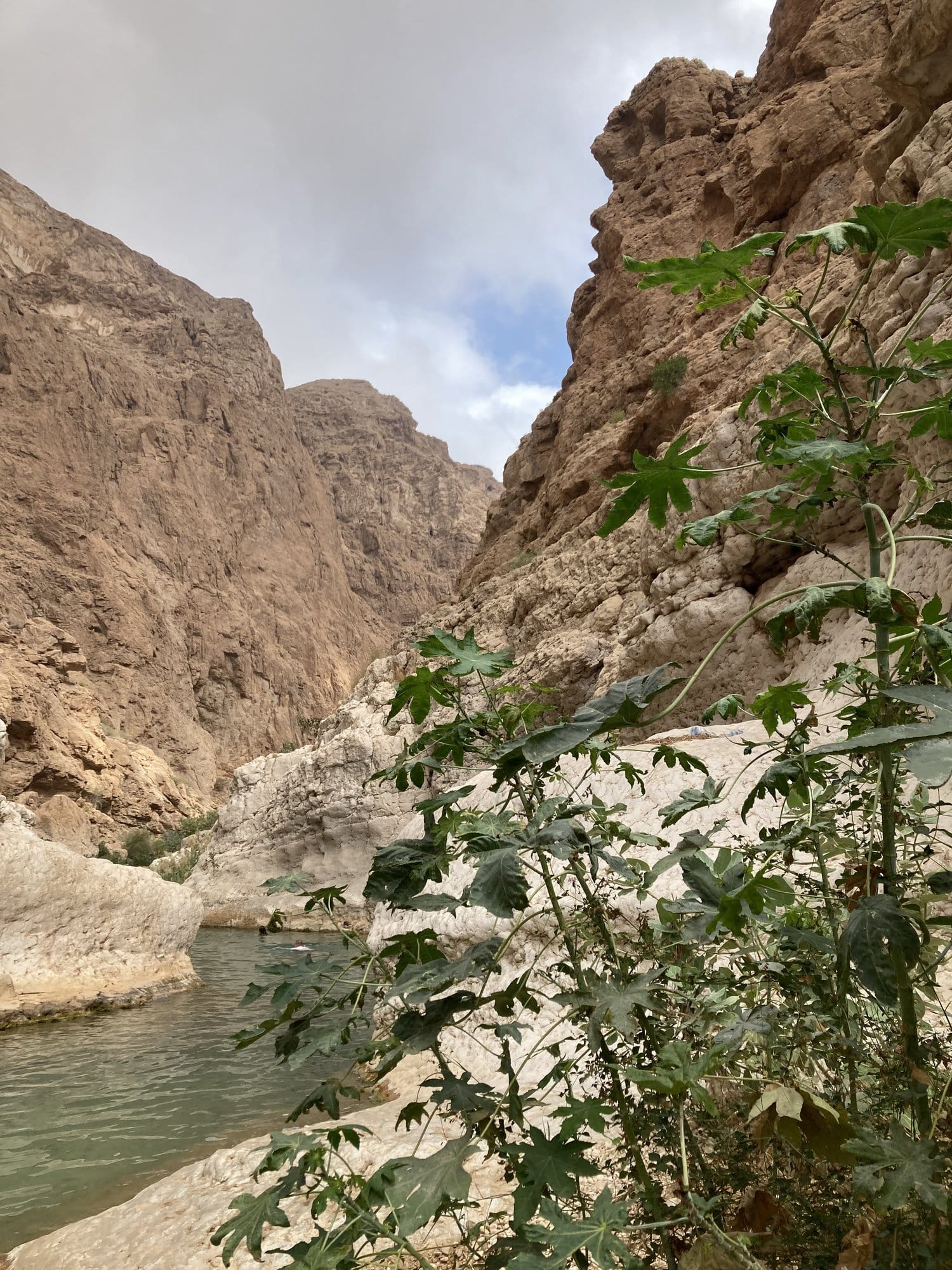
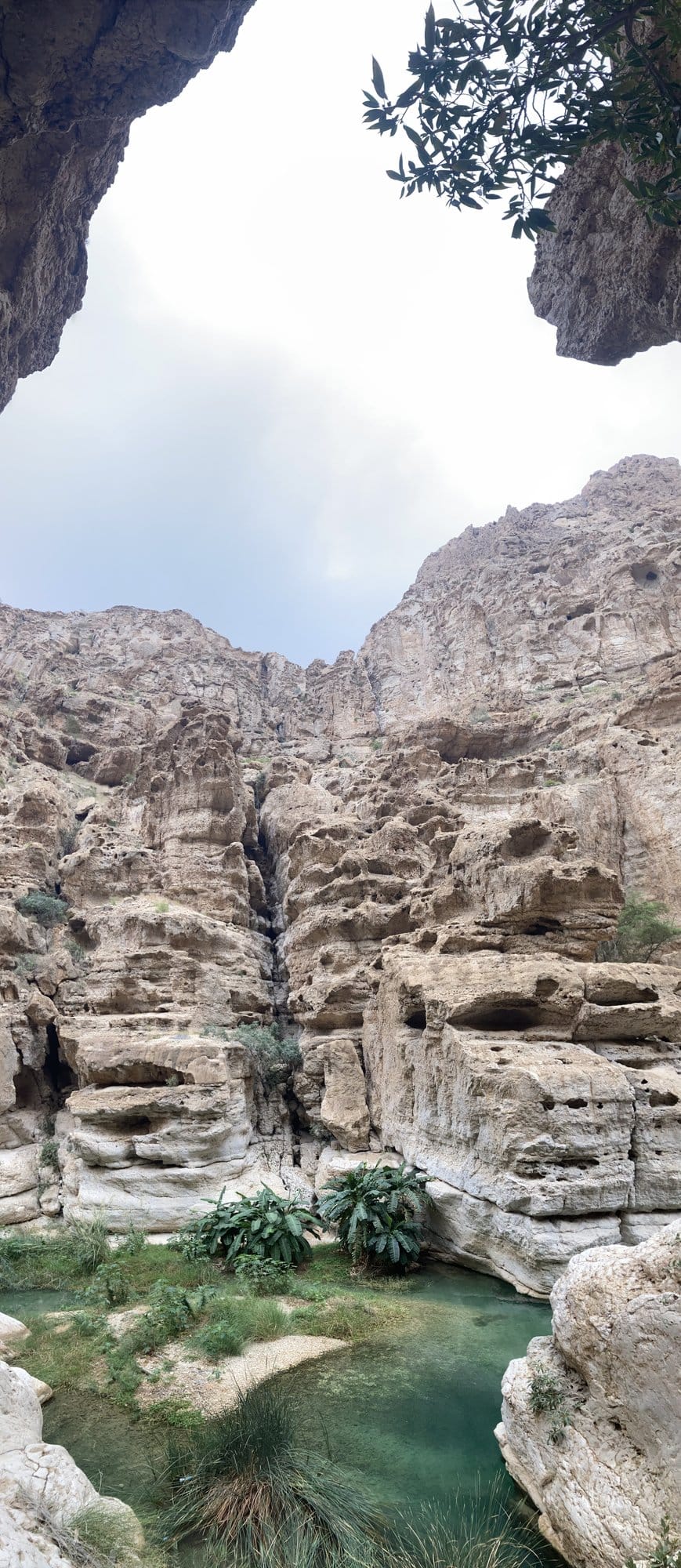
Shab sees more visitors than Tiwi — the easier access and the Instagram fame do their work — but it's a long canyon, and the crowd thins out past the first two pools. We arrived in the mid-morning, were at the end swim area by half past twelve, and back at the car soon after 1 pm with the hotel beach in Sur open for the afternoon. Mid-week in late December the car park was half-full; we saw maybe 40 people across three hours in the canyon.
Practical: Entry free, boat 1 OMR per person round-trip. Budget 3 to 4 hours car-to-car — we did 3h10 with older kids. The flagstone path is suitable for all reasonable fitness levels; the first 45 minutes are entirely walkable with sandals. The end-of-canyon swim is optional — if you don't want to swim, the first big pool at 10:42 on our timing is already worth the visit. If you do swim, a dry bag is non-optional: there's nowhere completely dry beyond the ledge.
The Quiet Wadi Nobody Knows
On Wednesday 28 December 2022 we drove inland from our Sur hotel to an unsigned wadi in the Al Qābil area — I'm not going to geo-pin it, because having it to ourselves was part of the trip. The Al Qābil area sits roughly 40 kilometres west of Sur along Route 23, and the interior wadis here see an order of magnitude less traffic than Tiwi or Shab. Ours required 25 minutes of graded dirt road off the paved network; any rental 4x2 handles it in dry weather.
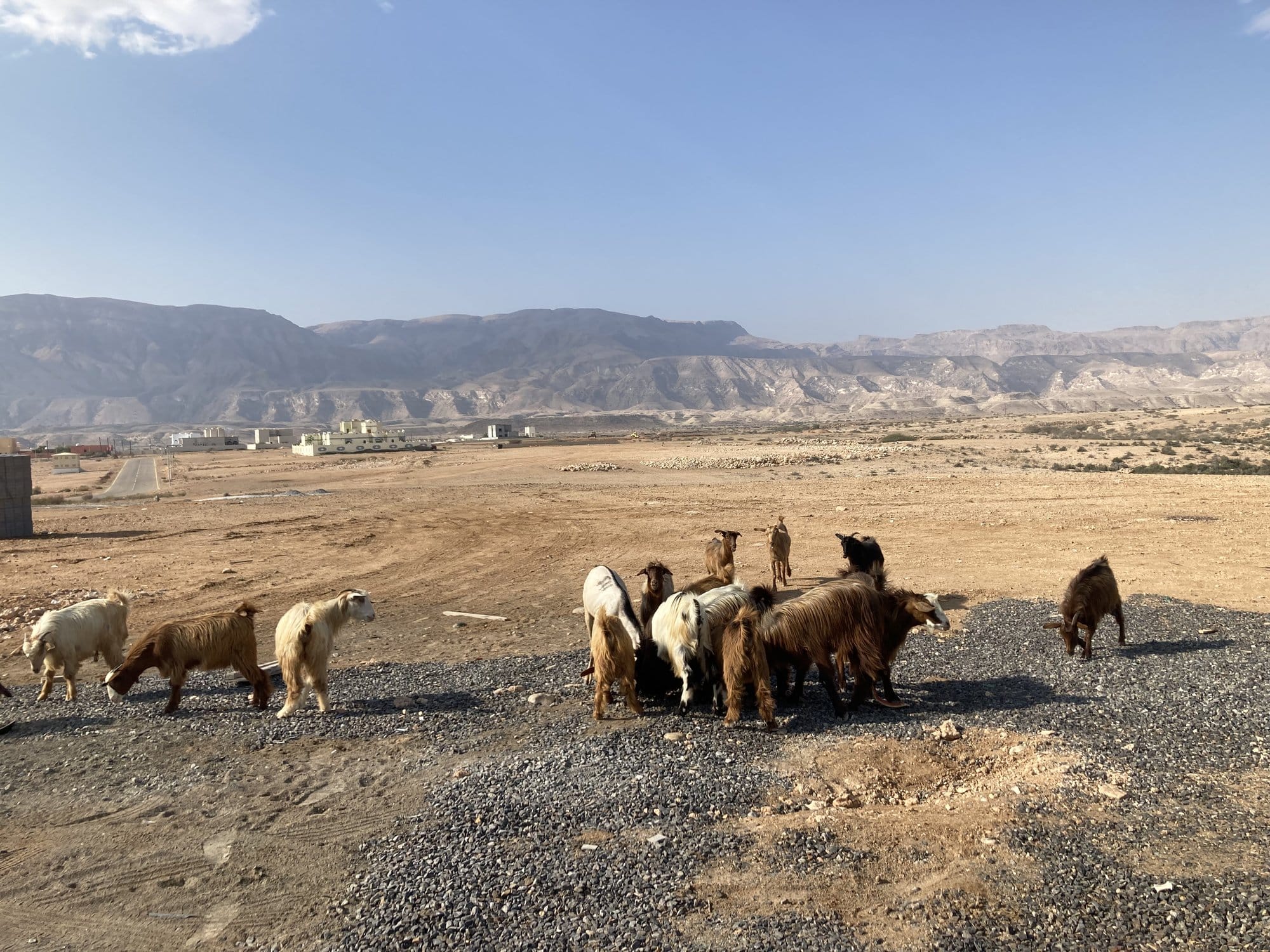
The drive threaded classic Omani interior landscape — arid gravel plains, distant striped Hajar peaks, the occasional free-range goat herd claiming the road. Our car (a Nissan X-Trail-class rental picked up at Muscat airport) handled everything easily in two-wheel drive. For these unmarked wadis you don't need a 4x4, but you do need comfort with dirt roads, no mobile signal, and a willingness to turn around if you misread the track.
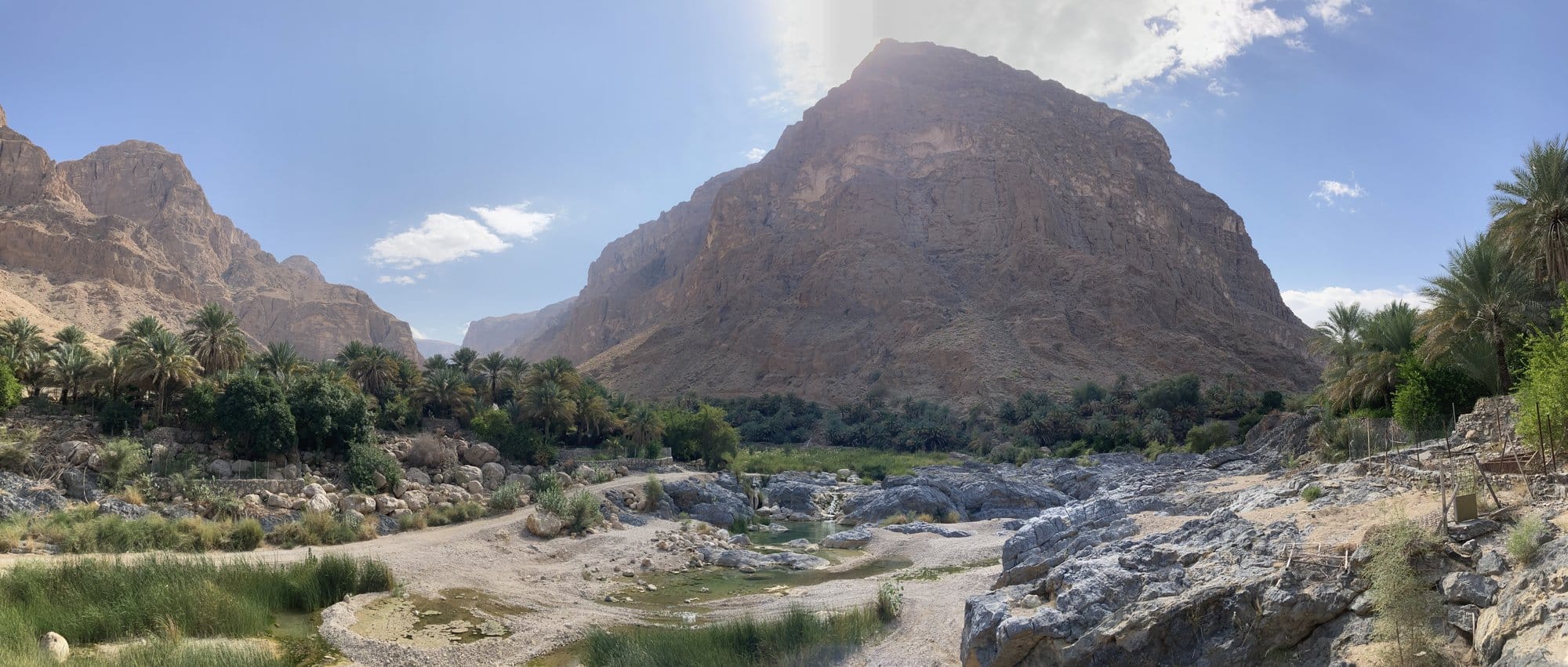
The wadi itself was the revelation of the whole Oman trip. A wide valley opened onto cliff faces that showed stratification so clean it looked like the pages of an open geology textbook — alternating bands of limestone and softer marl, uplifted and tilted by the Arabian-Eurasian plate collision that built the Hajars. Soon we were walking the wadi floor under a 200-metre striped wall, with a thin thread of spring water seeping out from between the strata and feeding reeds on the bank.
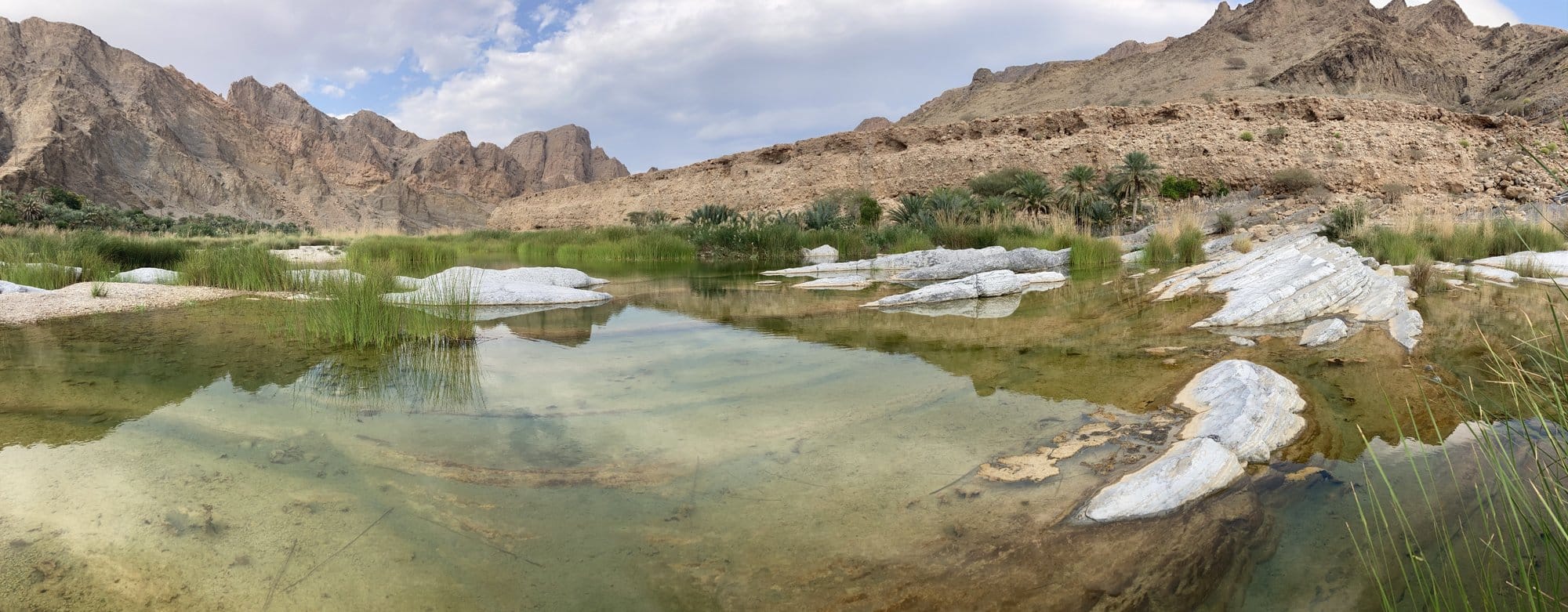
The upper valley opened into a run of pools held between smooth white limestone slabs — classic karst polished by seasonal floods. Further up we photographed a pool maybe 25 metres long with reeds and palms reflected in water so still the reflection was double-exposure sharp. By 2 pm we were deeper still, walking across a dry wadi bed of flawless polished limestone that looked like a skate park. Not a soul in either direction, the whole afternoon.
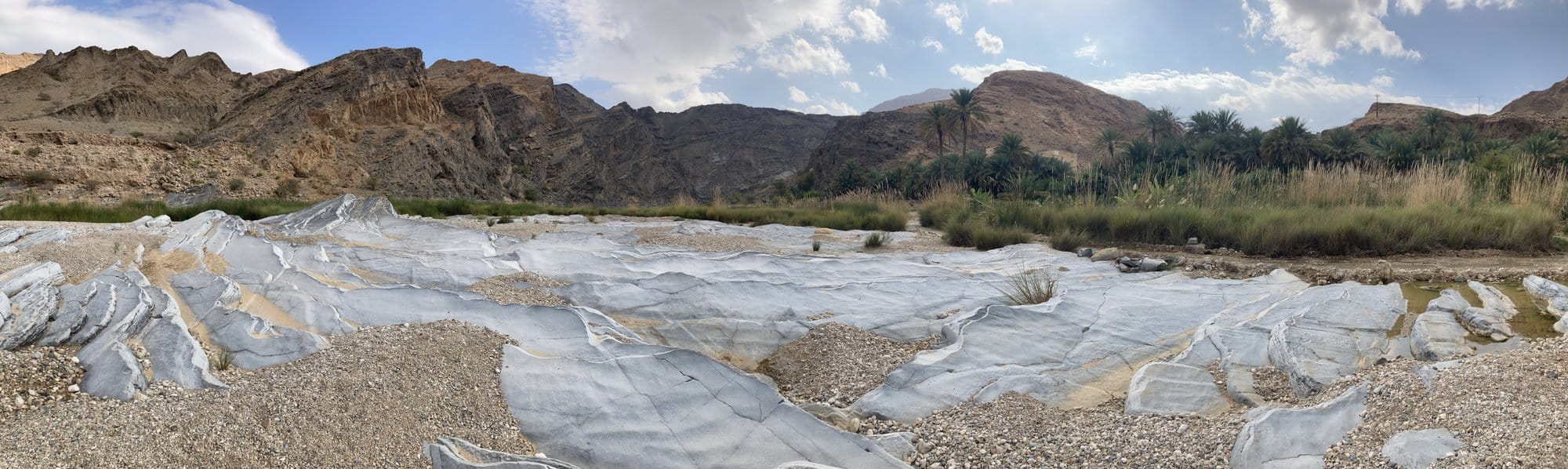
This is where Oman's tourism maths pays off. The headline wadis (Shab, Tiwi, Bani Khalid) are already uncrowded by Mediterranean standards — and the tier below them, the unsigned Al Qābil interior wadis, is essentially empty. Twenty-five minutes of dirt road and a willingness to not see another car all afternoon is the whole barrier to entry. No tour bus operator will sell you this, and that's precisely the point.
The Beach in Between
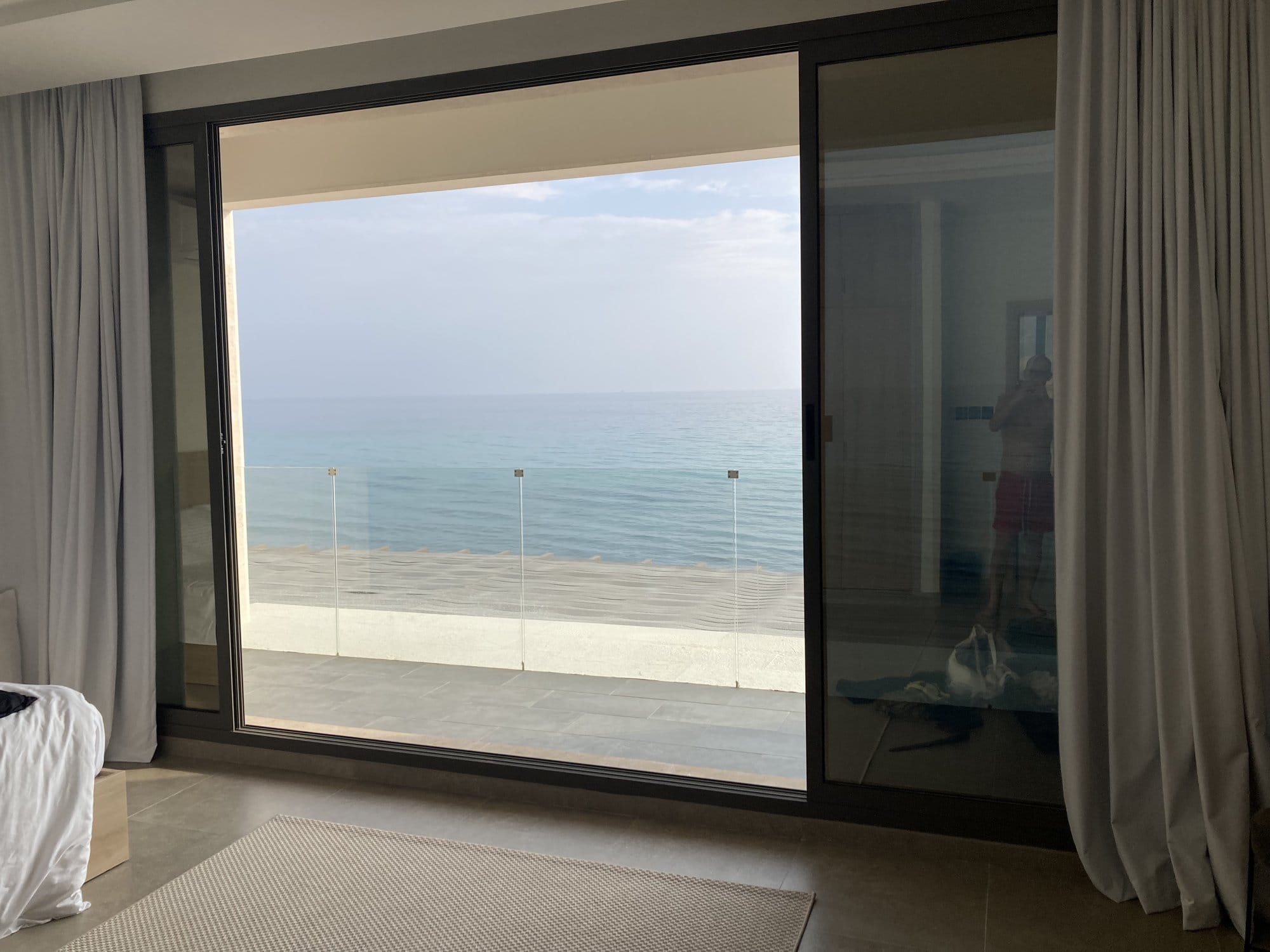
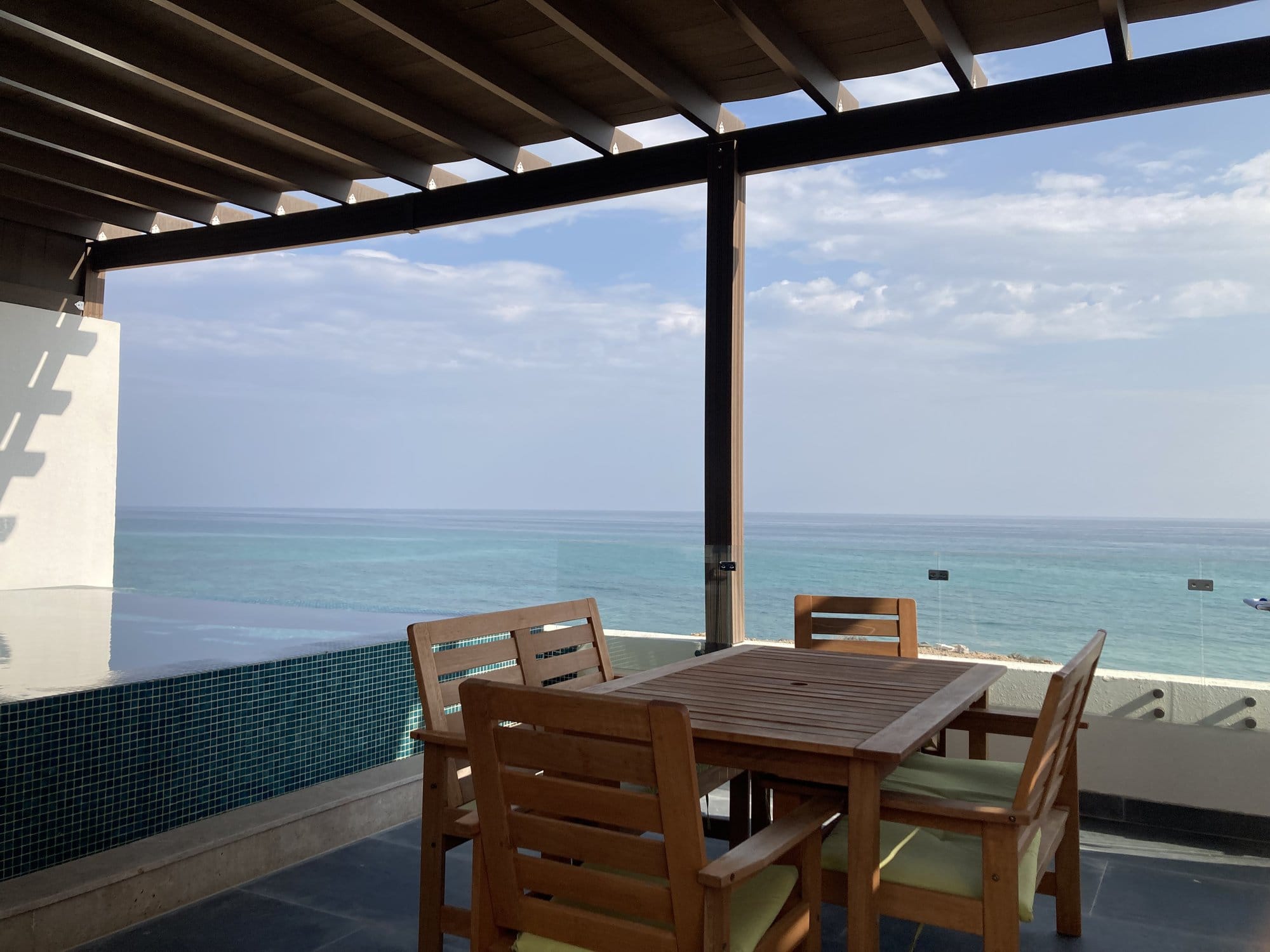
Our base for all four wadi days was a coastal resort hotel in Sur — we arrived on 27 December after the Wahiba camp and checked out on 29 December. After two nights in a Bedouin tent on the dunes, waking up on 28 December at 08:40 to floor-to-ceiling glass looking out on the Gulf of Oman was not a subtle contrast. If you're pricing accommodation in Sur yourself, you can search Booking/Trip.com or use Stay22's live map — the resort hotels cluster on the southern Turtle Beach stretch and run roughly 55–110 OMR per night in late December depending on room class.
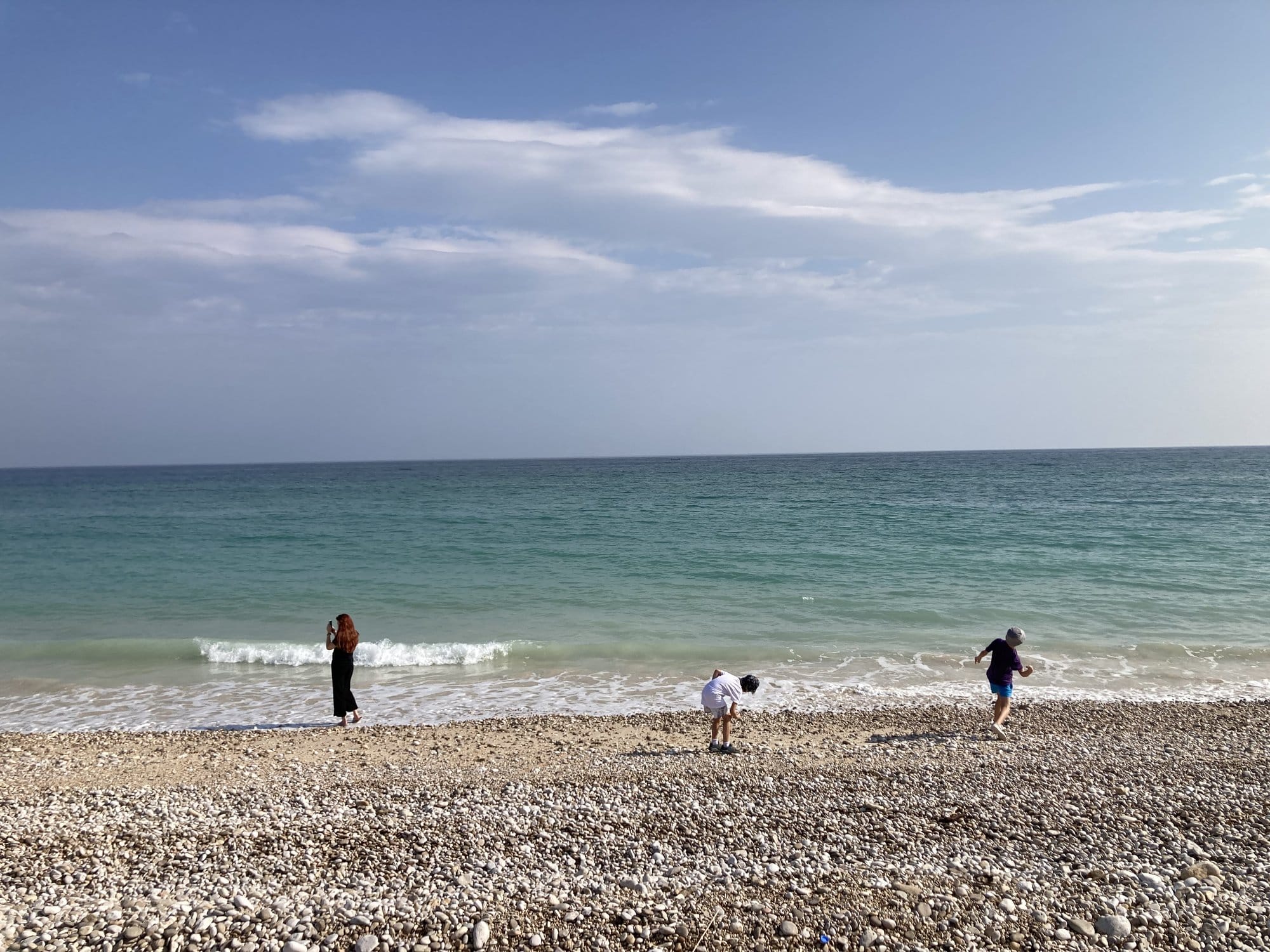
The beach at the resort was a genuine Omani coast, not a curated pool deck — a kilometre of mixed pebbles and sand, clear turquoise water, 23°C in late December, no jet-skis, no music. Our kids spent two mornings running it end-to-end while we sat in the shallows. You won't find cocktail service; you will find hermit crabs and occasional fishermen setting out before dawn.
The coastal base was the single best logistical call of the trip. Scrambling Wadi Tiwi on Monday and Wadi Shab on Tuesday consumed every kilojoule we had each morning; the afternoons in Sur — beach from 15:00, nap, hotel dinner at 19:30 — were what let the kids wake up ready for the next wadi. If we were re-planning, we'd give Sur four nights (not three) and add an extra rest day between Tiwi and Shab.
Which Wadi When?
If you're planning an Oman trip and need to prioritise:
One wadi only? Wadi Tiwi. Our nine-year-old did the chain descent with one hand on the iron and one on the rock; the teenager came back the most excited about any day of the trip; the stalactite grotto at 14:16 is the image I still set as a screensaver. Best for families with kids aged 8 and up.
Two wadis? Add Wadi Shab. Easier walking approach, arguably more photogenic in the first big-canyon section, and the terminal-pool swim is a different flavour of fun (channel-through-canyon rather than chain-descent-to-pool). Works for all confident swimmers age 6 and up.
Three wadis? Put Wadi Bani Khalid first, ideally the afternoon you leave the Wahiba desert camp (the driving distance works perfectly — Wahiba to Bani Khalid is about 60 km, Bani Khalid to Sur is 120 km). It's the easiest, the most family-friendly, and it trains younger kids in wadi rules — slippery rocks, don't jump without checking depth, watch for current at pool edges.
A full week? Explore the unnamed wadis around Al Qābil and the Sur coast. This is where the real discoveries happen.
Practical Tips for Wadi Hiking in Oman
Footwear: the single most important piece of kit. Wadi limestone is polished slick and grows algae in any shaded seep; I landed hard once in Tiwi before I learned to read the black-edged rock. We wore Keen Newport H2 (adults) and Teva Omnium (kids) and neither slipped on the chain descent. Flip-flops are not sufficient — they cost me a split toenail in Bani Khalid in the first 15 minutes. Buy trail sandals before the trip.
Water: Bring at least 2 litres per person. The wadis themselves are not drinking water. You'll be more dehydrated than you think after swimming and scrambling in the heat.
Sun protection: Canyon walls provide some shade, but the approaches are exposed. Sunscreen, hat, and sunglasses are essential.
Dry bags: Your phone, wallet, and camera need waterproof protection. The swimming sections are unavoidable if you want to see the best parts. We used a cheap 10-litre dry bag and it was indispensable.
Timing: Arrive early (before 10 AM) to avoid both the heat and the tour groups. We started most wadi days around mid-morning and had the best conditions.
Kids: our 9 and 13 did all four wadi days without a meltdown. For reference, the chain descent at Tiwi 13:22 is the hardest single moment — our 9-year-old needed one verbal boost but no assist; below age 7 we'd have turned around there. Shab's terminal swim is age 6+ for confident swimmers. Bani Khalid is all ages. Bring goggles — the kids spent half their pool time looking for fish.
Flash floods: Wadis can flood quickly after rain, even if the rain is falling far upstream in the mountains. Check weather forecasts before entering any wadi, and if you see rising water levels, leave immediately. During our December visit there was zero rain, but this is a real risk during the October–March shoulder seasons.
About the Author
This guide comes from a family road trip that covered Oman end-to-end from 21 December 2022 to 1 January 2023 — Muscat, Bahlā', Jebel Akhdar, Wahiba Sands, Wadi Bani Khalid, Wadi Tiwi, Wadi Shab, Sur, Al Qābil, back to Muscat. We travelled with two kids (then 9 and 13), drove a regular two-wheel-drive rental, and shot everything on an iPhone because Oman is not a practical drone country (restricted zones around Muscat and the military coastal stretch, plus the wadis themselves swallow line-of-sight). All timestamps, prices in OMR, drive distances, and kit notes come from that trip. More about us on the About page.
Getting there
Wadis Tiwi and Shab are reached via the coast road from Muscat — fly into MCT, drive 1.5 hours south to Sur, and the wadi entrances appear off the highway. MCT is Oman's only international gateway worth using; Salalah (SLL) is too far south unless you're routing via Salalah on a one-way loop.