
East Bali Beyond the Crowds: Amed Black-Sand Beaches, Tirta Gangga and the Gateway to Heaven
Four slow nights on East Bali's quiet coast — black-sand beaches, Tirta Gangga and Pura Lempuyang before the Instagram crowds.

The first thing that hit us in Amed wasn't the colour of the sand — it was the silence. After a week of South Bali scooter horns and Ubud yoga-mat traffic, the east coast felt like someone had finally turned the volume down. Just waves on dark gravel, a rooster somewhere up the lane, and the wooden creak of a jukung being pushed out at dawn.
We came to East Bali in August 2019 as part of a slightly absurd convoy — our family of four plus two other families we've known since engineering school, all travelling Indonesia together with seven kids between us. We split the Bali leg into two stints in Amed: one night at Good Karma Bungalows on 6–7 August before crossing to the Gilis, then three more nights at Kelapa Cottage from 11 to 14 August on the way back. Four nights total, just enough to forget what day it was.
> Bookings: Some of the links in this article are affiliate links. This means that if you choose to make a booking, we will receive a small commission at no extra cost to you. Thank you!
Where East Bali Begins
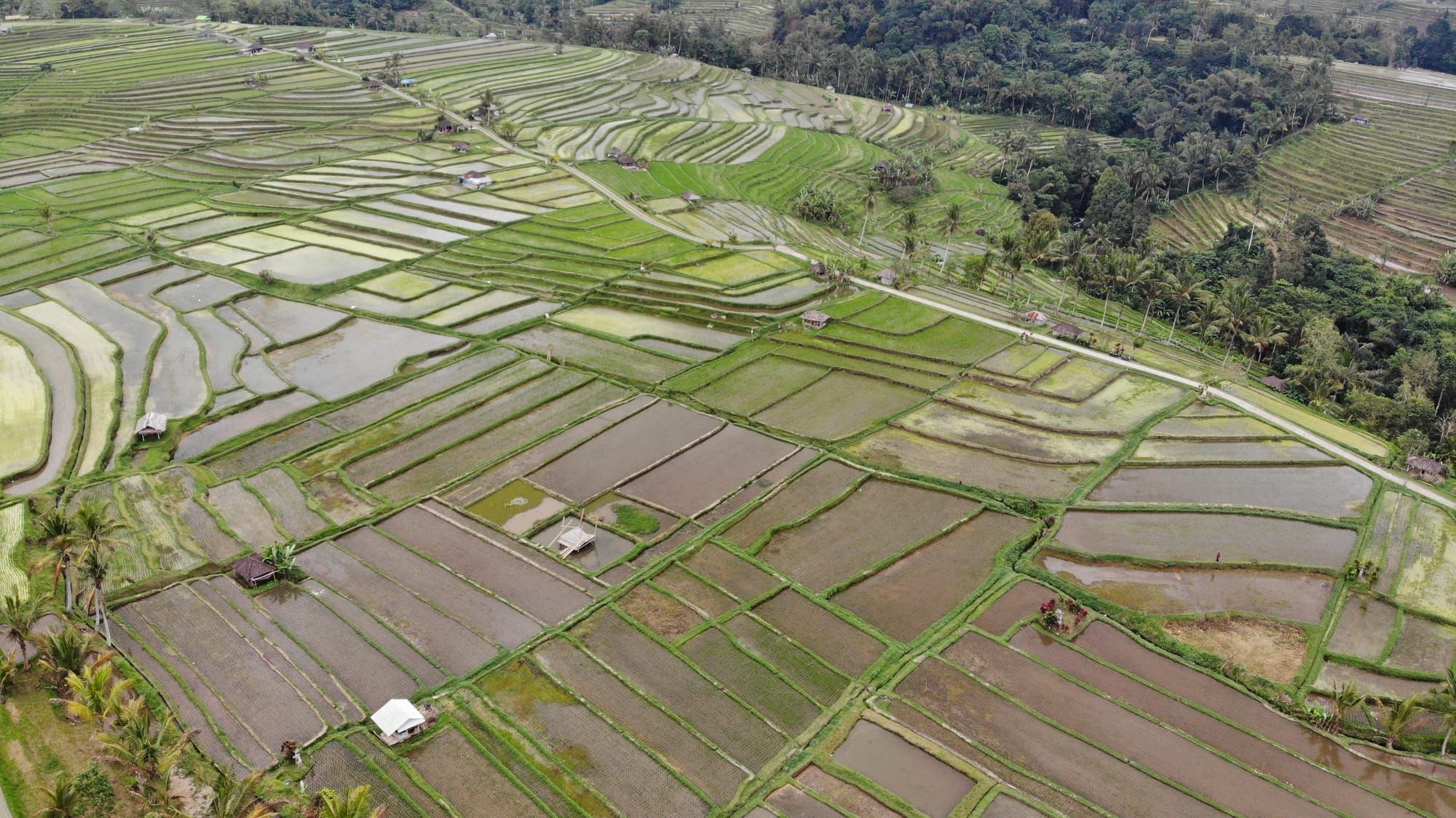
East Bali, for us, starts the moment Candidasa fades in the rear-view mirror and the road begins to curl around the coast toward Amed. From there it stretches north through a string of fishing villages — Jemeluk, Bunutan, Lipah, Selang — before climbing toward the dive mecca of Tulamben and, eventually, the slopes of Mount Agung. The whole region sits in the rain shadow of the volcano, which is why the landscape looks more savannah than jungle: dry grasses, lontar palms, and that famous dark volcanic sand.
The vibe is fishing-village-with-a-few-bungalows rather than resort. You'll see drying racks of small fish along the road, women carrying offerings to tiny shrines, and old motorbikes loaded with kayaks for the snorkel crowd. It's still Bali, but a version that hasn't been edited for Instagram.
Getting Here
From Ubud, allow about two hours by car. From Denpasar airport, closer to three — and longer if you hit the morning Sanur crawl. We hired a driver for the day each time we moved, which back in 2019 ran roughly 600,000–800,000 IDR (around 40–50 €) including fuel. Worth every rupiah with kids, car-seat-free roads, and luggage for nine people.
A scooter is the iconic Bali option, and plenty of solo travellers ride straight up the east coast on one. With a family of four it's a hard no for us — the road has steep bends, mid-day buses cutting wide, and zero shoulder in places. Driver, full stop.
Where We Stayed — Good Karma & Kelapa Cottage
Our first night in the area, before the Gili boat, was at Good Karma Bungalows — a low-key, almost time-warped little place right on the beach where the staff seemed mildly amused to see a tribe of European children appear at sunset. Simple bamboo bungalow, mosquito net, fan, and the sound of waves about ten metres from the door. Perfect for a one-night reset.
When we came back from the Gilis, we moved up the coast to Kelapa Cottage for three nights. We took two beachfront bungalows for the wider crew — around $610 for three nights for one family of three, so roughly $200 a night, which felt fair for the location. Nothing fancy: thatched roofs, cold-water bathroom, a small pool that the kids basically lived in, and a frangipani tree that dropped white flowers into it all day.
Where to stay along the Amed coast: The seven Amed fishing villages run roughly Jemeluk → Bunutan → Lipah → Lehan → Selang → Banyuning → Aas. Kelapa Cottage and Good Karma sit on the calmer Lipah/Lean end (family-workable, restaurants two minutes by scooter, dive shops on the doorstep). Map covers all seven plus Tulamben for the wreck-diving crowd.

It's the kind of place where breakfast is brought to a wooden table under a palm, the wifi is moody, and nobody minds because there's a black-sand beach thirty seconds away.
Black-Sand Beach Days
The Amed coast is a chain of small coves rather than one big sweep of beach, and each cove has its own colour of sand depending on how much volcanic mineral made it that far. Around Kelapa, it's a deep charcoal grey — almost wet-slate dark even when dry — studded with traditional jukung outrigger boats pulled up in rows. Blue, red, yellow, all hand-painted, all working fishing boats that go out before dawn and come back mid-morning with the day's catch.


Two quick warnings nobody tells you. First: black sand absorbs heat like a frying pan. Between roughly 11 and 3, you cannot cross it barefoot — flip-flops are non-negotiable, and you'll still hop a bit. Second: the slope into the water is steep in places, so it goes from ankle-deep to chest-deep faster than you'd expect. Fine for confident paddlers, worth knowing for little ones.
We spent most of our beach time in the early morning and late afternoon. Kids splashed around the jukungs, fishermen mended nets a few metres away and didn't seem to mind, and the whole scene felt very far from the influencer beach clubs further south.
Pura Lempuyang and the Gateway to Heaven
If you've ever seen a photo of two split temple gates framing a perfect snow-capped volcano with a glassy reflection underneath, that's Pura Lempuyang — specifically the lower temple, Pura Penataran Agung Lempuyang. By 2019 the place had started to get busy, but the great Instagram queue hadn't fully exploded yet, and the famous "mirror" trick (a guide holding a piece of glass under your phone to fake the reflection) wasn't yet the main attraction.
When we went, we waited maybe twenty minutes for our turn between the gates. No mirrors, no props. What you see in our photo is the real framing on a clear morning.


A few things worth knowing. The full Lempuyang pilgrimage climbs through seven temples up the mountain, and the total stair count is famously around 1,700 — a serious half-day hike. With kids, we did just the lower gate complex, which is a manageable wander rather than an expedition. You'll be given a sarong at the entrance (included in the small donation) and asked to wear it. Mornings before 9 am give you the clearest shot at Mt Agung; by 11, cloud usually swallows the summit and the picture stops working.
If you'd rather not drive Lempuyang and Tirta Gangga yourself in one morning, the East Bali Lempuyang + Tirta Gangga + Taman Ujung day tour bundles all three with an early-dawn Lempuyang slot — the only realistic way to get the Gates of Heaven photograph without the three-hour queue and the mirror-trick stampede that builds by 9 AM.
Tirta Gangga Water Palace
Tirta Gangga is the other unmissable East Bali stop, and it's a complete change of texture from the temple. Built in 1946 by the last raja of Karangasem, it's a series of formal water gardens — koi ponds, tiered fountains, stepping stones across reflecting pools, all set against terraced rice fields.


The big hit with the kids was the koi pond by the entrance. You buy a small bag of fish food at the gate, drop a pellet, and a writhing carpet of orange and white fish surfaces in seconds. Our crew ran out of bread (and the official pellets) within about four minutes flat and then spent another half hour trying to negotiate refills with us.

Tucked among the serious religious statuary we found one little stone figure dressed up in a checked sarong and a pair of white plastic sunglasses. Nobody explained who put them there. It's that kind of place — formal on the surface, gently mischievous up close.
Allow about an hour and a half. Go in the late afternoon if you can: light is softer, the fountains glow gold, and most tour buses have already left.
Diving Amed and Tulamben
If there's one reason serious divers come to East Bali, it's Tulamben — and specifically the wreck of the USS Liberty, a WWII US Army cargo ship torpedoed by a Japanese submarine in 1942. It was beached on the Bali coast for repairs, then pushed back into the water in 1963 when Mt Agung erupted. Today it sits between 5 and 30 metres deep, just metres from shore, encrusted in coral and patrolled by bumphead parrotfish.
We didn't dive on this trip — our kids were too young and we were travelling in a big group — but Amed is one of the best places in Indonesia to learn. The bay has a gentle slope, easy shore entries, and a string of small dive schools running open-water certifications for around 350–450 € when we asked, with English-, French- and Japanese-speaking instructors. For non-divers, the Liberty wreck is also one of the rare wrecks shallow enough to snorkel — you'll see the stern in about 5 m of water, which is wild.
For families with older kids (10+ and confident swimmers), this would be the place to do a "discover scuba" half-day with one parent staying on the surface. Filing that one away for next time.
For the diving side, with children 10+ who want to try a discover-scuba in still, shore-entry water, the Tulamben USAT Liberty wreck scuba experience is the option we'd send divers to — the wreck sits 3-30 m below the surface 30 m from the beach (no boat dive needed), which means a confident snorkeller can swim out and look down at the bow while a parent dives. Younger kids stay on the sand with the other parent.
Candidasa Sunset and the Drive On
On the way back south, we broke the drive at Candidasa to catch sunset from a clifftop café. It's a small town that used to be a beach resort until most of the beach eroded away in the 1980s — these days it's a string of restaurants and guesthouses along the cliffs, looking straight out over the Lombok Strait.


Just before we got back in the car, we stopped at the big heart-shaped "Candidasa Bali" frame on the seafront. It's the kind of thing that would normally make me roll my eyes, but with the light going pink behind it, fine, I queued up like everyone else.

And one last morning back on the beach before we packed up.


Practical Notes for Families
A few things we wish we'd known before turning up with three kids in tow.
Several Amed dive schools run family-friendly half-day combos that pair an introductory dive with a guided snorkel for the non-divers — a Tulamben-area dive experience can be a good first step if your older child is curious.
Cash. Amed has ATMs but they run out, especially in low season and on Sundays. Bring enough cash from Ubud or Candidasa to cover at least two days. Most small warungs don't take card.
Scooter or driver. As mentioned — with kids, hire a driver. For day trips to Lempuyang plus Tirta Gangga, a private car for the day was around 700,000 IDR (about 45 €) including waiting time.
On the scooter-or-driver question: with kids under ten we'd hire a driver every time on the Amed coast (the coast road is winding, narrow, and shared with sulphur-transport trucks). Booking through Discover Cars Bali before you arrive locks in the daily rate, the airport-transfer leg if you need one, and a clear cancellation window — useful given how often plans shift on a long Bali day.
What to skip. If you only have a day or two, skip the upper Lempuyang temples (the 1,700-step climb) unless you've got teenagers itching for it. The lower gate complex gives you the famous photo and the view in about ninety minutes flat.
Bring. Reef shoes if your kids hate hot sand, a light long-sleeve for temple visits (shoulders should be covered even with a sarong over shorts), and mosquito repellent for dusk on the beach.
When to come. August was excellent — dry, clear mornings at Lempuyang, hot beach afternoons. November to March can be wetter and Mt Agung may stay hidden behind cloud, which kills the temple shot.
More East-Asia & Family Travel
If East Bali fits your idea of a holiday — slower, more local, less polished — here's where we'd send you next around the region.
FAQ
How many days do you need in East Bali?
We'd say three nights minimum to make the drive worthwhile and still have time for both Lempuyang and Tirta Gangga without rushing. Four to five nights if you want to dive Tulamben or just slow down on the beach.
Is Amed worth it with young children?
Yes, with one caveat: bring your own beach toys (selection is limited), accept that the sand gets very hot, and book a bungalow with a pool. The Tirta Gangga koi pond and the fishing boats on the beach were huge hits with our kids; the steep climb at Lempuyang was not.
Can you visit Pura Lempuyang and Tirta Gangga in the same day?
Easily. Most drivers will suggest Lempuyang first thing (for the clearest view of Mt Agung), then a late lunch nearby, then Tirta Gangga for the soft afternoon light. About six hours door-to-door from Amed.
Is the famous Lempuyang gate reflection real?
The mirror reflection most travellers see in modern photos is fake — a guide holds a small mirror under your phone. In 2019 we waited our turn and shot the gate as it actually looks. After a rainstorm there can be a genuine puddle reflection, but otherwise the foreground is just stone.
Four nights wasn't long, but East Bali stuck. Months later we'd still randomly mention the koi pond, the heat of the black sand, or that one little statue in its plastic sunglasses. If South Bali is the headline, this quiet east coast is the part of the story most people skip — and the part we'd come back for first.