
A Slow Villa Week in Penestanan, Ubud: Pools, Rice Fields and a Drone-Eye View
Five nights in a shared villa in Penestanan, west of Ubud — pool, rice fields and the perfect base for Bali day-trips.

The smell of frangipani drifts in from the garden, a gecko clicks somewhere behind the rattan blinds, and the only soundtrack is the slow drip of pool water onto stone. Penestanan, the painter-village west of Ubud, has a different rhythm to the rest of Bali — and that rhythm is exactly what we came looking for.
We landed in Bali in mid-August 2019 as a family of four, joined by two other families who'd flown in from France for the same idea: rent one big villa together, plant ourselves in it for five nights, and let the kids run wild while the adults figured out the rest. Central Ubud — Hanoman, Monkey Forest Road, the cafés around the palace — felt too busy on paper for what we wanted. So we pointed the cars west, crossed the Campuhan ridge, and ended up in Penestanan, a fifteen-minute walk from the centre but a world away in pace. Five nights, twelve people, one pool. That was the plan, and that's exactly how it unfolded.
> Bookings: Some of the links in this article are affiliate links. This means that if you choose to make a booking, we will receive a small commission at no extra cost to you. Thank you!
Why Penestanan, Not Hanoman
Penestanan sits about 1.5 km west of central Ubud, on the other side of the Campuhan ravine. On a map it looks close — and it is — but the moment you turn off Jalan Raya Penestanan onto one of the village paths, the soundscape changes. There's no through-traffic. Scooters slow down because the lanes get narrower. Houses give way to rice paddies, often within ten metres of someone's back door.
The village has been the Ubud painters' enclave since the 1960s, when Dutch artist Arie Smit set up his studio here and trained a generation of local "Young Artists." Even today, half the buildings tucked between the paddies are galleries, ceramic studios or yoga sheds. It's quiet in a way that central Ubud genuinely isn't — and for a family with kids who needed a place to decompress after the flight from Paris, that quiet was the whole point.
The trade-off is honest: you're a 20-minute uphill walk (or a 30-second scooter ride) from the cafés, market and Monkey Forest. We never minded. The walk back through the Campuhan rice fields at sunset was always one of the best parts of the day.
The Villa: Five Nights, Twelve People, One Pool
We'd booked the villa months in advance, picking it precisely because three families could fit without anyone tripping over each other: a main house with four bedrooms, a separate two-bedroom bale across the garden, and — the social glue of the whole stay — a long rectangular pool wedged between the buildings and the rice fields behind.
Where to stay in Penestanan and the wider Ubud west side: The Penestanan ridge sits on a footpath network (no car access for the inner villas — taxis drop you at the bottom of the steps). Pengosekan and Nyuh Kuning to the south are the closest car-accessible alternatives. Map covers all three plus the Campuhan ravine side.

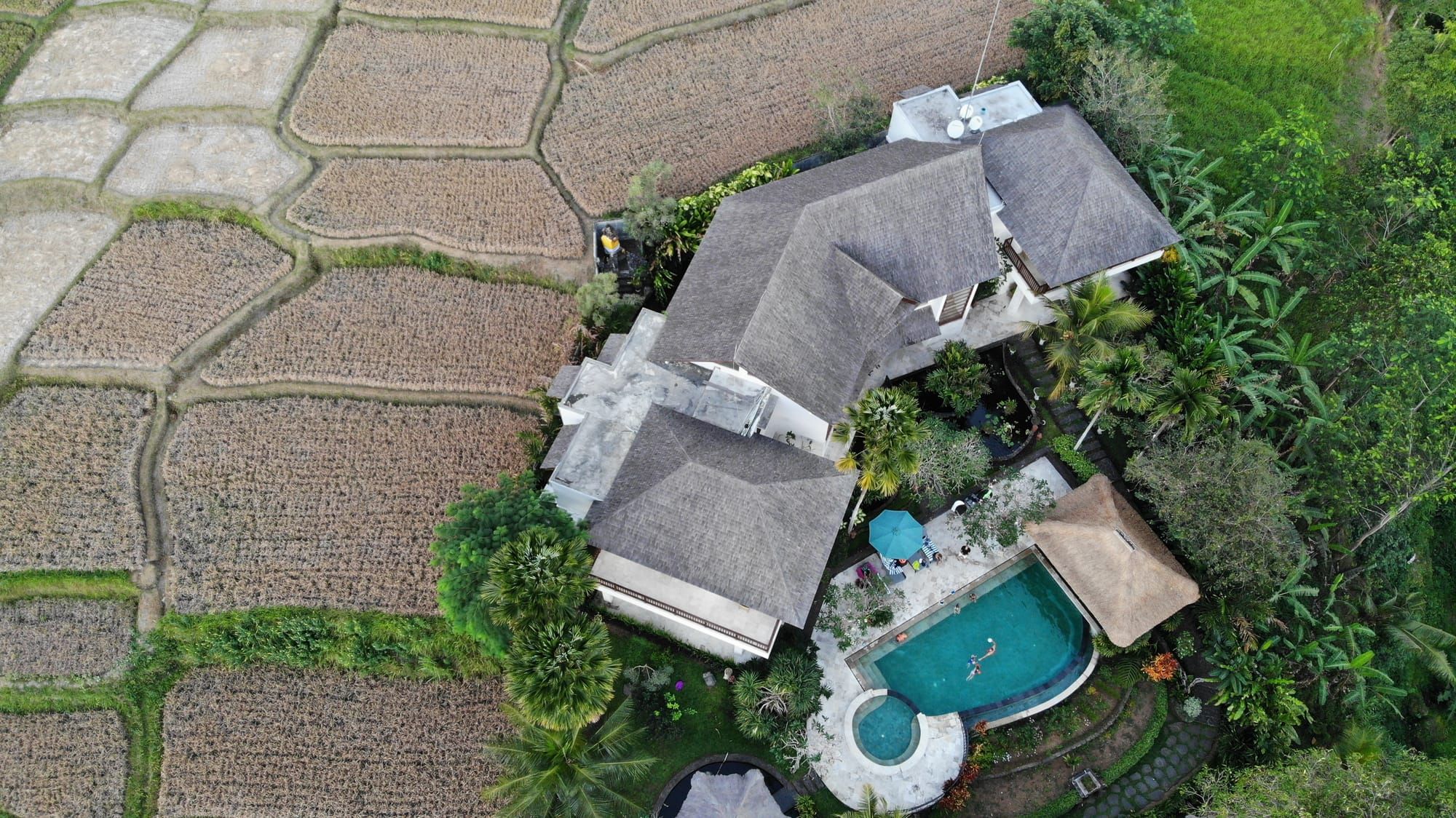
The pool ran almost the full length of the property. Mornings it belonged to the kids; afternoons the adults took over with books and Bintangs. From above, the geometry was almost ridiculous — a clean rectangle of turquoise dropped into a patchwork of green.

This was also where I unpacked the DJI Mavic Pro 2 for the first time on the trip. Bali has tightened drone rules since (always check current regulations and respect private property), but back in August 2019, from inside our own villa garden, the rice paddies right behind the wall were too tempting to ignore.

What surprised us most about a shared rental this size was how naturally it worked. Three kitchens-worth of breakfasts on one big terrace. Six adults rotating who walked into Ubud for ice and beer. Kids forming a small pack and not asking for screens for two days straight. The villa absorbed all of it without ever feeling crowded.
A Penestanan Day
A day in Penestanan didn't really have a schedule, and that turned out to be the best part.
Mornings started slowly on the terrace with fresh fruit, jaffles from a street cart down the lane, and very strong Balinese coffee. By 9 a.m. the kids were already in the pool. By 10 a.m. one of the adults was usually wandering down a village path with a camera, getting politely lost between two paddies.
The art galleries are everywhere. Some are working studios where you can watch a painter at their easel; others are tiny showrooms tucked behind a courtyard gate, often with no signage at all. A few were closed for the morning's offerings — incense smoke curling out of small temple shrines, the smell of clove cigarettes from the warung next door. We bought a couple of small canvases over the week. Nothing major. Just souvenirs the kids could point at years later and say, "That came from the village with the pool."

Lunch was almost always a warung. The two we kept coming back to were both within five minutes' walk of the villa — one for nasi campur with a dozen tiny side dishes for under 30,000 IDR, the other for grilled fish with sambal matah. Afternoons looped back to the pool. By 4 p.m. someone was always asleep on a lounger.
Sunset From Above
The light in Penestanan changes character around 5.30 p.m. The palm canopy turns from green to bronze; the paddies briefly look gold; and the village's pitched thatched roofs catch a copper glow that you don't really notice from ground level.

I flew the drone twice that week at golden hour, both times from the villa's own garden, both times with the kind of nerves you get when you're hovering a small camera over thatch and palm fronds. The framing was easy — the village does most of the work — but the reward was seeing, for the first time, just how cleanly our pool sat inside that green-and-gold patchwork.

If you only fly once during a Penestanan stay, fly at sunset. The mornings are softer but a bit hazy; the late afternoon is when the village looks the way it feels.
Temples Within Walking Distance
Penestanan is small but devout. Within a fifteen-minute walk we found three working temples, and one of them — a red-gated family temple just off the path — became a daily landmark for us.

We never went inside (these are working places of worship, not attractions), but the carved gate and the daily offerings of canang sari on the steps became part of the rhythm of our walks. A few minutes further on, a grey stone guardian stood watch at a side entrance.

The kids called them the "fanged statues" and started a small competition to spot them. By day three they'd counted seven without trying. If you decide to visit any of Penestanan's larger temples, bring a sarong (most ask you to wear one) and time the visit around mid-morning offerings — it's quieter and the light is gentler.
Evening Down-Time at the Villa
Evenings were the part of the day we'd most underestimated. After dinner — sometimes at a warung, sometimes a long communal meal back at the villa — the place naturally split into three little zones: kids stretched out around a film in one of the bales, a board-game corner under the terrace lights, and a slow-burning pool table in the games room.
Movie nights for the youngest, increasingly stubborn games of Uno for the older ones, and pool tournaments that ran later than they should have. The villa held all of it without ever feeling cramped. That's the part you can't really book for in central Ubud, where most stays are smaller rooms in busier streets — you need a property big enough to absorb a tired family at the end of the day.
Practical Notes — Choosing a Penestanan Villa
If you're considering Penestanan for a slow family week, here's what we'd actually check before booking:
When we compare options for a return trip we cross-check the larger family villas on Trip.com's Ubud area listings alongside Airbnb — the inventory is different and the cancellation terms sometimes work better for a multi-family booking.
- Walking access to the path network. The best Penestanan villas sit on a footpath, not on Jalan Raya Penestanan itself. If a listing brags about "no scooter noise," it's probably on a path. - Real kitchen, not just a kettle. With kids and a long stay, breakfast at home saved both money and morning sanity. Check the photos for a proper hob, fridge, and ideally a blender (fruit is the local superpower). - AC in every bedroom, not just the master. August is dry-season but still hot at night. Fans alone don't cut it for the kids' room. - Pool size proportional to the group. A 4 m plunge pool is fine for a couple; for three families you really want something closer to lap length. - A real lock on the gate if you're a big group with belongings spread across multiple rooms. - Scooter access for day-trips. Most Penestanan villas have a parking shoulder at the end of the path; confirm before you arrive.
For current options, Airbnb still has the deepest catalogue of Penestanan villas (they tend to be family-run rather than hotel-branded), and Booking.com has gained ground since 2019, especially for the larger guest-houses on Jalan Raya Penestanan. Compare both — the same villa is sometimes listed at meaningfully different prices.
Beyond the Villa — Day-Trips From Penestanan
The other reason Penestanan worked so well as a base: most of Bali's classic day-trips are within 90 minutes by car or scooter. Over our five nights, we used the villa as a launchpad and came back to the same pool every evening — Sidemen rice terraces one day, Munduk waterfalls another, Tegalalang and a long detour to Tanah Lot for sunset. That whole route is the subject of its own companion piece, linked below.
If you'd rather not drive the classic Ubud day-trip yourself with tired kids, the Monkey Forest + Tirta Empul + Tegalalang Rice Terrace + coffee plantation combo is the version we'd book now — it folds all four classic stops into a single 9-hour driver-included day, including the Tegalalang swing if your kids want to do it (paid separately, around 100,000 IDR). It's the option we'd pick over piecing together scooter trips for families with three or more children.
For Tegalalang itself, if you want the swing photograph without the all-day combo above, the Bali Pulina swing + Tegalalang Rice Terrace half-day is a shorter alternative (4-5 hours, Luwak coffee tasting at Bali Pulina included). It works well as a 'kids tired by lunch' add-on.
FAQ
Is Penestanan better than central Ubud for families? For a stay of three nights or more, yes — that was our experience. Central Ubud is convenient for cafés and shopping, but Penestanan's footpath network, quieter evenings and direct access to rice fields are easier on kids (and on adults who want to sleep). You're still a 15-minute walk from the centre, so you lose almost nothing.
How far is Penestanan from the main Ubud sights? About 1.5 km from the palace, market and Monkey Forest. Walking takes 15–20 minutes through the Campuhan ridge or down via Jalan Raya Penestanan. Scooters cost a few minutes; by car, expect 5–10 depending on traffic on the main road.
Can you fly a drone in Penestanan? We did, in August 2019, from inside our own villa's garden. Indonesia has tightened drone rules since — check current regulations, register if required, and never fly over temples, ceremonies, or anyone's property without permission. Sunset over your own villa is one thing; over the village is another.
What's the best length for a Penestanan villa stay? Five nights felt right for us. Three is enough to settle in; seven would let you slow down even more and add another day-trip or two. Under three nights, you're better off in central Ubud where the walk-out cafés make short stays easier.
Penestanan didn't try to dazzle us. It just gave us a pool, a footpath, a few warungs, and enough quiet between rice paddies for a family of four — and two friend families — to actually decompress. Five nights later, we drove away with sun-darkened kids, a couple of small canvases, and a hard drive full of drone footage of a green-and-gold patchwork we keep going back to.