
Chamonix with Kids: Aiguille du Midi, Mer de Glace & Epic Hikes
From the dizzying heights of the Aiguille du Midi to the ancient ice of the Mer de Glace, Chamonix-Mont-Blanc delivers some of the most breathtaking mountain experiences in Europe — and yes, you can do it all with kids.

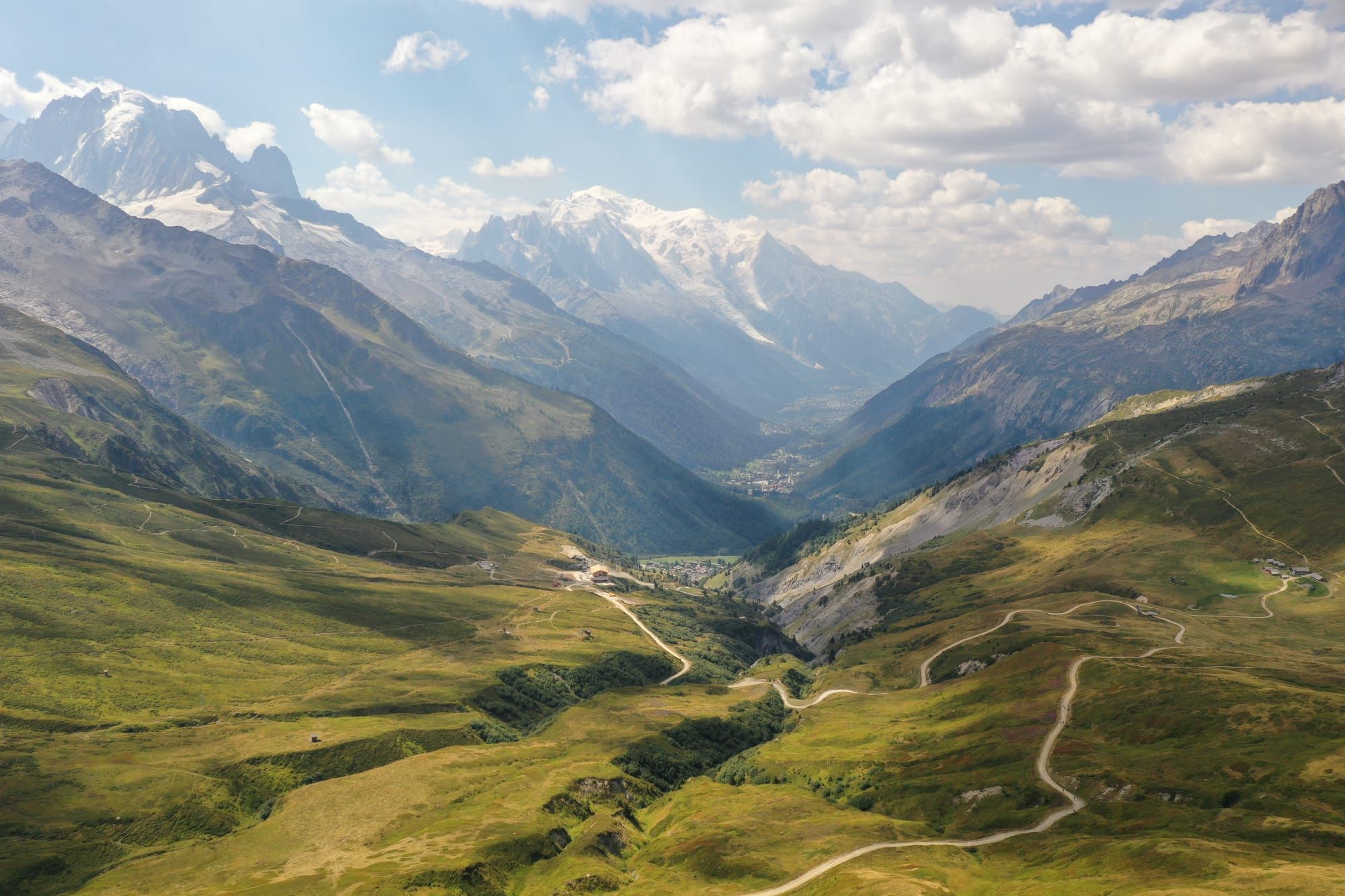
Early on the morning of 10 August 2022, our youngest was spread-eagled against the railing of the Pas dans le Vide — a glass-floored cube bolted to the side of the Aiguille du Midi at 3,842 metres — refusing, at first, to look down at the kilometre of empty air between his boots and the Bossons Glacier. Our eldest, four years older, had walked straight across without blinking. The cable car from Chamonix had left the valley just after 8 am; twenty minutes and 2,800 vertical metres later we were on a metal platform staring at the east face of Mont-Blanc, with cirrus clouds drifting past the antenna tower above us.
This guide is the ten-day version of what worked for our family of four (children nine and thirteen) during a French-Alps road trip from 7 to 19 August 2022. What follows is the Chamonix-Mont-Blanc section — the Aiguille du Midi, the Mer de Glace, Le Brévent, and the quieter corners we found when we needed to drop altitude for the kids: Les Praz chapel, the Arve riverbank, Saint-Gervais square.
A quick calibration before we dive in. Chamonix town sits at about 1,035 metres — from there the big-three lifts (Aiguille du Midi, Montenvers/Mer de Glace, Brévent-Flégère) take you between 2,200 and 3,842 metres in thirty minutes or less. Altitude sickness is real; a child who is fine in a cable car for twenty minutes may not be fine on a two-hour ridge hike at 2,400 metres. We learned to do the big altitudes before lunch and drop back into the valley for late afternoons, which is also when the light is best for the lower-elevation walks.
Bookings: Some of the links in this article are affiliate links. This means that if you choose to make a booking, we will receive a small commission at no extra cost to you. Thank You!
Take the Cable Car to the Aiguille du Midi (3,842m)
If there is one experience you don't want to miss in Chamonix, this is it. The Aiguille du Midi cable car whisks you from the valley floor at 1,035 metres to a summit terrace at 3,842 metres in just twenty minutes — one of the highest vertical ascents by cable car in the world.
From the viewing terraces you get Mont-Blanc's east face at arm's length, the Aiguilles de Chamonix as a row of dark granite spires to the north, and the Vallée Blanche sweeping south toward the Italian border. On our clearest panel — 08:18 that morning — we could pick out the Grandes Jorasses fifteen kilometres east. Give yourself at least ninety minutes up here: once the cloud base rises around 10:30 a.m. in August, the visibility drops fast.
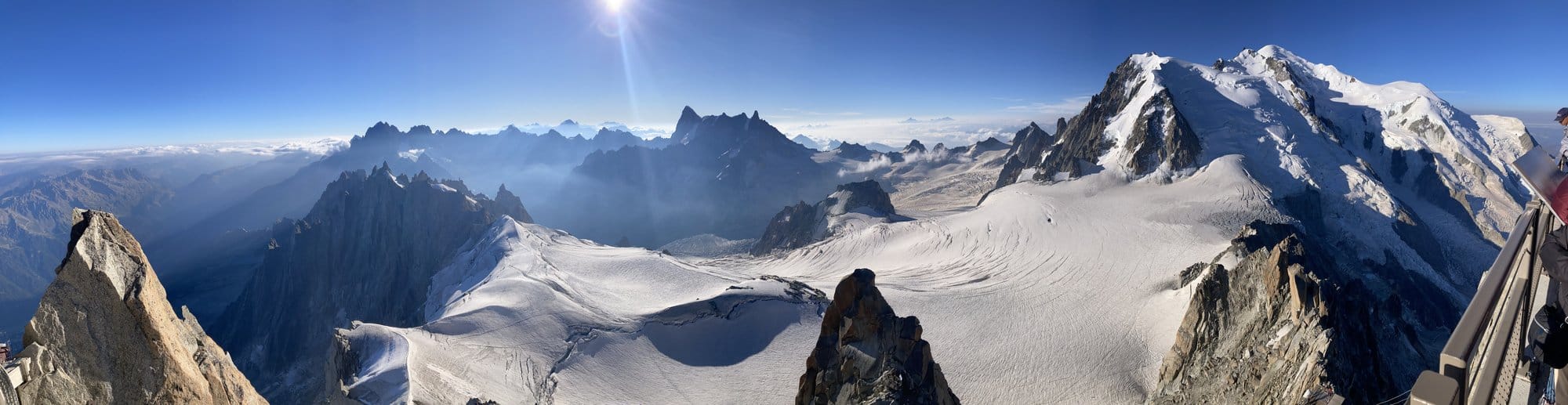
Step into the Void
The Pas dans le Vide — the glass box cantilevered off the upper terrace — is the part everyone queues for. You remove your shoes (they give you slippers) before stepping onto the floor, which helps nobody's courage. Our youngest did it for about fifteen seconds at arm's length from the wall; our eldest spent three minutes lying flat with her nose against the glass watching climbers rope up on the ridge below. Worth the fifteen-minute queue we hit early in the morning — by mid-morning the wait was closer to forty-five.
We arrived early, catching the first cable car at around 8 am, and the light at that hour was extraordinary — soft gold on the snow, deep blue sky, minimal crowds. If you're planning a visit, this early timing makes a real difference.
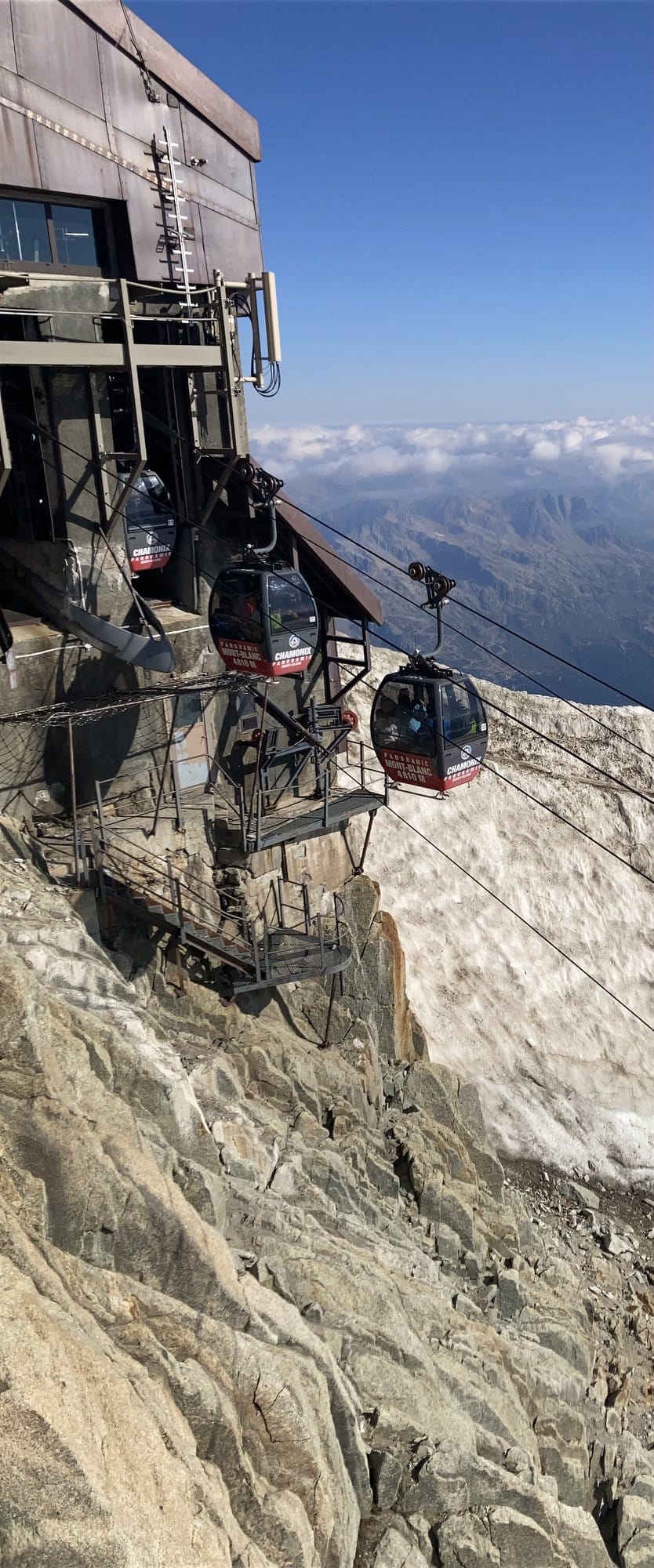
Watch the Panoramic Mont-Blanc Cable Cars
From the summit platform, you can watch the small red gondolas of the Panoramic Mont-Blanc line departing toward Pointe Helbronner on the Italian side. They glide silently above the Glacier du Géant, looking impossibly tiny against the scale of the mountains. Even if you don't take the crossing yourself, watching them from the observation deck is mesmerizing.
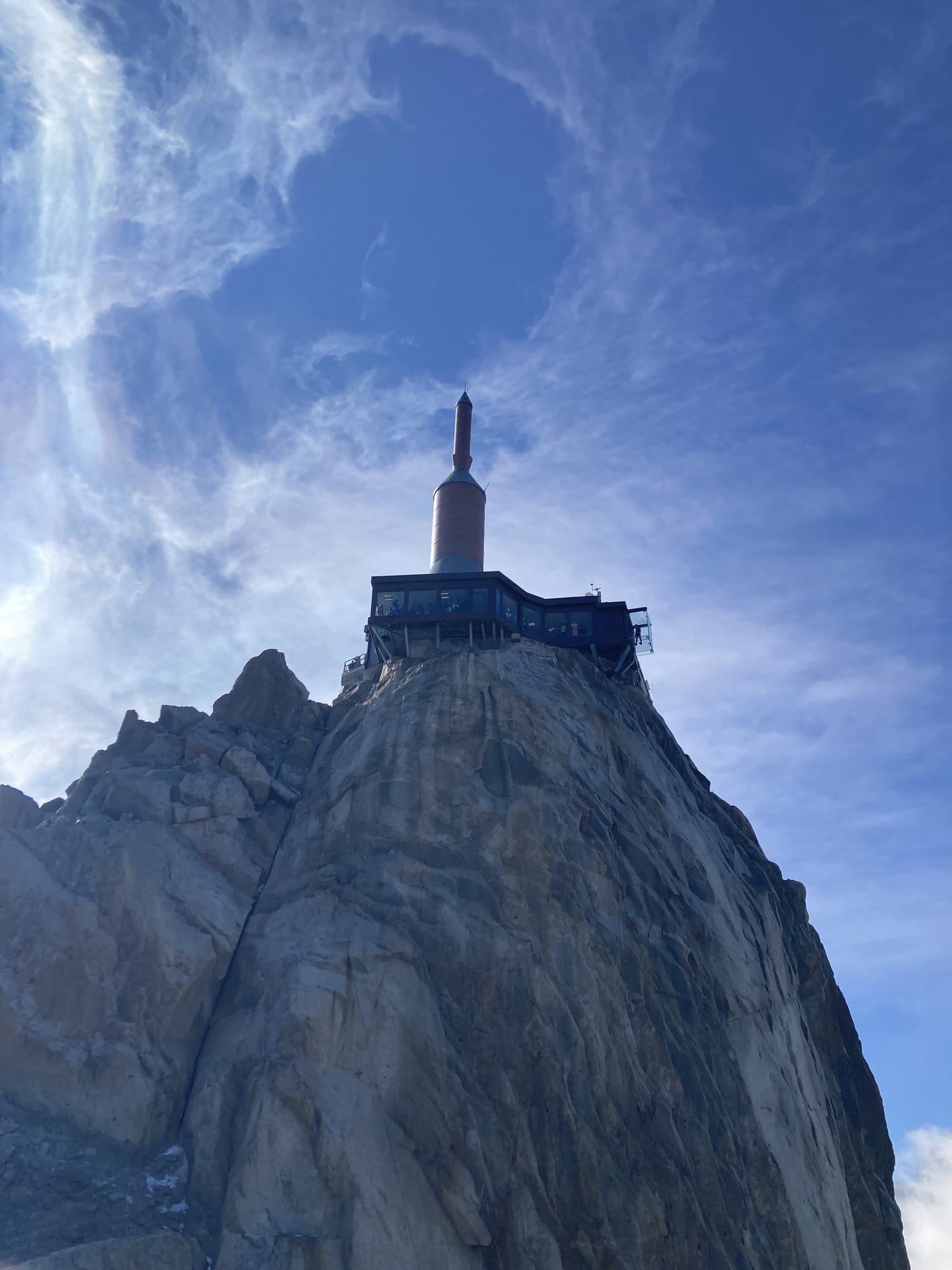
Look Up at the Summit Spire
Before you head down, walk around to the platform facing the actual Aiguille du Midi summit — the needle with the antenna on top. From the station you're looking up at a rock spire that holds a functioning weather tower at close to 4,000 metres, and in late morning there's usually a thin cirrus layer blowing past it. Our photo of this (IMG_6243 for the archives) is the single shot from the trip that gives a reliable idea of the scale.
Hike Down from Plan de l'Aiguille
Rather than ride the cable car all the way down, we got off at the intermediate station (Plan de l'Aiguille, 2,317 metres) and walked back to Chamonix. That's about 1,300 metres of descent over roughly 2h30 of walking. The path is well-marked and not technically hard, but some of the upper sections are loose scree that rolls under boots; avoid sandals.
The path is well-marked and not technically difficult, though there are some steep descents that require sturdy shoes. The reward is a continuously changing perspective on the glaciers and peaks above, plus the satisfaction of having earned your descent the hard way.
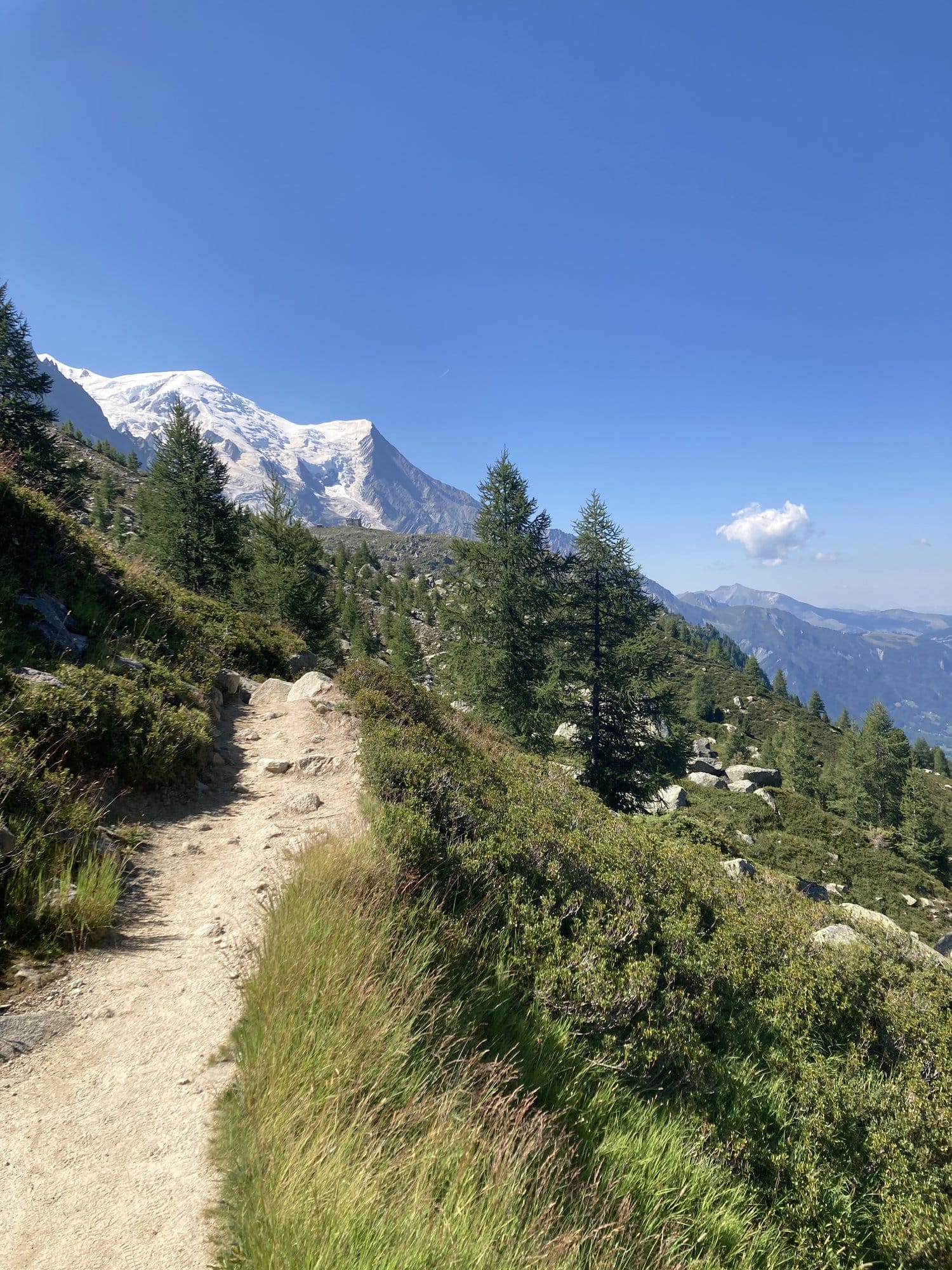
Our nine-year-old was flagging by the last switchback. Bring more water than you think you need and a bag of dried fruit — there is a refuge partway down (Refuge du Plan de l'Aiguille) but nothing reliable on the lower two thirds, and in August the heat loads up in the trees below 1,800 metres.
Visit the Mer de Glace and Ice Cave
The Mer de Glace is France's longest glacier — about seven kilometres from the cirque under the Grandes Jorasses down to the tongue. You get there on the Montenvers rack railway from Chamonix station, a 20-minute climb to a panoramic terrace at 2,211 metres. We went up on 7 August 2022 and stepped out of the train in the mid-morning; by midday we were inside the Grotte de Glace at 1,745 metres.
The glacier itself is both stunning and sobering. The grey-white ice, streaked with moraine debris, fills the valley below, and markers along the path show where the ice level stood in past decades — a vivid reminder of how much it has retreated.
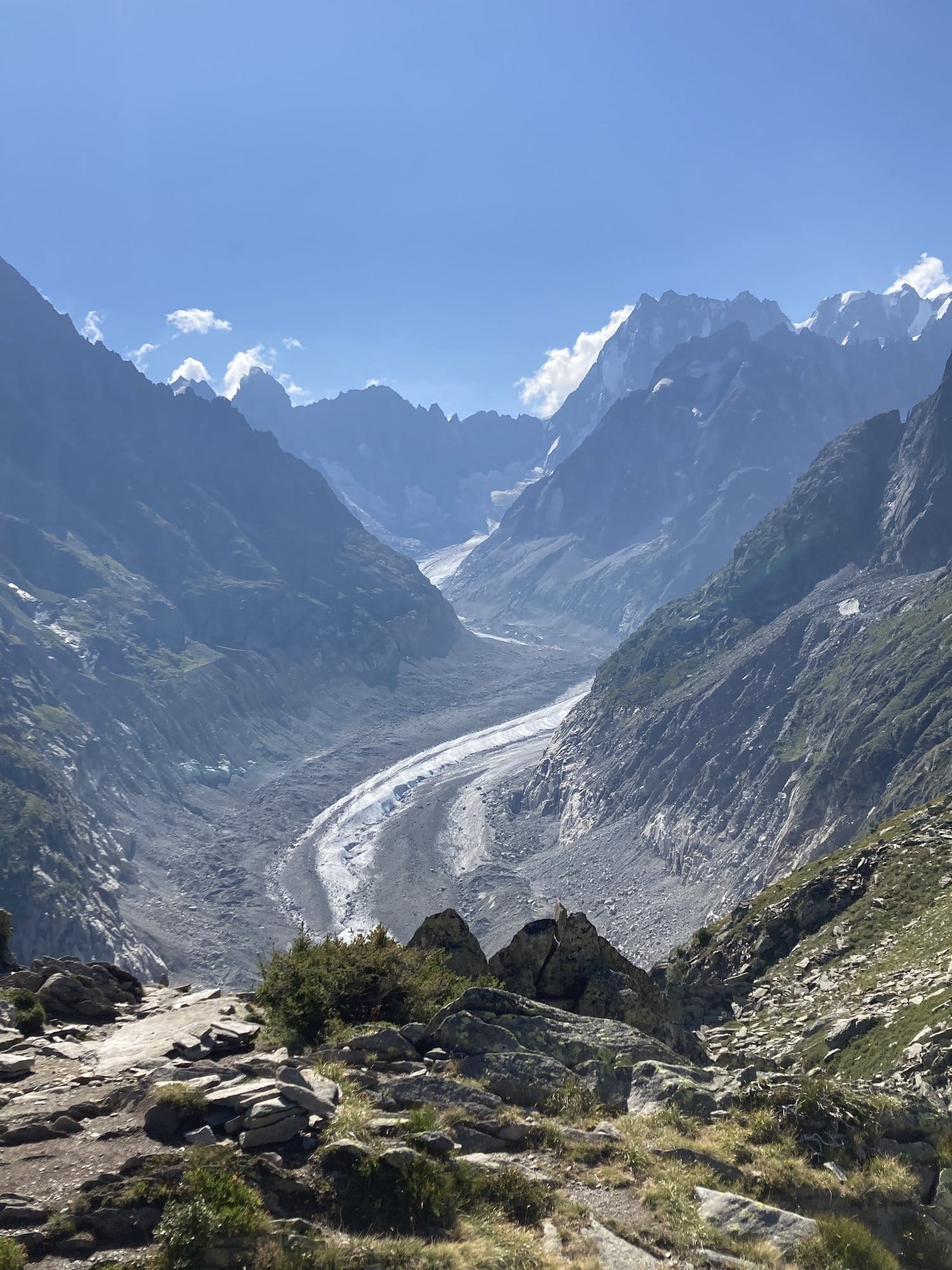
From the viewing platform, a series of metal staircases — updated regularly as the glacier retreats — leads down to the Grotte de Glace, an ice cave carved fresh into the glacier each summer. Inside, the walls glow with an ethereal blue light, and sculpted ice figures add a touch of whimsy to the frozen corridors.
Conquer Le Brévent for the Best Mont-Blanc Panorama
Le Brévent sits opposite the Mont-Blanc massif, across the valley — so instead of being on the mountain you're looking at it, which for photographers is arguably the better end of the deal. We rode up on 9 August 2022 and had our watch reading 2,518 metres in the mid-morning on the top platform. From the summit, the Bossons Glacier cascades down the middle of the frame; the Aiguille du Midi is clearly visible on the right (you can see the cable-car lines).
The cable car from Chamonix's Planpraz station takes you most of the way, and a short final gondola reaches the summit. From there, a sweeping panorama opens up: the entire north face of Mont-Blanc, the Bossons Glacier cascading toward the valley, the Aiguille du Midi's spire directly across, and the town of Chamonix miniaturized two and a half kilometres below.
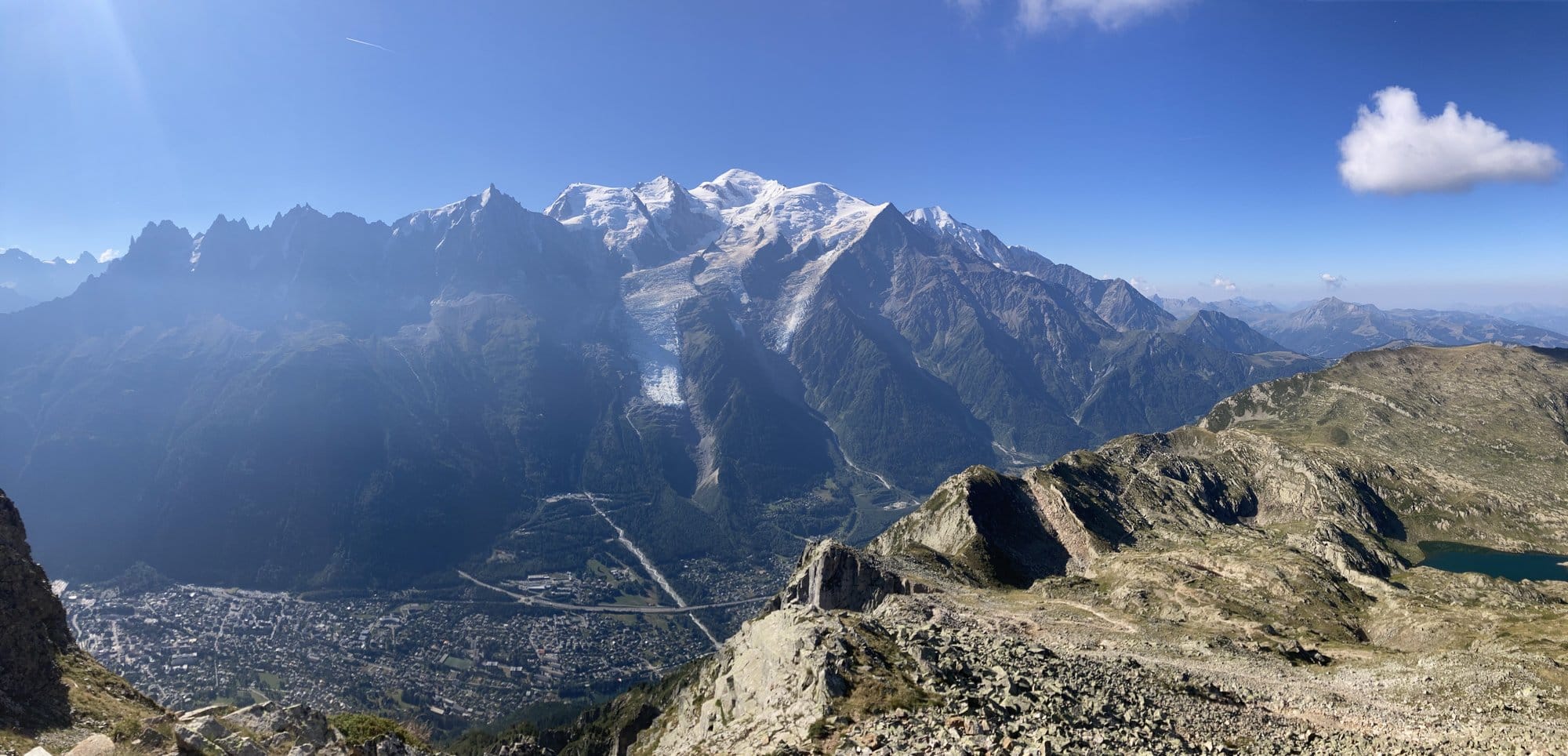
We spent a morning here, hiking along the ridge trails toward Lac du Brévent before descending on foot to an intermediate station. The trails at this altitude are exposed but well-maintained, and the views are unrelenting in the best possible way.
Silhouettes on the Ridge
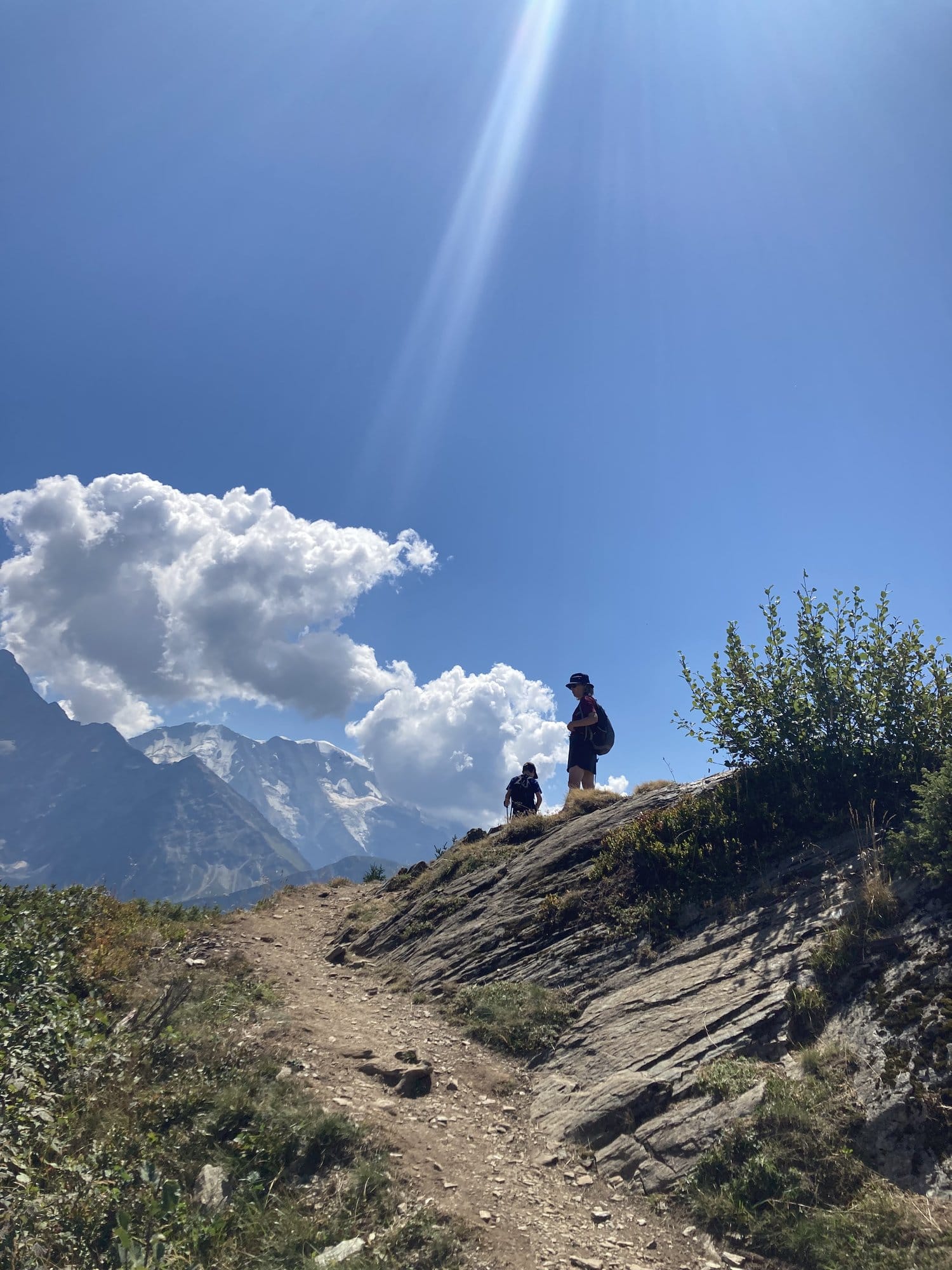
One moment from Le Brévent that keeps coming back to me: 13:30 on the descent, about 1,960 metres, two silhouettes — adult and child — paused on a rock outcrop with Mont-Blanc behind them in contre-jour. The light was the kind you get when a thin haze sits in the valley and the sun is still south-west — backs lit, faces unreadable. It's IMG_6167 on the camera roll, and if you walk the ridge between 2400m and 2000m between 13:00 and 14:00 you'll find the same corner yourself.
Explore Chamonix Town
After several days up in the cable cars, Chamonix town itself is worth an unhurried afternoon. The pedestrian centre — rue du Docteur Paccard and the blocks around it — is the right amount of busy for kids: gear shops, gelato, the tourist-office window with weather bulletins. There's a helicopter-rescue rotor blade displayed as a memorial on the main square that our youngest spent ten minutes reading about.
Strolling through the streets with the Aiguille des Drus and Aiguille Verte visible at the end of nearly every avenue is a constant reminder of where you are. The town makes an excellent base, with everything you need within walking distance.
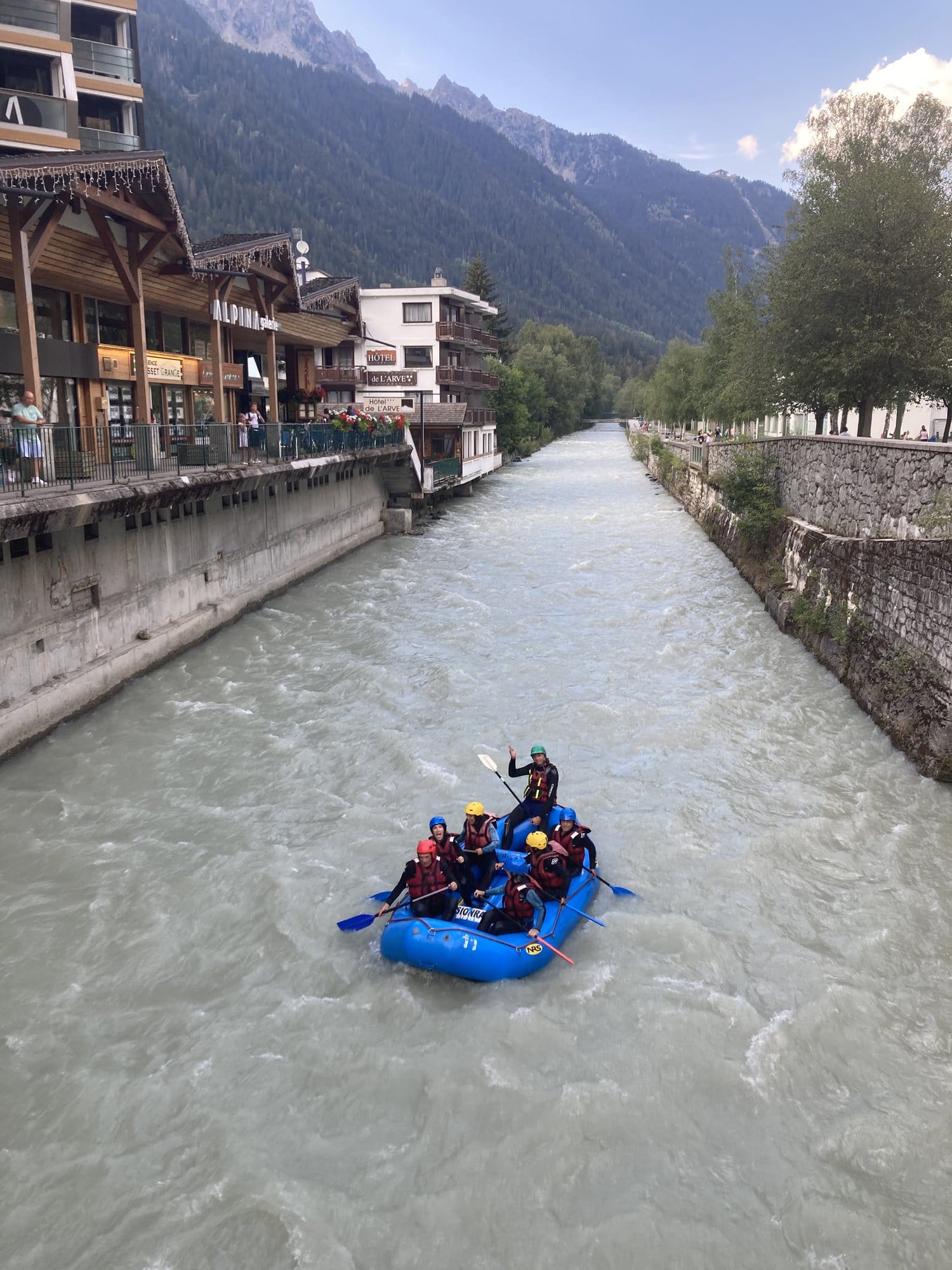
One thing we didn't plan for: late one afternoon on 11 August we watched a blue raft full of rafters in helmets shoot down the Arve through the middle of Chamonix, wooden chalets on both banks, the water the particular milky turquoise of glacier melt. Several operators run this — it's a Class II-III run depending on the week and meltwater — and booking in the morning for an afternoon start is usually fine in August.
The Chapel at Les Praz-de-Chamonix
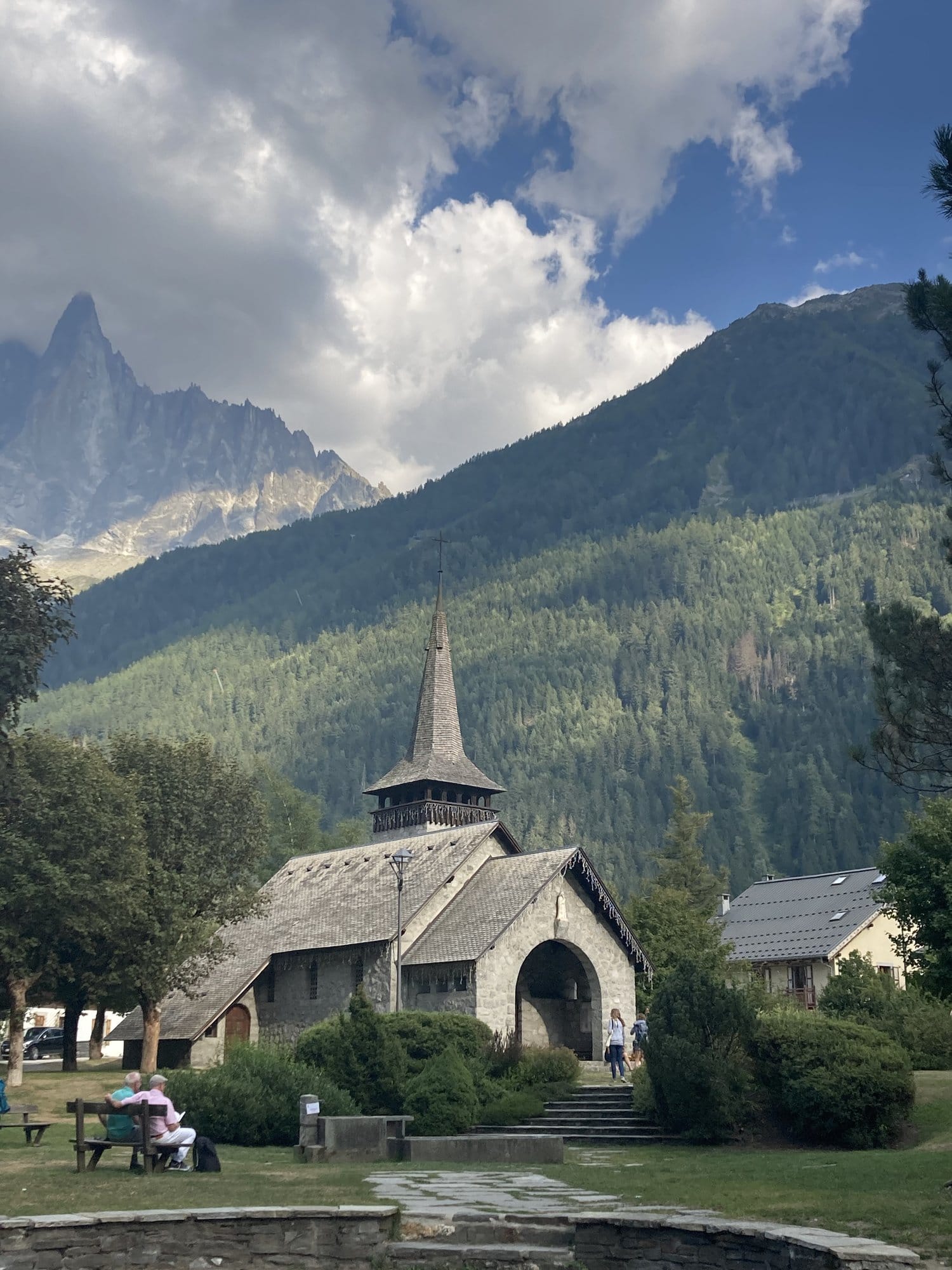
A short walk from the centre brings you to Les Praz-de-Chamonix. A stone chapel with a wooden bell tower sits on a clipped green lawn, and the Aiguille des Drus — the obelisk-shaped granite peak that climbers come to Chamonix specifically for — rises behind it. We were there at 17:54 on 11 August. The light does most of the work: late afternoon in August paints the Drus in a warm rust colour for about twenty minutes before the valley shadow climbs it.
Fly High: First Paragliding Experience
The single activity our kids still ask about was a first tandem paragliding flight above the valley on 10 August. Most operators launch from the Brévent side (the Planpraz take-off at around 2,000 metres) or from Plan Praz at the Col de Voza area, with landing on the fields near the Bois du Bouchet — a 20-to-30-minute flight depending on thermals. Minimum age is usually six, and adults fly tandem with a qualified pilot. Book the night before in high season.
If you've never tried paragliding, Chamonix is arguably the most spectacular place in the world to do it. Several operators offer tandem flights of varying lengths, and you don't need any experience — the pilot handles everything while you take in views that no cable car or hiking trail can match.
Find the Best Place to Stay
Explore Chamonix with GPSmyCity
This article is also featured on GPSmyCity. To download this article for offline reading or create a self-guided walking tour to visit the attractions highlighted in this article, go to Walking Tours and Articles in Chamonix.
Practical Information
How to Get There
Chamonix-Mont-Blanc is in the Haute-Savoie department of eastern France, about 80 km from Geneva, Switzerland. The easiest approach is to fly into Geneva Airport (GVA) and drive — it takes roughly one hour and fifteen minutes via the A40 motorway. The road is straightforward and well-signposted. You can book a rental car online to arrange transport in advance.
Alternatively, the Mont-Blanc Express train connects Chamonix to Saint-Gervais-les-Bains, which is on the main TGV network from Paris (about five and a half hours total). During summer, direct bus services also run from Geneva airport. compare flights to Geneva from your home city.
Best Time to Visit
Summer (June to September) is ideal for hiking and cable car access. July and August bring the warmest weather and longest days, but also the biggest crowds — booking the Aiguille du Midi cable car online in advance is strongly recommended during peak season. We visited in August and enjoyed consistently clear skies, though early morning starts were essential to beat the heat at lower altitudes.
Budget
The Aiguille du Midi cable car costs around €70 for adults and €60 for children (2024 prices). A combined pass covering the Aiguille du Midi, Montenvers (Mer de Glace), and Le Brévent offers better value if you plan to do all three. Accommodation in Chamonix ranges from budget gîtes at around €80/night to upscale mountain hotels at €250+. Restaurant meals average €15-25 per person for a main course.
Tips for Families
Altitude can affect young children — at 3,842 metres, some kids (and adults) may feel lightheaded. Take it slow, drink plenty of water, and don't plan a long hike immediately after the Aiguille du Midi. The Mer de Glace ice cave involves quite a few stairs, which can be tiring for small legs. Bring layers — even in August, the summit of the Aiguille du Midi hovers around 0°C.
More Alpine Adventures
If you loved Chamonix's mountain scenery, these destinations deliver equally stunning experiences: — family skiing in the Pyrenees
Pierrick explored Chamonix-Mont-Blanc and the surrounding valleys for eleven days in August 2022 with his family of four, using the vacation rental as a base for a mix of 3,000-metre lift days and lower-elevation river, town, and chapel afternoons. The Pas dans le Vide on 10 August and the silhouettes-on-a-rock moment above Le Brévent are the two he mentions when people ask where to start. More about his approach on the About page.
FAQ
Q: Is the Aiguille du Midi suitable for young children? A: Yes, but be mindful of altitude effects. At 3,842 metres, some children may feel lightheaded. The cable car ride is smooth, and the viewing platforms are well-protected. We visited with children aged 9 and 13 without any issues, though the 9-year-old found the Pas dans le Vide quite intense.
Q: Do you need to book the Aiguille du Midi cable car in advance? A: In summer (July-August), advance booking is strongly recommended. Time slots sell out, particularly for the first departures of the day. You can book online through the Compagnie du Mont-Blanc website.
Q: How difficult is the hike from Plan de l'Aiguille to Chamonix? A: The trail is moderate — mostly well-maintained paths with some steep sections. It takes about 2.5 hours and descends roughly 1,300 metres. Suitable for fit children aged 8+ with proper hiking shoes.
Q: When is the best time to visit the Mer de Glace? A: The ice cave is typically open from June to September. Morning visits tend to be less crowded. The rack railway runs frequently throughout the day.