
Yuanyang Rice Terraces: Which Viewpoint, Which Hour, Which Season
The Hani terraces reward precise timing more than any other sight in Yunnan. Here's where to stand, what hour to be there, and what the fields actually look like season by season.

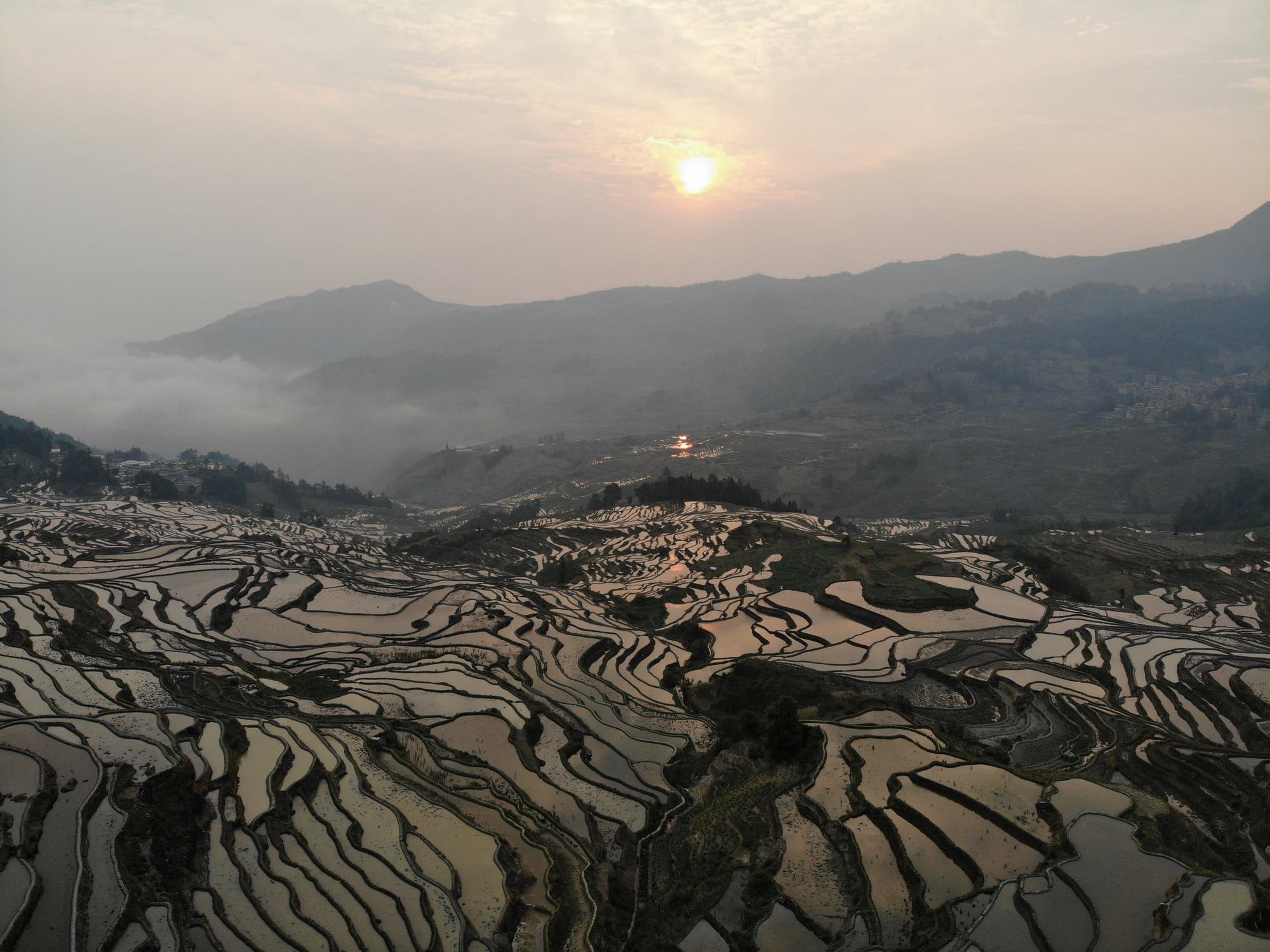
Most of the photographs that made the Yuanyang terraces famous were taken within about twenty minutes of each other, from roughly the same handful of wooden platforms, on mornings when the fields happened to be under water. That is not a criticism. It is the single most useful thing to know before you go, because it means the difference between a spectacular morning and a flat one comes down to three decisions: which viewpoint, which hour, and which month.
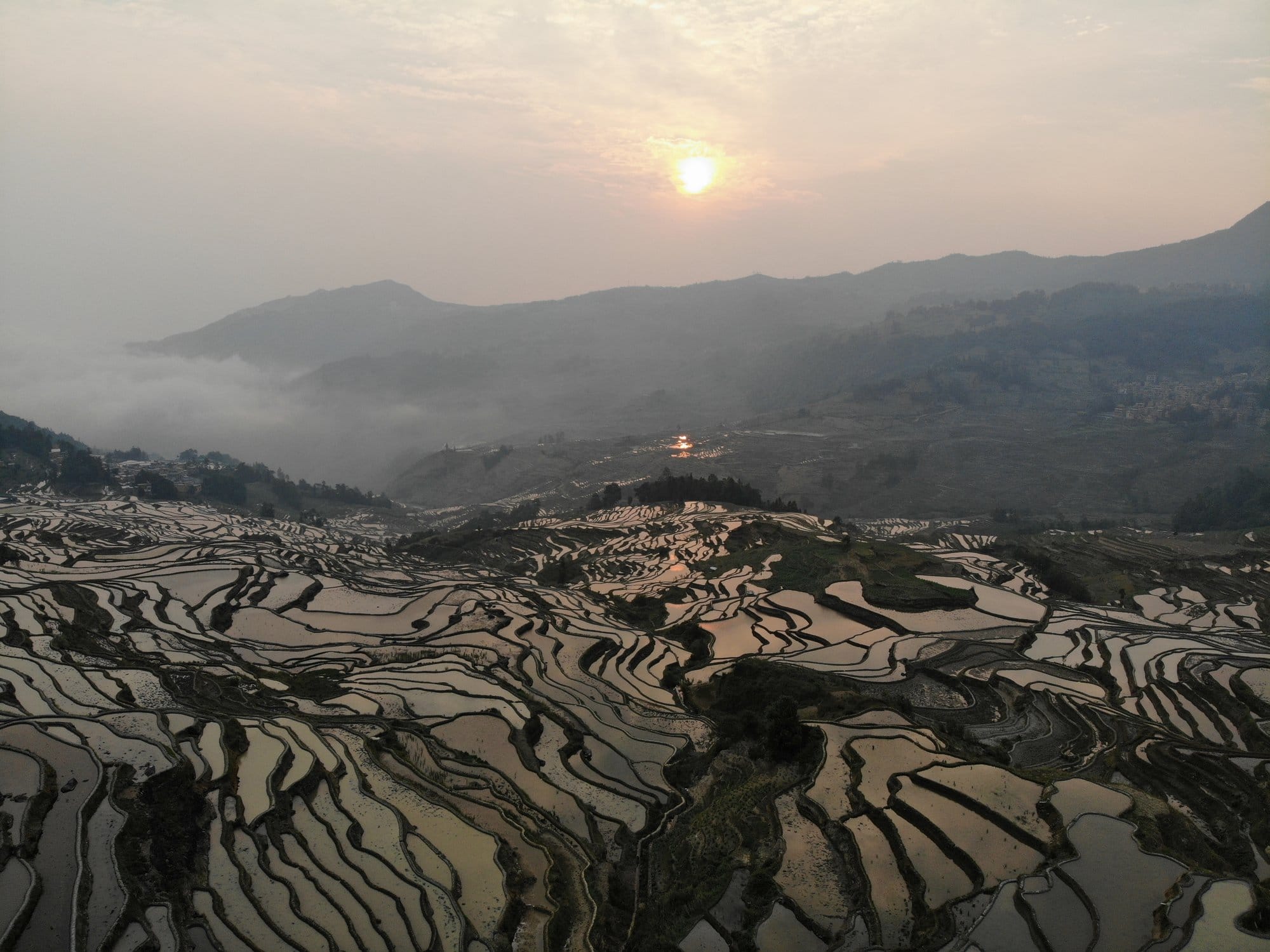
Get those right and the Honghe Hani terraces are among the most extraordinary landscapes in China — a hillside carved into thousands of curved basins, some of them a thousand years old, holding the sky like broken mirror. Get them wrong and you will stand in a car park looking at damp mud.
Here's how to get them right.
> Some links in this guide are affiliate links. If you book through them it costs you nothing extra and helps keep this site running. We only recommend places and operators we would use ourselves.
Be at Duoyishu Before the Sun Clears the Ridge
Duoyishu is the sunrise viewpoint. Everything else at Yuanyang is optional; this is the one worth setting an alarm for.
The sequence is worth understanding, because it is shorter than people expect. Arriving at around 6:35 on a spring morning means standing in near-darkness with the valley still full of mist and the terraces barely legible. By just before 7 the sun clears the mountains on the far side of the valley and the water turns — first a hard red, then orange, then the pale silver that holds for the rest of the morning. The twenty minutes after the sun breaks the ridge are the ones that matter. By 8 the light is ordinary.
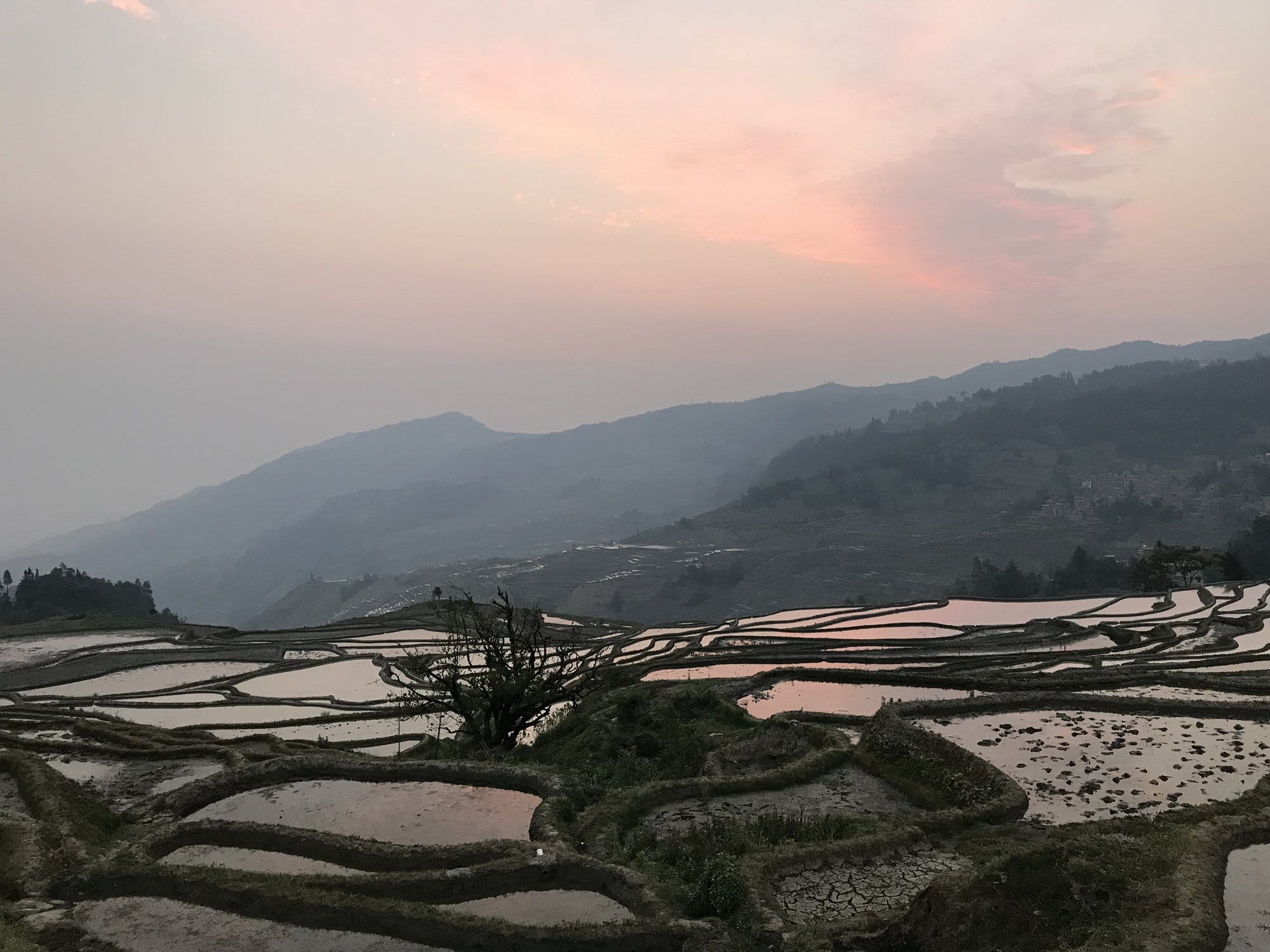
That timing shifts through the year, so check the local sunrise time for your dates and subtract half an hour. Aim to be in position before you can see properly. The platforms fill up — this is not a secret spot, and on clear mornings in the flooding season there will be tripods three deep at the railings — but they are large enough that arriving early gets you a front row.
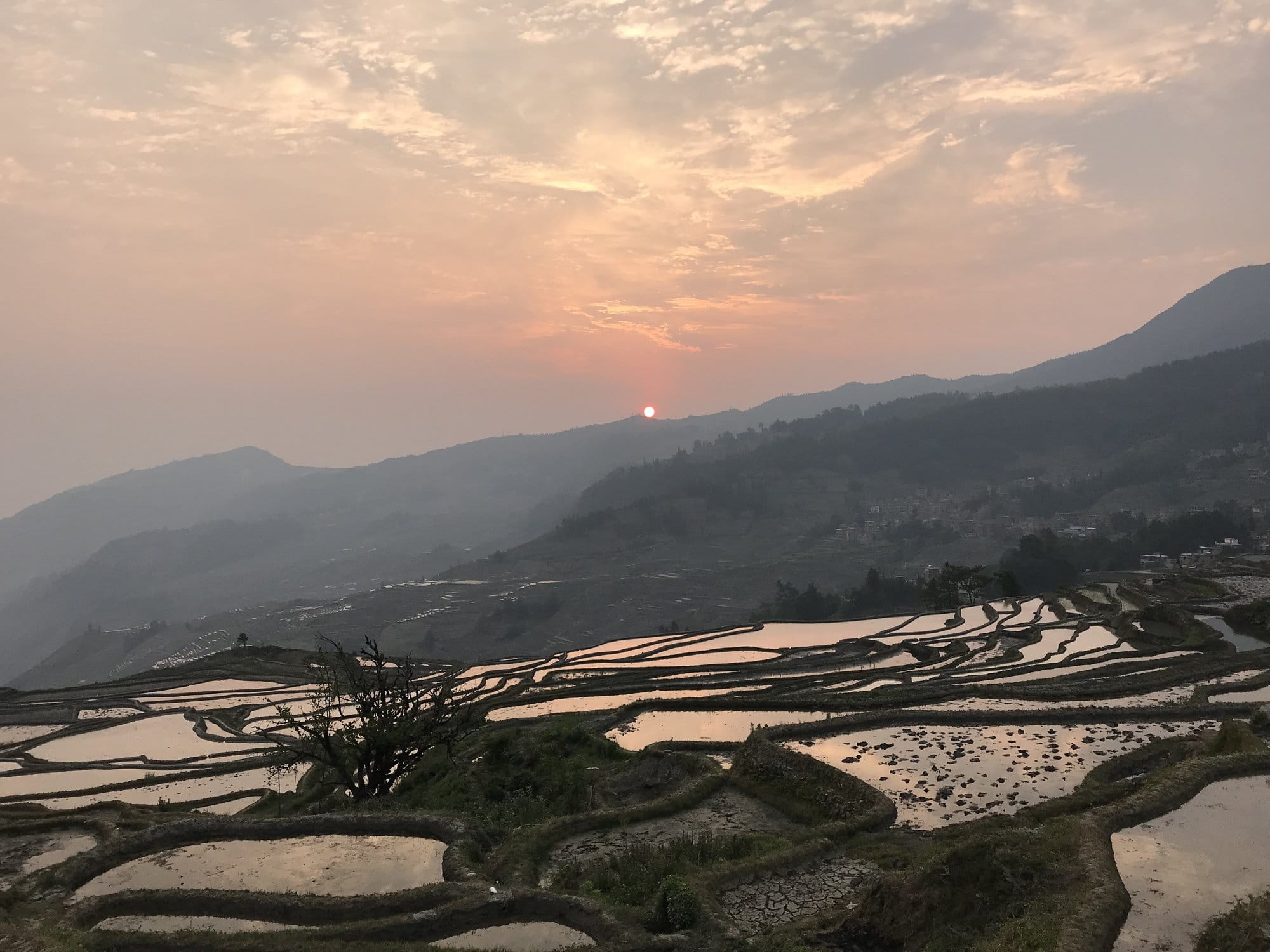
Two practical notes. It is cold before dawn at this altitude, around 1,800 metres, even in spring — bring a layer more than you think. And mist is a genuine risk rather than a nuisance: on some mornings the valley never clears, and there is nothing to do about it except try again the next day. Plan two nights if the photographs matter to you.
Choosing Between the Viewpoints
The terraces spread across a large area and the main viewing platforms each have a character and a best hour.
Duoyishu faces east across the valley and is the sunrise site, as above. It is also the most developed, with the largest platforms and the most visitors.
Bada is the sunset counterpart, a wide amphitheatre that catches the evening light. If you only have one full day, pairing Duoyishu at dawn with Bada at dusk gives you both ends of the light.
Laohuzui, sometimes translated as Tiger's Mouth, is the most dramatic in shape — steeper, more vertiginous, and photogenic later in the afternoon.
The three are spread along the ridge road above Xinjie and a driver or a scooter is the practical way to move between them, and a guided sunrise run between the viewpoints takes the logistics off your hands. Between the platforms, the roadside is often as good as the official viewpoints: some of the most satisfying views come from simply stopping where the road bends and the terraces open up below.
Flooded or Green: What You Will Actually See
This is the decision that most guides gloss over, and it changes the trip completely.
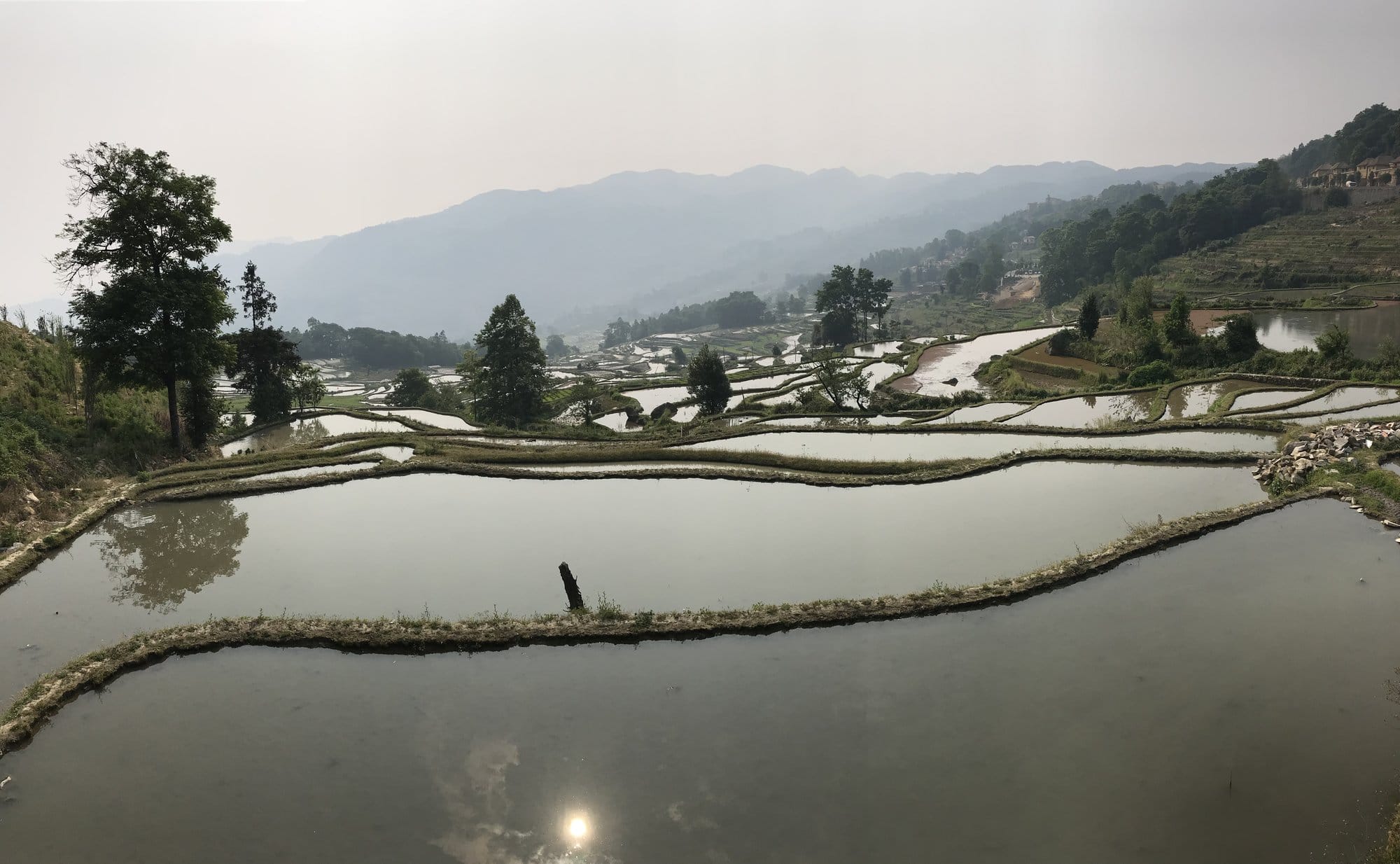
From roughly late autumn to early spring the terraces are flooded and empty. This is the postcard version: bare water, mirror reflections, the whole hillside behaving like a mosaic of mirrors. It is also the coldest and mistiest period.
From late spring the fields are planted, and the water gradually disappears under green shoots. By summer the terraces are a solid green staircase — beautiful, but a different photograph entirely, with no reflections.
What nobody mentions is that the transition is not uniform. Walking the villages in late April means passing a hillside of perfect mirrors and, a few hundred metres later, a valley already solid green with young rice. Transplanting happens plot by plot, family by family, over weeks. If you come at the shoulder you get both — which is arguably the most interesting version of all.
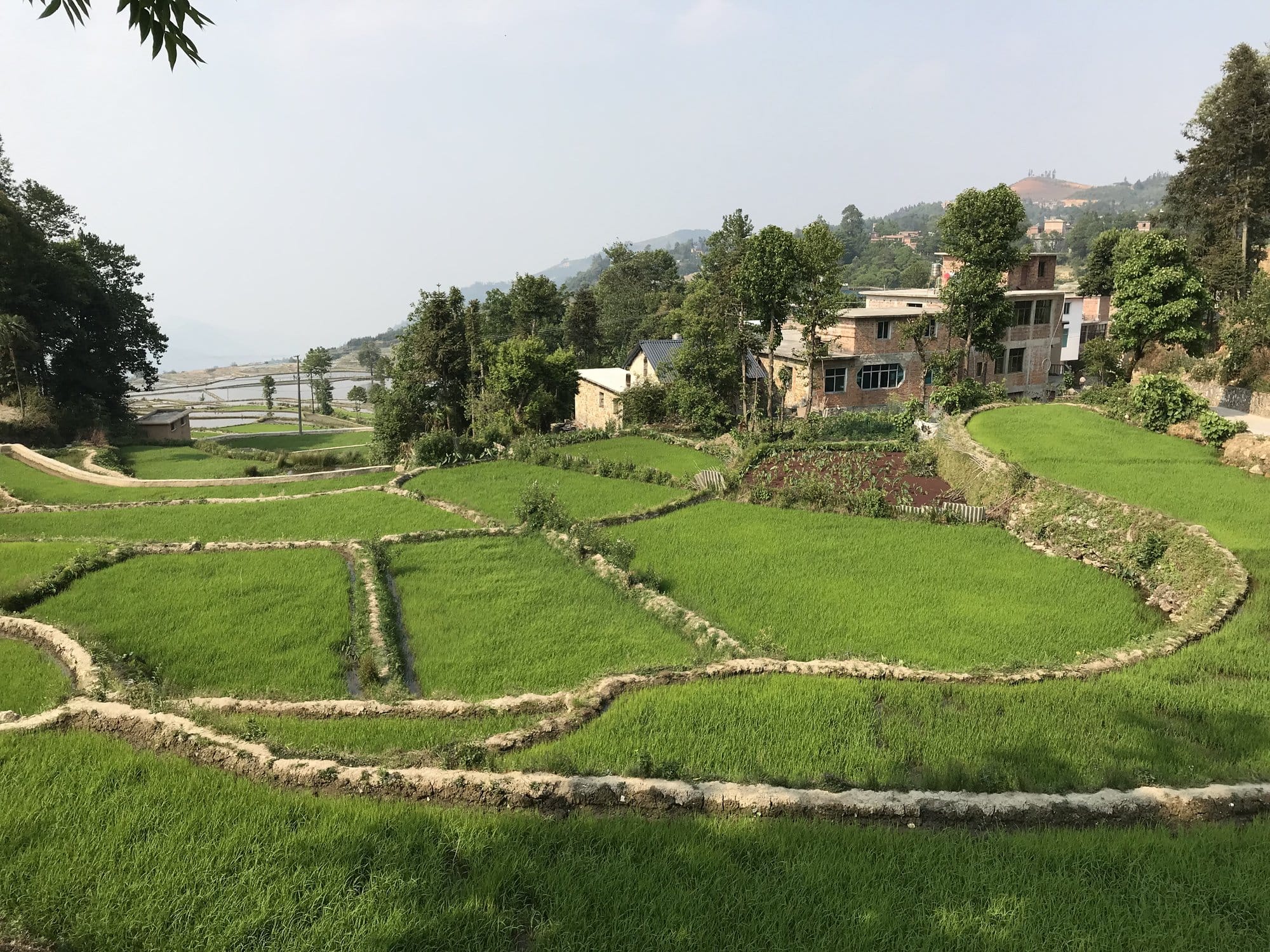
If the flooded look is what brought you here, aim for the heart of the flooding season rather than its edges, and accept the weather that comes with it.
Stay in a Village, Not in Town
Xinjie is the district town and has the most beds, but it is a forty-minute drive from Duoyishu on mountain roads — which means leaving in the dark to make sunrise.
Staying up on the ridge instead, in one of the Hani villages, solves the alarm problem and is a better experience besides. Pugaolaozhai, the village immediately below the Duoyishu platform, has a handful of guesthouses; the Duoyiwan Inn there puts you a short walk from the viewpoint, which is the difference between a five-minute stroll and a long dark drive.
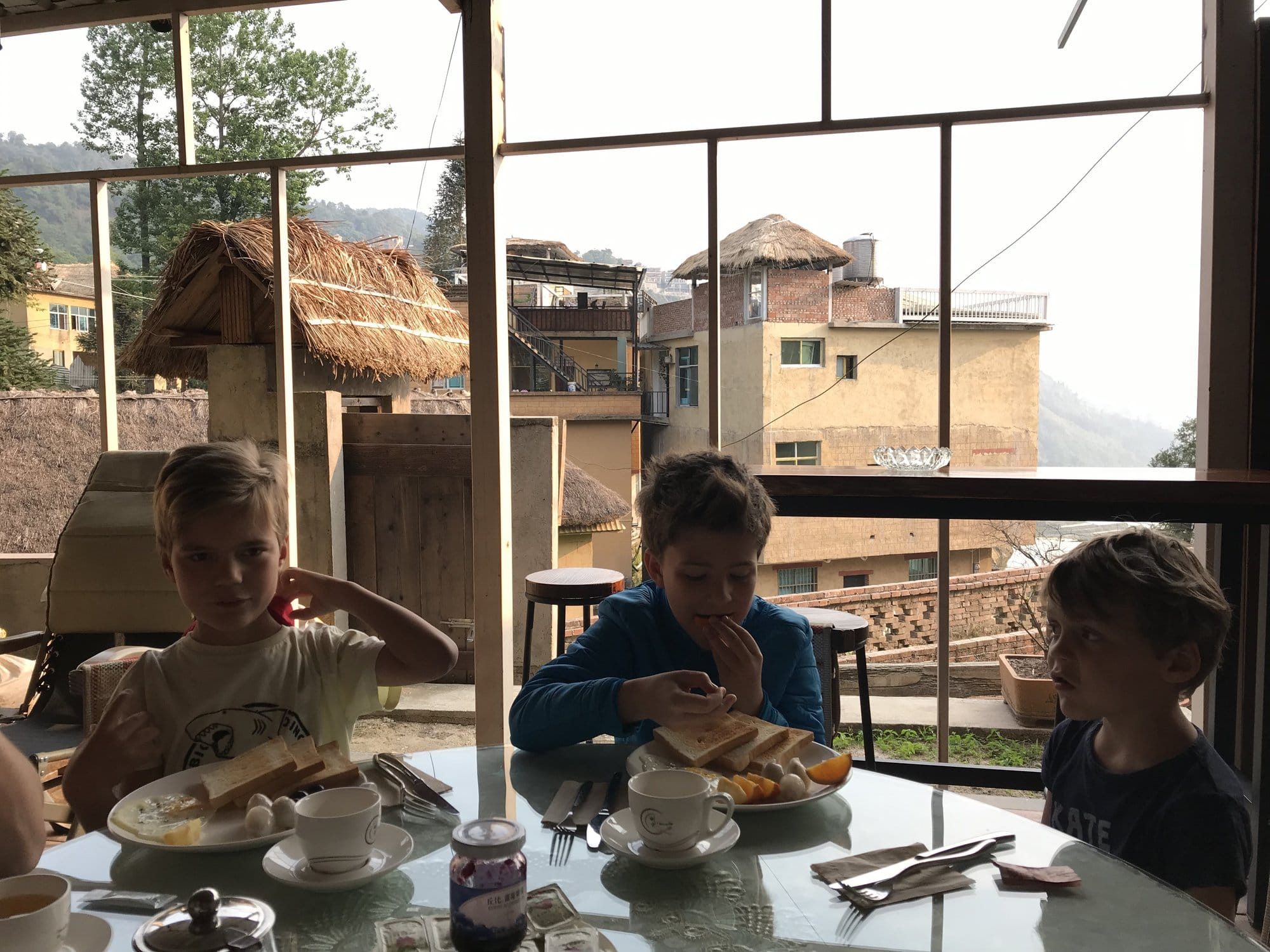
The villages themselves are the reason to stay rather than merely a convenience. Hani houses are built with thick earth walls and steep thatched roofs that give them their local nickname, mushroom houses, and a handful survive among the newer concrete builds. Breakfast on a terrace looking over those roofs, with the terraces dropping away beyond, is a better start to the day than a hotel corridor in town.
Walk Down Into the Terraces
The viewpoints give you the scale. Walking gives you everything else.
Paths run down from the villages along the dykes between basins, and they are public — farmers use them to reach their plots. Follow one downhill for half an hour and the terraces stop being a landscape and become a workplace: ankle-deep water, mud walls maintained by hand, a farmer walking the narrow ridge between two basins with a shoulder pole, entirely unbothered by the fact that his commute is a UNESCO World Heritage site.
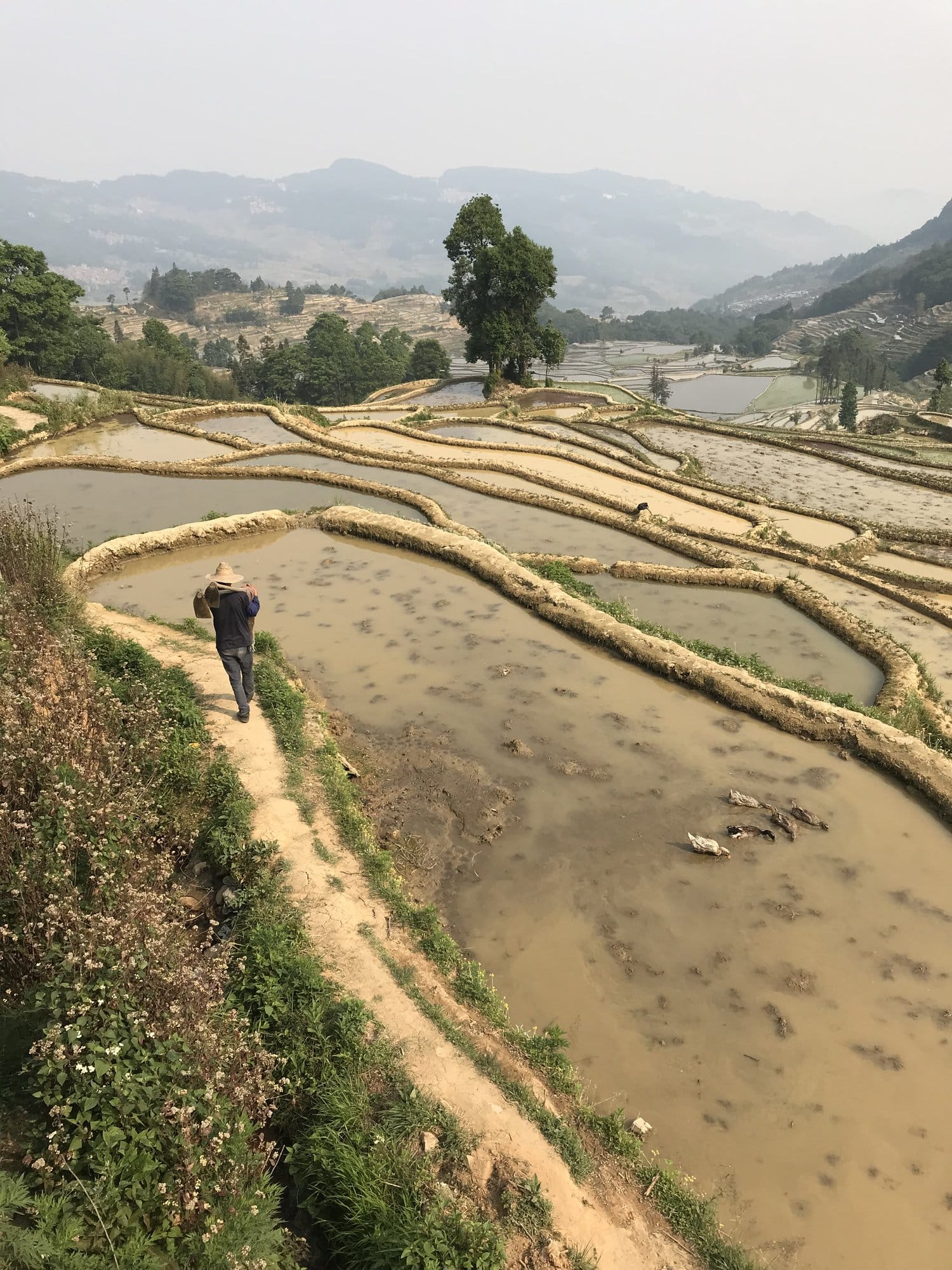
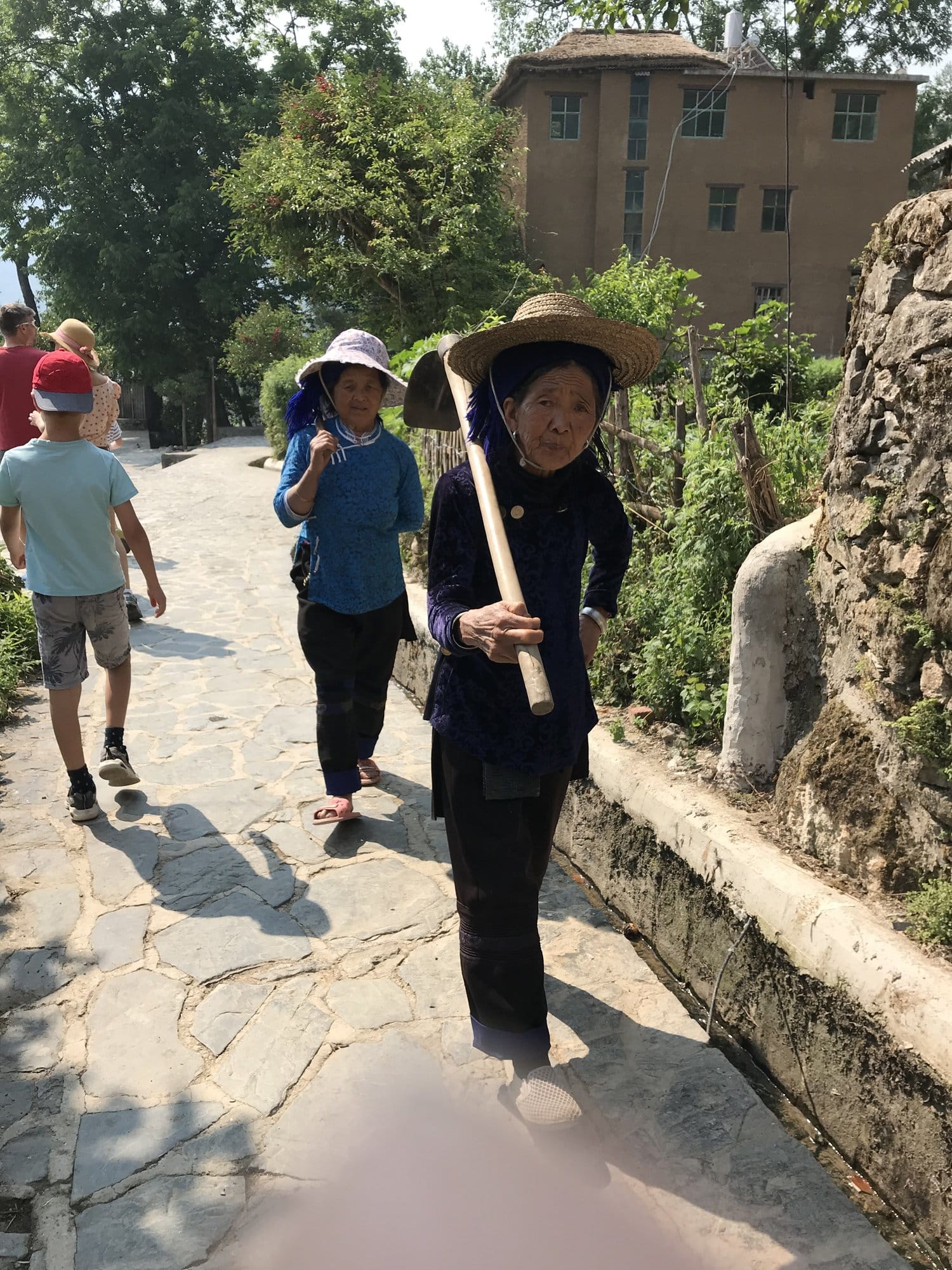
Go early. The light is better, the heat has not arrived, and you will cross villagers heading out to work with hoes over their shoulders — which is the best possible answer to anyone who thinks these terraces are a museum piece. They are farmed, actively and by hand, by the families who live above them.
Wear shoes you do not mind ruining. The dykes are earth, they are often wet, and they are narrow.
The Villages at Ground Level
Spend an afternoon in a Hani village and the thing that strikes you is how much of it belongs to the animals.
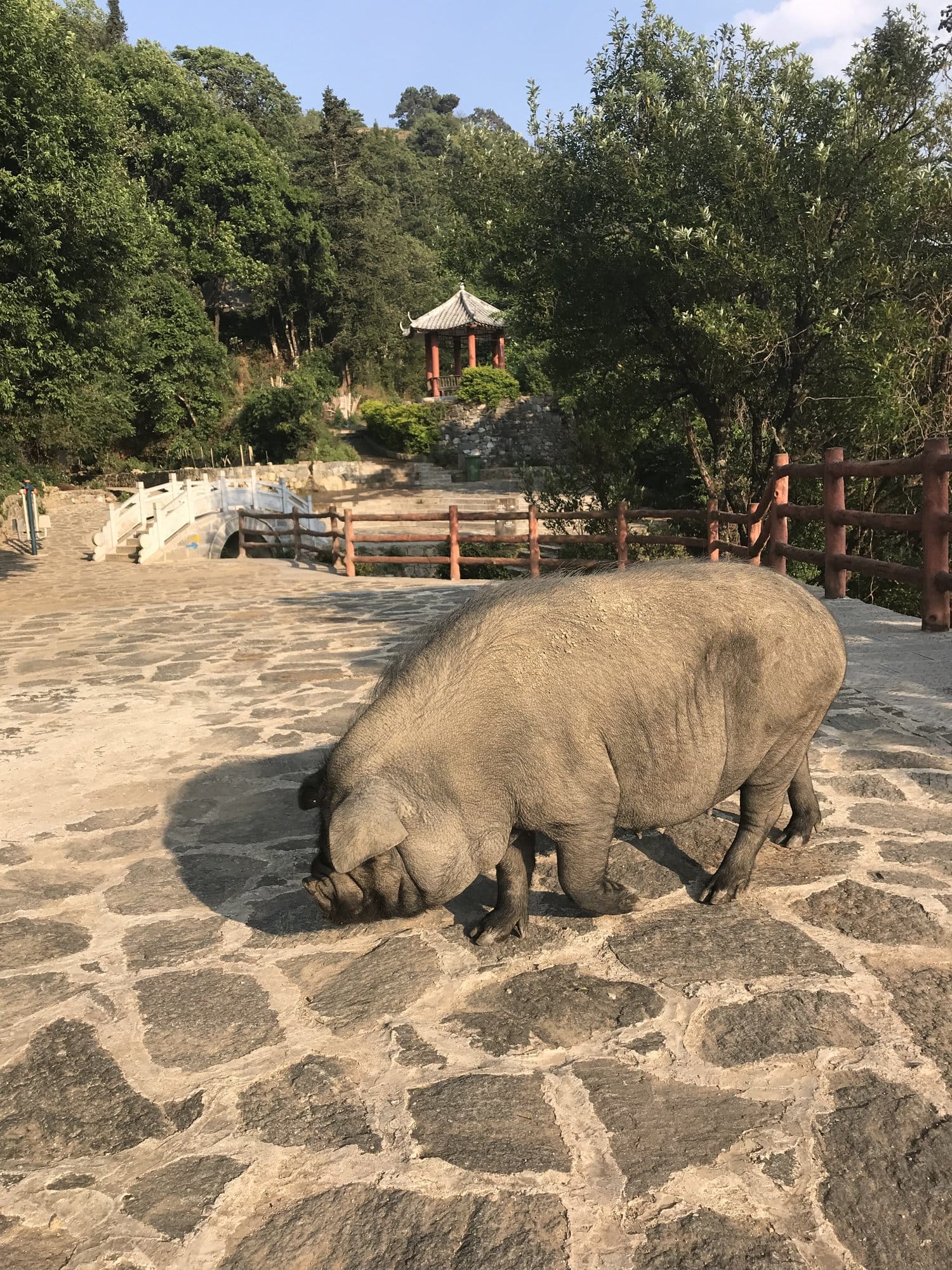
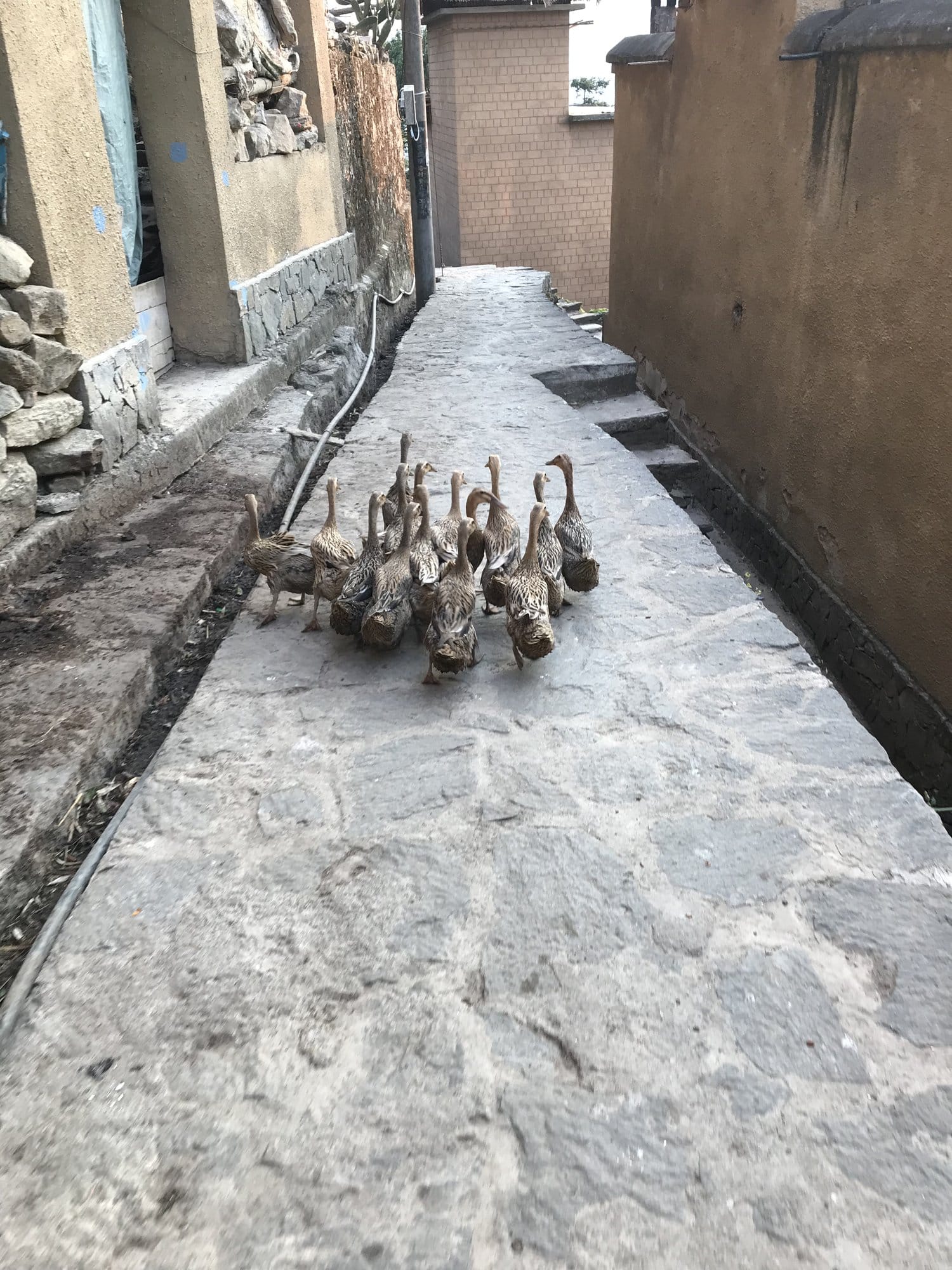
Pigs wander the lanes alone — large, entirely self-possessed, in no hurry. A sow will cross the main path with a line of piglets behind her while a rooster picks through the yard beside them. Follow a stone alley and you may find a dozen ducks marching up it in formation with nowhere in particular to be. None of this is decorative and none of it is aggressive. The animals are simply part of the village in a way that has mostly vanished from European countryside.
There is real work going on alongside it. Walls get repaired, mortar gets mixed, and the women do the same building jobs as the men — a detail worth noticing if you arrived with assumptions about rural China.
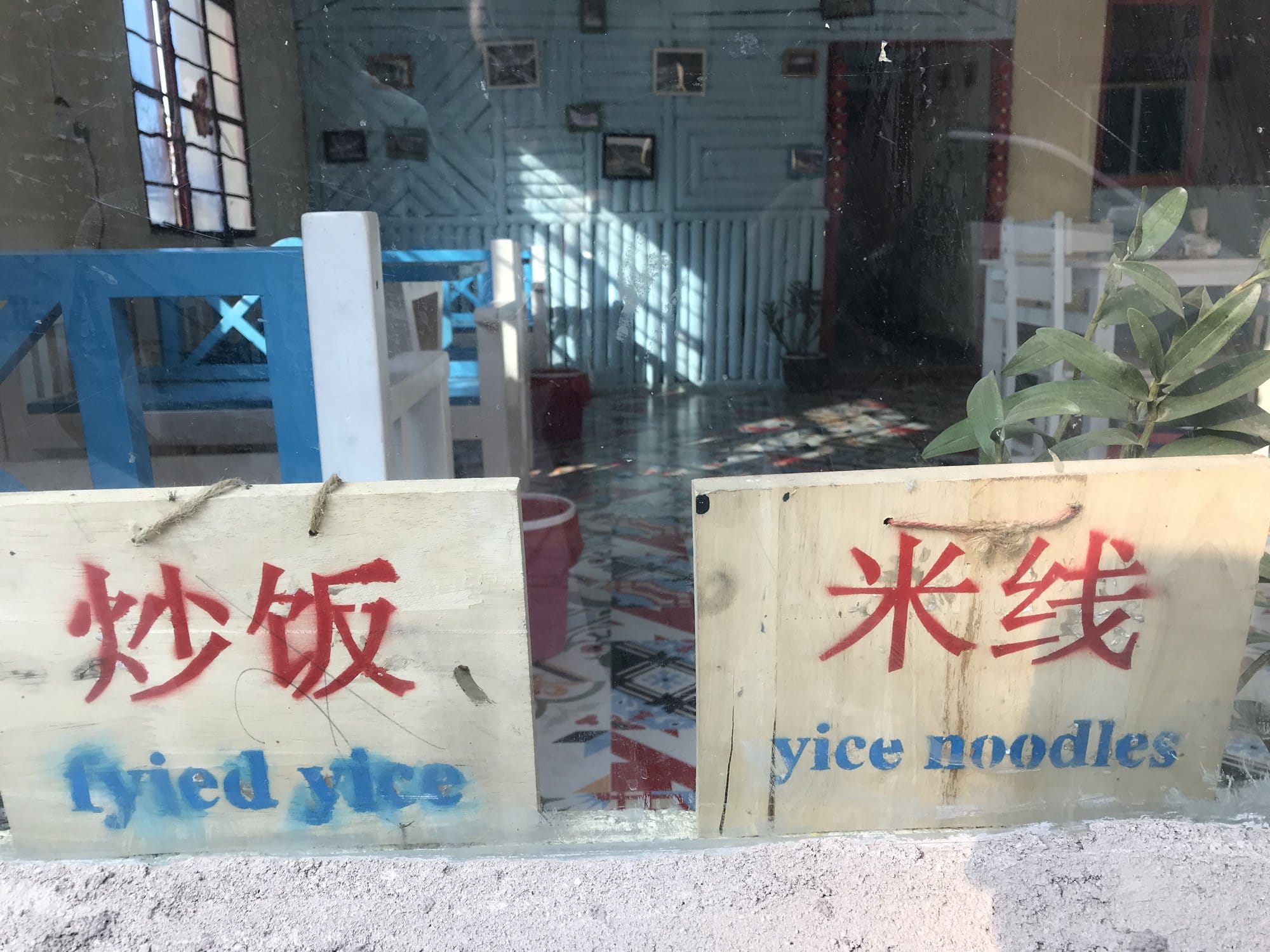
And there is food, which deserves a word. Village restaurants here are small, plain, and reliably good. One near the Duoyishu platform advertises fyied yice and yice noodles on two hand-painted boards, the R gently replaced by a Y throughout. The fried rice is excellent. The lesson is one that holds across the whole of Yunnan: the places with the least convincing English signage tend to have the best food.
Getting to Yuanyang
There is no airport at Yuanyang and no railway station in the terraces themselves. Everything arrives via Kunming, and the last stretch is always a bus or a car.
Via Jianshui — the most pleasant option, and the one that lets you add a second destination. High-speed trains run from Kunming to Jianshui several times a day and take between two and a half and three and a half hours. From Jianshui station it is a short hop to the bus terminal, and buses to Yuanyang leave roughly every half hour through the day, taking around three hours. Jianshui is worth a night in its own right, which makes this the route to choose if you have the time.
Via Mengzi — bullet trains from Kunming take under three hours, then a bus of two to two and a half hours to Xinjie.
Direct by bus — a handful of daily departures from Kunming's south coach terminal run straight through to Xinjie in around six and a half hours. Simplest, longest, least flexible.
Whichever you choose, budget six to seven hours door to door from Kunming and do not plan to arrive and catch sunrise the same morning. Schedules and fares change; check current times when you book rather than relying on any published timetable, including this one.
From Xinjie, the viewpoints are up on the ridge and you will want a driver, a shared van or a scooter. Guesthouses arrange this routinely and it is usually simpler to ask yours than to negotiate at the bus station.
Practical Information
Tickets. The terraces are a ticketed scenic area with a combined ticket covering the main viewpoints. Check the current price and validity when you arrive — it has changed more than once.
Altitude. The viewpoints sit at roughly 1,800 to 1,950 metres. High enough to be cold at dawn, not high enough to raise altitude concerns for most people.
Translation. English is close to non-existent once you leave the main guesthouses, and a translation app is genuinely useful. Download an offline language pack before you travel: Google Translate's online service does not work in mainland China, though its offline pack does if you install it in advance. Apple Translate, Microsoft Translator and Pleco all work offline too.
Money. Mobile payment is standard everywhere, including village shops. Carry some cash as a fallback for the smallest places and for the bus.
Drones. The terraces are extraordinary from the air, and the light at dawn makes them more so. Two warnings. Check the current rules on flying in China before you travel, including registration requirements and restrictions over scenic and heritage areas. And be careful of the wind: valley gusts here are strong and unpredictable, and a drone caught in one can be carried a long way before you get it back.
How long to stay. Two nights. One gives you a single sunrise and no second chance if the valley is misted in.
Frequently Asked Questions
When is the best time to see the Yuanyang rice terraces? For flooded terraces and reflections, the winter months through early spring. For green terraces, late spring into summer. At the shoulder, in the weeks when transplanting is under way, you can see both on the same hillside.
Which is the best viewpoint? Duoyishu for sunrise, Bada for sunset, Laohuzui for drama. If you only have one morning, make it Duoyishu.
Can you visit Yuanyang as a day trip from Kunming? Not realistically. It is six to seven hours each way, and the whole point is the light at dawn.
Is it suitable for children? Yes. The viewpoints are accessible platforms, the village walks are gentle, and the animals in the lanes are a genuine draw for younger children. The early alarm is the hardest part.
How many nights do you need? Two, ideally. One night is a gamble on the weather.
More to Explore
<!-- BOOKMARK CARDS — grouped here, never mid-article -->