
Southern Morocco Itinerary: A 12-Day Family Road Trip
Our full 12-day southern Morocco family itinerary, from Essaouira's medina and Atlantic surf to the Anti-Atlas around Tafraout, the canyon pools of Aït Mansour and the art-deco coast around Sidi Ifni.

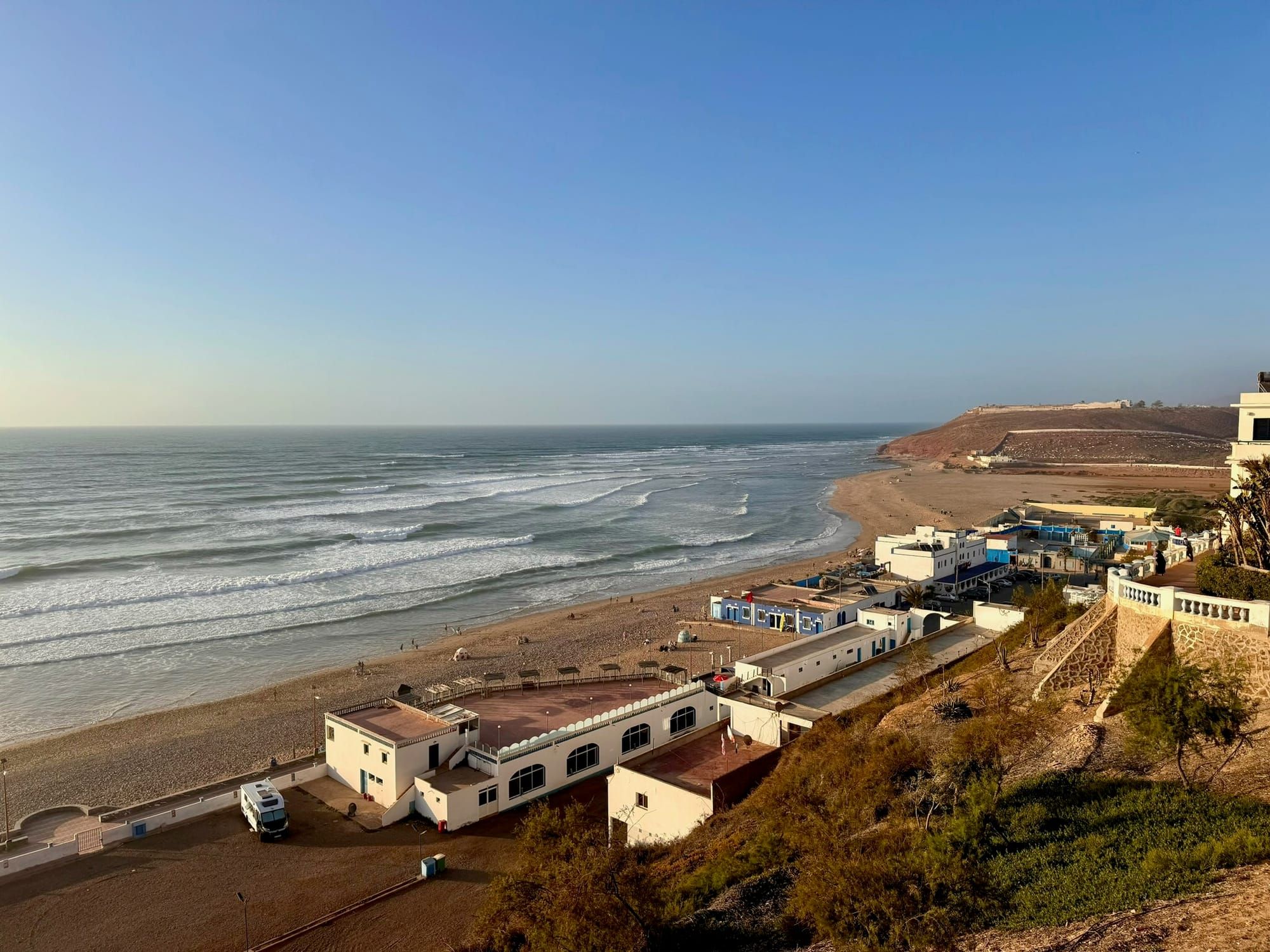
Picture this: ten days on a single Atlantic coast where the light goes from cool and grey in Essaouira at breakfast to emerald-in-red-canyons by mid-afternoon, and pastel art-deco rooftops by sunset. This is the southern Morocco most first-time visitors never see — and it is, for our money, the best two weeks you can spend in the country with a family.
We drove this loop with our family and friends in late April and early May, flying into Essaouira and out of Agadir on an open-jaw ticket. Two Dacia hatchbacks, two families, twelve days and roughly 1,500 kilometres later, we came home convinced this is the southern Morocco itinerary we will be recommending for years. Here's the full 12-day plan, along with the practical details you need to make it work.
Bookings: Some of the links in this article are affiliate links. This means that if you choose to make a booking, we will receive a small commission at no extra cost to you. Thank You!
Why Southern Morocco — and Why This Route
Most people's first Morocco trip takes them through the big imperial cities (Marrakech, Fez, Chefchaouen) and maybe out into the Sahara. All of that is worth doing, but the Atlantic south is an entirely different country: cooler, quieter, less hustled, and visually unlike anything else in Morocco.
Our logic on this route was simple:
**Cool coastal air** in Essaouira and Sidi Ifni — essential when travelling with kids in spring and early summer. One big contrast halfway through — the granite Anti-Atlas around Tafraout — to break up the beaches. **An optional slow week** (yoga retreat, surf, hammam) built into the start, so the adults can peel off and recharge while the rest of the group stays near Essaouira. An open-jaw flight (Essaouira-in, Agadir-out) to avoid doubling back on the long Essaouira–Agadir drive.
The result is a loop that works for families with kids from around seven upwards, and that does not require any 4x4 driving, any Arabic, or any tour operator. Two rental Dacias handled the whole thing with ease.
The 12-Day Southern Morocco Itinerary
| Day | Base | Highlights |
|---|---|---|
| 1 | Essaouira | Arrive, settle into riad, medina sunset |
| 2 | Essaouira (south coast) | Sidi Kaouki, Smimou sunset + camels |
| 3 | Essaouira | Split week begins — yoga retreat starts / Essaouira exploration |
| 4 | Essaouira | Hammam, port fish sandwiches, Chez Fatima tajines, kids' football at the port |
| 5 | Essaouira | Diabat + Jimi Hendrix café, bivouac night |
| 6 | Essaouira / Douar Noujoum | Yoga retreat ends with beach bivouac; group reunites |
| 7 | Tafraout | Long drive east (via Agadir bypass); first Berber village walk |
| 8 | Tafraout | Chapeau de Napoléon, Painted Rocks, Amtoudi canyon |
| 9 | Tafraout | Souk day, pool afternoon, sunset on the Anti-Atlas |
| 10 | Aït Mansour | Southbound canyon drive, natural pools |
| 11 | Sidi Ifni | Descent to the coast, art-deco rooftops |
| 12 | Mirleft / Agadir | Legzira, Mirleft rugs, drive to Agadir for evening flight |
The itinerary has plenty of slack built in — you can skip Amtoudi if you are tired of driving, extend Essaouira by a day if you love the medina, or push Mirleft into a full extra night if surfing is your priority.
Days 1–6 — Essaouira and the Split Week
The first six days are anchored in Essaouira. This is the most flexible part of the trip and the part where a good riad makes a real difference.
If everyone in your group is up for it, Essaouira is endless: medina walks, sunsets at Smimou with camel caravans on the beach, surf at Sidi Kaouki, fresh fish plates at the port, and short excursions to Diabat's Jimi Hendrix Café. For a group that wants a genuine change of pace, consider building a yoga retreat into the week — we stayed at Douar Noujoum, a walled eco-lodge 15 minutes inland from Essaouira that hosts yoga retreats ending with a beach bivouac and camel-ride at dawn. Half the group did the full retreat while the others stayed in town; the two storylines made for one of the richest travel weeks we have had as a family.
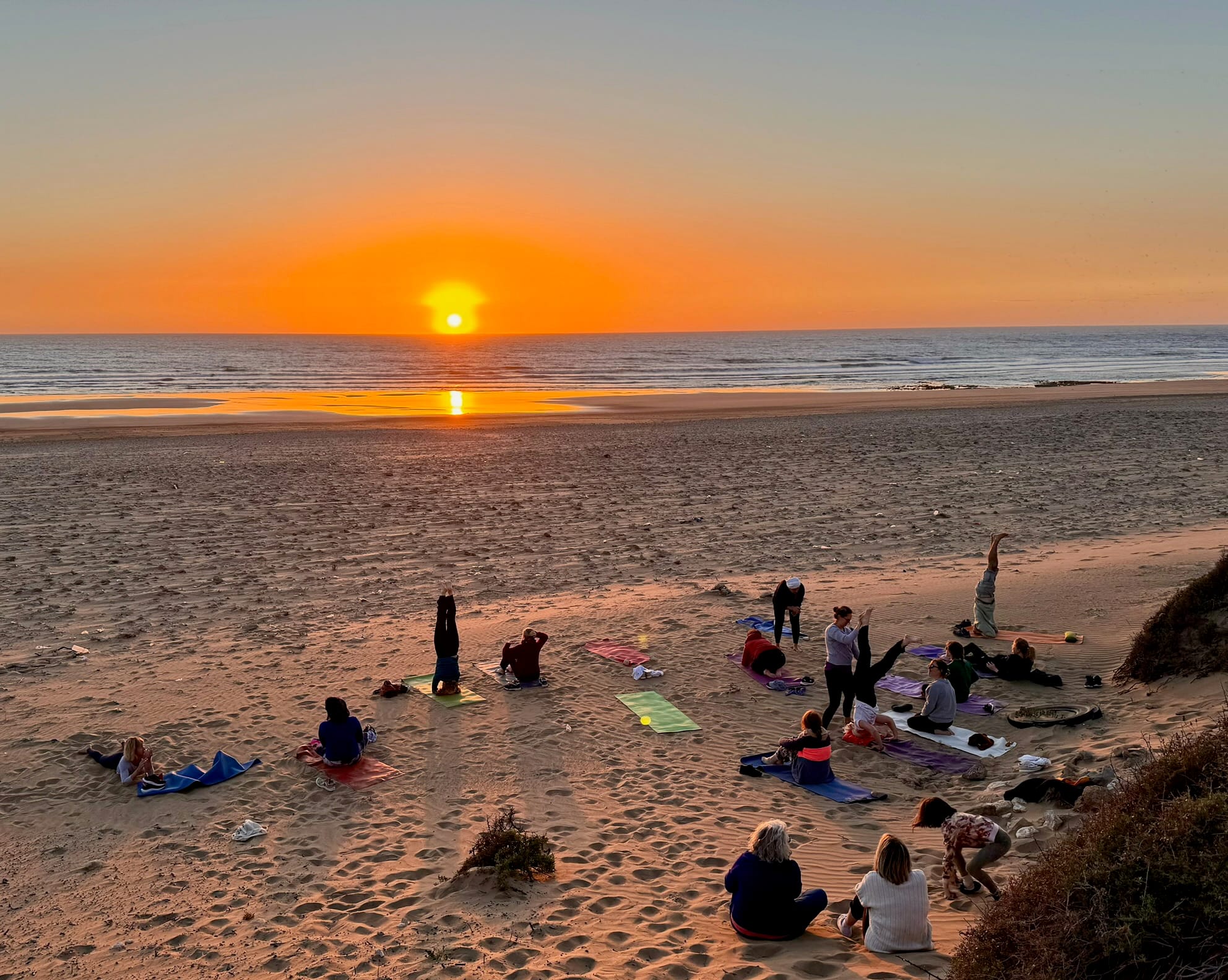
For a full breakdown of what to do with this base — from port fish plates to Smimou camel sunsets — see our dedicated Essaouira guide:
Day 7 — Transition to the Anti-Atlas
Day seven is the big driving day: Essaouira to Tafraout via the Agadir bypass is about six hours, broken up nicely by a lunch stop on the coast between Tamri and Imsouane.
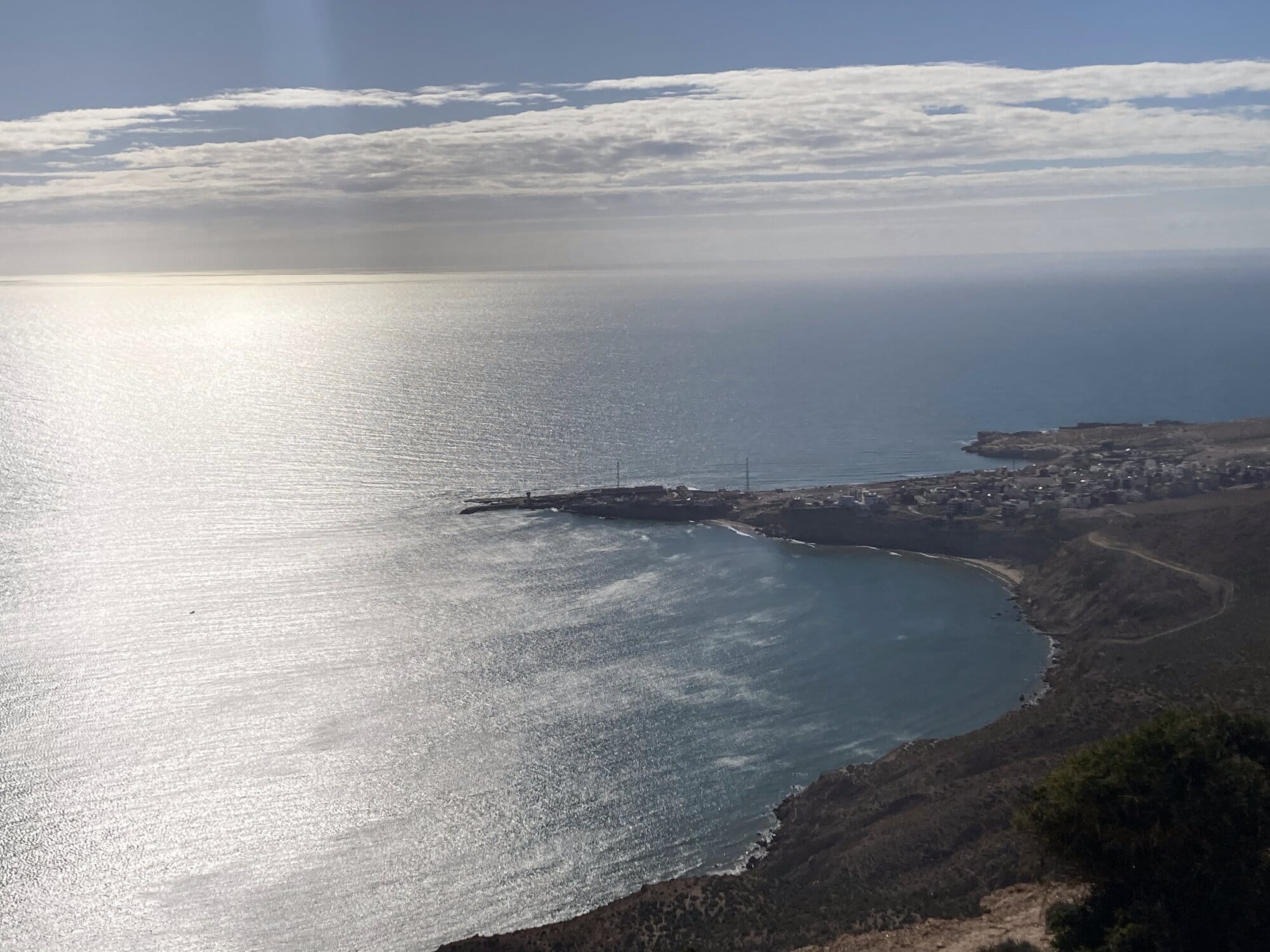
The small harbours between Tamri and Imsouane are a worthwhile break — quiet fishing ports carved into the cliff line, with tea cafés perched on the bluffs above. By the time you climb up into the granite basin around Tafraout in late afternoon, the pink-ochre town cupped in its boulder field is one of the most memorable arrivals in the country.
Days 7–9 — Tafraout and the Anti-Atlas
Three nights in Tafraout is the sweet spot. You need one day for the main highlights close to town — Chapeau de Napoléon, Painted Rocks, Ameln Valley villages — and a second for the longer drive out to Amtoudi and its palm canyon. A third night lets you slow down, enjoy a pool afternoon, and do the souk without rushing.
Days 10–12 — Canyons, Coast and Colonial Towns
From Tafraout, the route drops south and east through increasingly dramatic canyons to the Aït Mansour oasis and its emerald pools, then swings west to the coast at Sidi Ifni. By the time you reach the rooftops of Sidi Ifni for sunset, you will have covered three entirely different landscapes in a single day.
Day 12 is the drift back north — Legzira's sea arches, the rug stalls of Mirleft, lunch with a beach view — to Agadir for a late-afternoon or evening flight home. Budget a two-hour drive from Mirleft to Agadir airport, plus a buffer for Moroccan customs.
How to Get There — Flights and the Open-Jaw Trick
The single most useful booking decision on this itinerary is to fly open-jaw: in to Essaouira (ESU), out of Agadir (AGA). This saves you a full day of backtracking and keeps the drive moving forward the whole way.
Both airports have direct seasonal flights from Paris, London, Luxembourg and other European hubs. Check both cities independently and combine them — most airlines allow the open-jaw routing without a price penalty. compare flights to see what's available.
If Essaouira flights do not line up with your dates, fly into Marrakech (RAK) instead — it is a three-hour drive to Essaouira on the well-maintained N8, and Marrakech is worth a night on the way back if time allows.
Renting a Car in Morocco
You need a car for this itinerary. Public transport exists but it is slow, the distances are large and the detours (Aït Mansour, Smimou, Painted Rocks) are essentially impossible without your own wheels.
We rented two small Dacia Sandero hatchbacks — practical, cheap (around €25–€35 per day), and perfectly capable on every road we took. You do not need a 4x4 for any part of this route. If you are a larger group, consider booking two small cars rather than one large minivan: parking in medinas and navigating small mountain roads is significantly easier in a pair of compacts.
Hire a car at Essaouira or Marrakech airport and drop it at Agadir. One-way drop-offs within Morocco are widely available at reasonable fees.
A few practical driving notes:
Moroccan roads are good but narrow. Expect overtaking on blind curves and shared-lane behaviour — drive defensively. Fuel is cheap (around €1–€1.10 per litre of diesel in 2024). Fill up before long mountain stretches (Tafraout–Amtoudi in particular). * Police checkpoints are common and almost always friendly. Have passports and rental papers to hand.
Where to Stay Along the Route
Use our interactive map to find accommodation across the whole route. Zoom in on the area that interests you most.
Our rough suggestions by leg:
**Essaouira (5 nights):** a riad in the medina if you want atmosphere, or Douar Noujoum in the countryside if a retreat appeals to half your group. Tafraout (3 nights): a small hotel on the edge of town with a pool and a view of the granite ridges. **Aït Mansour (1 night, optional):** a few guesthouses exist in the canyon itself, but many travellers skip the overnight and do the canyon as a long day between Tafraout and Sidi Ifni. Sidi Ifni (2 nights): a small hotel with a rooftop in the old town. * Mirleft (1 night, optional): a surf-oriented guesthouse if you want a final beach day before Agadir.
Budget around €80–€120 per night for a comfortable family room through the whole route, a little more in Essaouira and a little less in Tafraout. Compare Morocco hotels on Trip.com to see current prices.
Best Time to Visit
Southern Morocco has a long shoulder season. October to early May is the sweet spot: warm sunny days (20–28°C), cool nights, minimal crowds and comfortable walking weather everywhere. We visited in late April and found it close to perfect.
Summer (June–September) is not impossible but is best avoided for this exact itinerary — the Anti-Atlas and Aït Mansour can hit 40°C by midday, and the kids will wilt. Winter (December–February) is crisp and beautiful inland, though evenings can be cold in Tafraout (single-digit Celsius) and Atlantic swell on the coast can limit swimming.
Southern Morocco in Winter: What Changes
We drove this route in late April, but the same loop works very well from November to February with a few adjustments.
- Weather: the coast stays mild, around 18–22°C by day around Agadir and Sidi Ifni, while Essaouira is cooler and windier. Inland, Tafraout gets cold at night, often dropping to single digits.
- Daylight: the sun sets around 18:00 in December, so plan shorter driving days and avoid mountain roads after dark.
- Sea: the Atlantic swell is bigger in winter. Legzira and the Sidi Ifni coast are spectacular, but swimming is often off the menu.
- Almond blossom: around Tafraout, the almond trees usually flower in late January and February, one of the best reasons to come in winter.
- Prices and crowds: outside Christmas and New Year, the south is quiet and good value, and many riads and guesthouses lower their rates.
Budget for Two Weeks
Southern Morocco is one of the best-value destinations on the Atlantic. A rough budget for a family of four for 12 days, excluding flights:
**Accommodation:** €80–€120 per night × 11 nights = €880–€1,320 Car hire (two small cars): ~€600 for 12 days **Fuel:** ~€180 for 1,500 km Food: ~€35–€45 per person per day × 4 people × 12 = €1,680–€2,160 **Activities (surf lessons, hammams, tour tickets):** ~€250 Total: around €3,600–€4,500 for a family of four over 12 days
Eating locally — tajines, port fish, street beignets — keeps the food budget at the lower end without compromising on experience.
What to Pack
**Light layers.** Temperatures swing from 12°C in a Tafraout evening to 28°C in a canyon afternoon. Good walking shoes. Rocky canyon floors, uneven medina streets, sandy beaches — nothing technical, but no sandals. **Swimsuits.** Aït Mansour pools, Sidi Kaouki surf, hotel pools everywhere. Sun protection. The Anti-Atlas sun is intense even in April. **A day pack with water bottles.** Refill where you can — tap water is not drinkable but many hotels provide filtered water. A small Arabic/French phrasebook or app. English is patchy once you leave Essaouira; French is widely spoken; Berber is the first language in Tafraout.
Practical Information
Money
The Moroccan dirham is closed outside Morocco — withdraw from ATMs on arrival. Cards are accepted at mid-range hotels and bigger restaurants, but everywhere else is cash. Bring a mix of small notes for tips and parking (usually 5–10 dirhams).
SIM Cards & Data
Maroc Telecom and Inwi both sell tourist SIMs at Agadir and Essaouira airports for around €10, including 20 GB of data. Coverage is excellent along the whole route, including in Aït Mansour and Amtoudi canyons.
Safety
Southern Morocco is very safe by most measures. The usual big-city considerations (watch your wallet in Marrakech, do not flash expensive electronics) apply less here — it is a calmer, slower part of the country. Women travellers often find the south more relaxed than the imperial cities.
Language
French is the working language for tourists — restaurants, hotels and car hire will all work comfortably in French. Berber (Tashelhit) is the first language in the Anti-Atlas; Arabic in Essaouira and Sidi Ifni. A few Arabic greetings (salam alaykum, shukran) go a very long way.
FAQ
Q: Can I do this itinerary in 10 days instead of 12? A: Yes, but you will have to drop one of the softer days. The fastest way to compress is to cut one night from Essaouira and one from Sidi Ifni. Do not cut Tafraout below three nights — the drive does not pay off otherwise.
Q: Is this route suitable for kids under 7? A: It can be, but the driving days are long. For younger kids, consider halving the route — a full Essaouira week plus a few days in Tafraout, skipping the southern coast — and flying in and out of Essaouira.
Q: How does this compare with a Marrakech–Sahara classic route? A: Completely different feel. The Atlantic south is cooler, quieter and much easier to drive. The Sahara route gets you the dunes, the imperial cities and a more "iconic" Morocco trip; this route gets you the Morocco that locals go to when they want to breathe.
Q: Can I add a night in Marrakech at the end? A: Easy — drive back from Agadir to Marrakech in three hours, or fly the short hop. Marrakech is a very different register after this kind of slow coastal trip; a single full day and one night is plenty.
Q: What about a yoga retreat — is it worth splitting the group like that? A: In our experience, absolutely. Douar Noujoum ran a full week-long retreat with our friends that ended in a beach bivouac; the rest of us had our own Essaouira week. Both groups came back with a better trip than we would have had all doing the same thing.
More to Explore
If southern Morocco's slow pace and mix of coast, canyon and culture has clicked for you, these guides cover some of our other favourite family road trips: