
Kashgar: Old Town, Bazaars and the Sunday Livestock Market
Green tiles, arcaded lanes, coppersmiths and a Sunday morning of yaks changing hands — four days in the far west of China, where the map runs out and Central Asia begins.

Look at where Kashgar sits and the trip starts to make sense. It is closer to Bishkek than to Beijing, and by the time you get off the train you have crossed more longitude than most people cross in a year. We arrived on the overnight service from Turpan, four of us and two boys aged nine and six, with the guide who travelled with us every day of the trip.
We had four days here, with the drive up the Karakoram Highway taking the middle of them. What was left — the mausoleum, the old town, the bazaar, a natural arch in the hills and a Sunday morning among the yaks — is the part of the trip our boys still describe first.
Arriving in the Far West
The night train from Turpan covers around 1,400 kilometres, exactly the sort of distance a bunk solves and a bus does not. You go to sleep below sea level and wake on a dusty plain at about 1,300 metres, ringed on three sides by mountains you cannot yet see.
Kashgar has been a junction for as long as the Silk Road has had junctions: the northern and southern rims of the Taklamakan meet here before the road climbs into the Pamirs. Modern Kashgar is a large Chinese city with the usual ring roads and tower blocks, and the parts you have come for sit inside that, compact enough to cover on foot over two days.
The whole nine-day run west is set out in our Silk Road China itinerary.
The Afaq Khoja Mausoleum
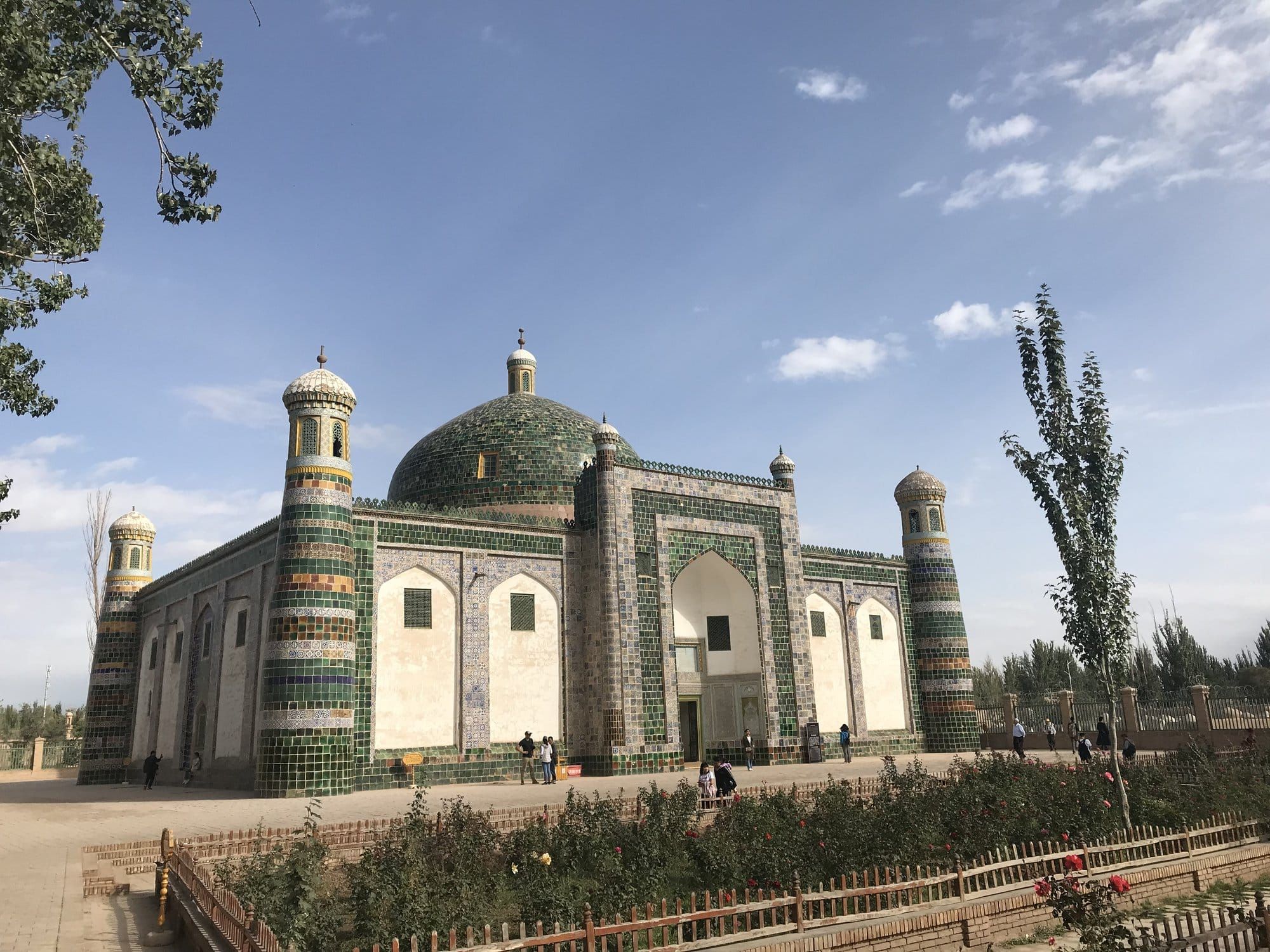
The mausoleum on the north-eastern edge of the city is the one building everyone photographs, and it deserves the attention. A broad dome and four slim minarets, faced in glazed tiles that run from bottle green to turquoise depending on where the sun is, above a garden of rose bushes. It reads as Central Asian rather than Chinese — the tilework belongs to the same family as Samarkand and Bukhara, not to anything further east.
It is a quiet, contained visit and a good first stop, mostly because it recalibrates your expectations. Whatever you were picturing of western China, this is the correction.
The Old Town on Foot
The old town is where we spent the most time, and it is not a single street but a grid of them, worth wandering without a fixed destination.
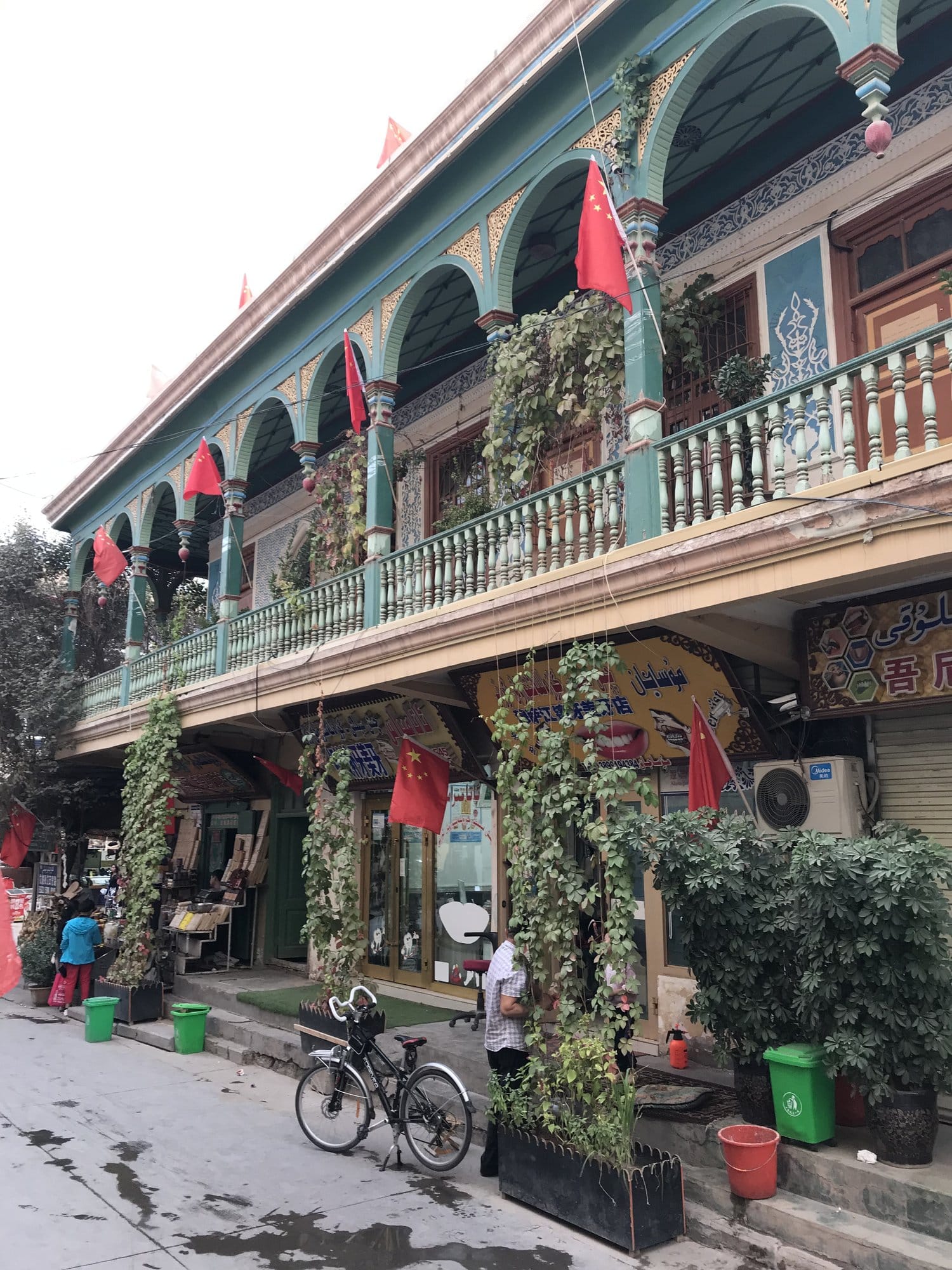
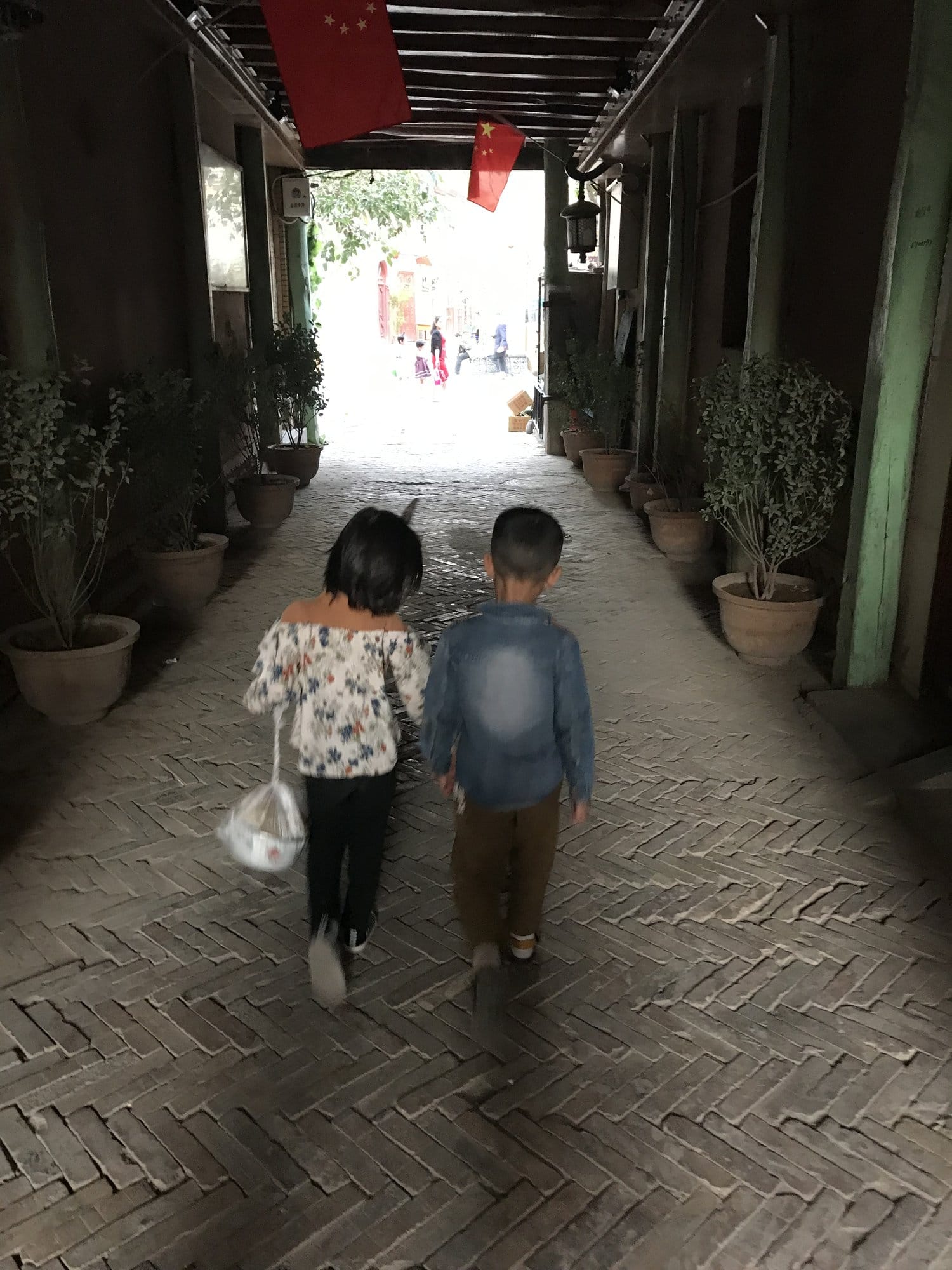
What stays with us is the woodwork and the colour. Arcaded galleries painted green and gold above the shopfronts. Carved wooden balconies overhanging the lanes. Covered passages paved in brick, cool after the glare outside, with potted plants along the walls and light coming down in strips.
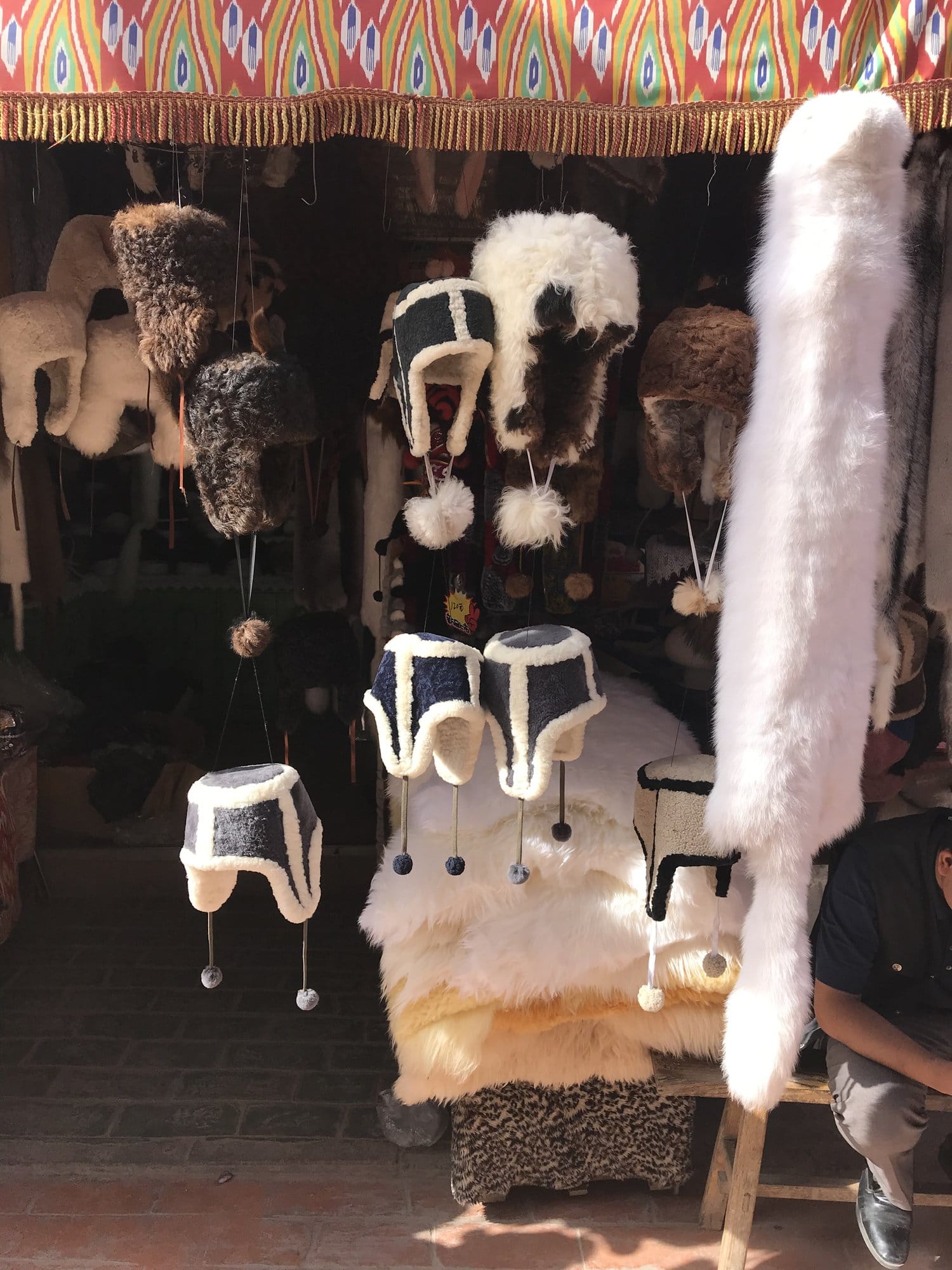
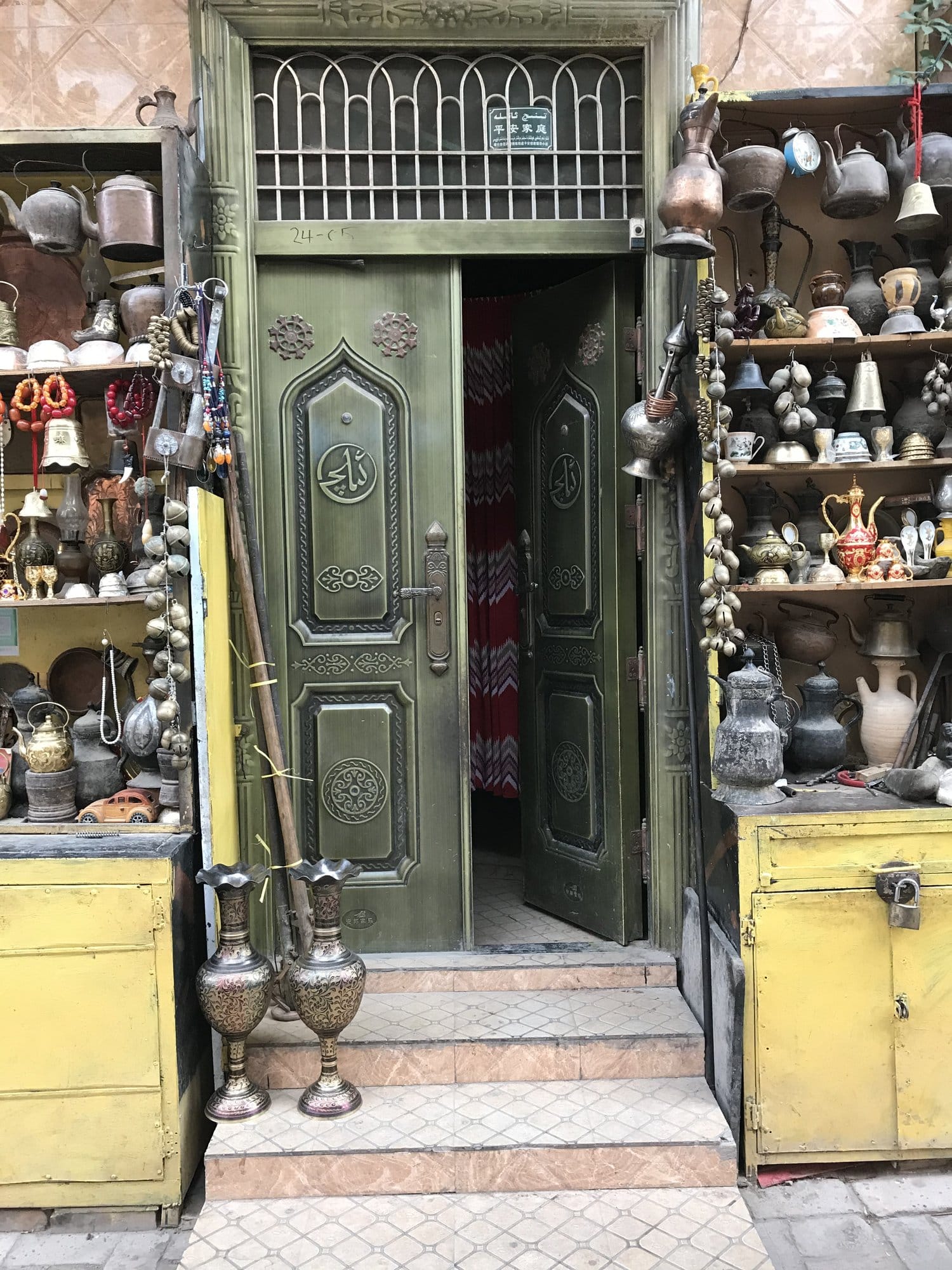
The workshops are the other half of it, and you hear them before you reach them. A run of coppersmiths' shops with the stock on shelves and stacked on the pavement: teapots with long curved spouts, bells, ewers, deep trays, all hammered and none identical. Elsewhere, stalls of fur hats hanging in rows under awnings printed in ikat patterns, pelts stacked below.
Large parts of the old town have been rebuilt in recent decades, and the debate about that is easy to find. What we can tell you is what walking it is like: slow, shaded, and far quieter a few lanes off the main axis.
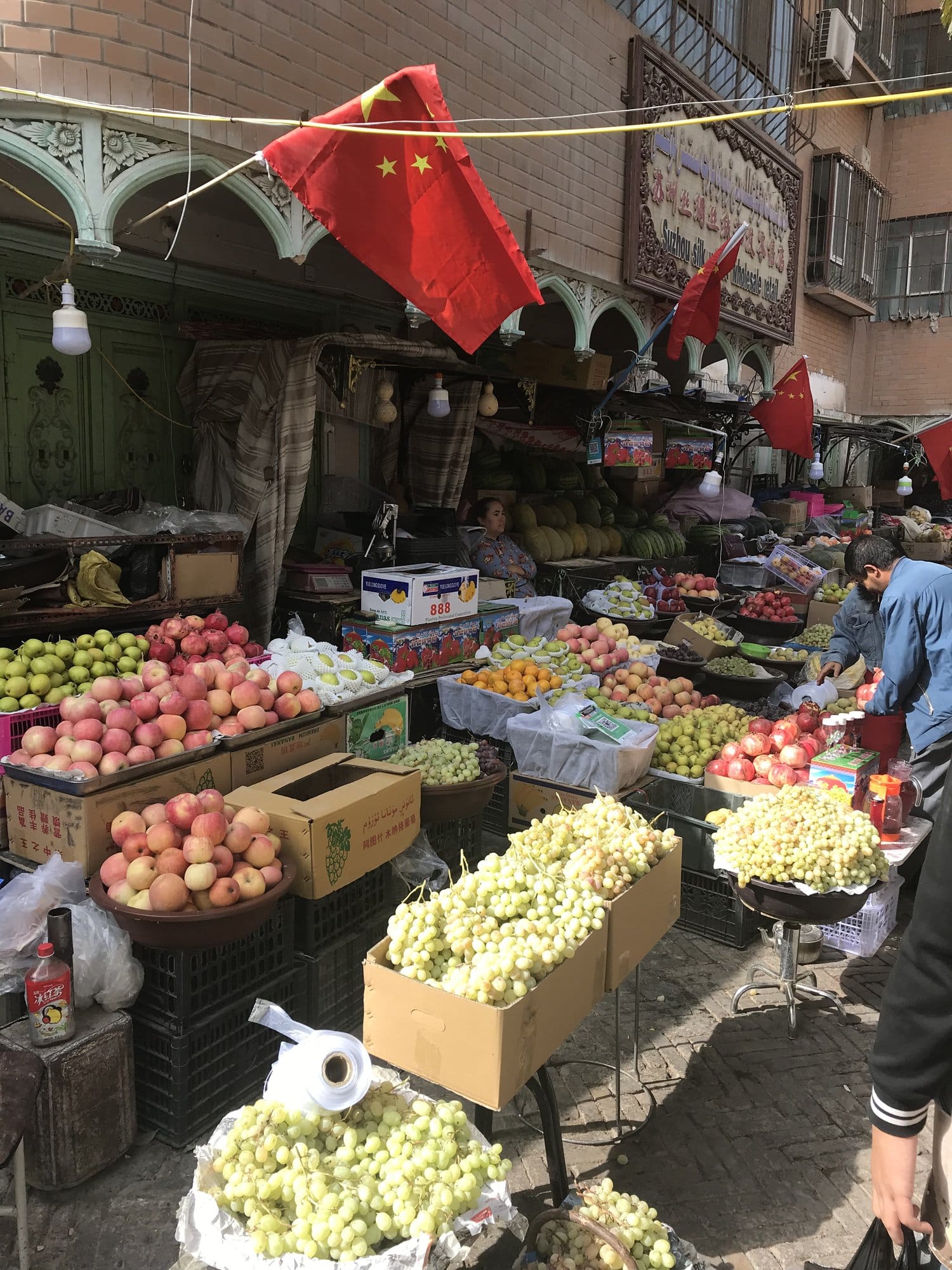
The Covered Market
The covered fruit market is small, dense and one of the best things about the city in early autumn. Apples in pyramids, white grapes by the crate, pomegranates split open to show the colour, melons crated above head height. The lighting is bare bulbs strung along the aisles, which does the produce no favours photographically and no harm at all otherwise.
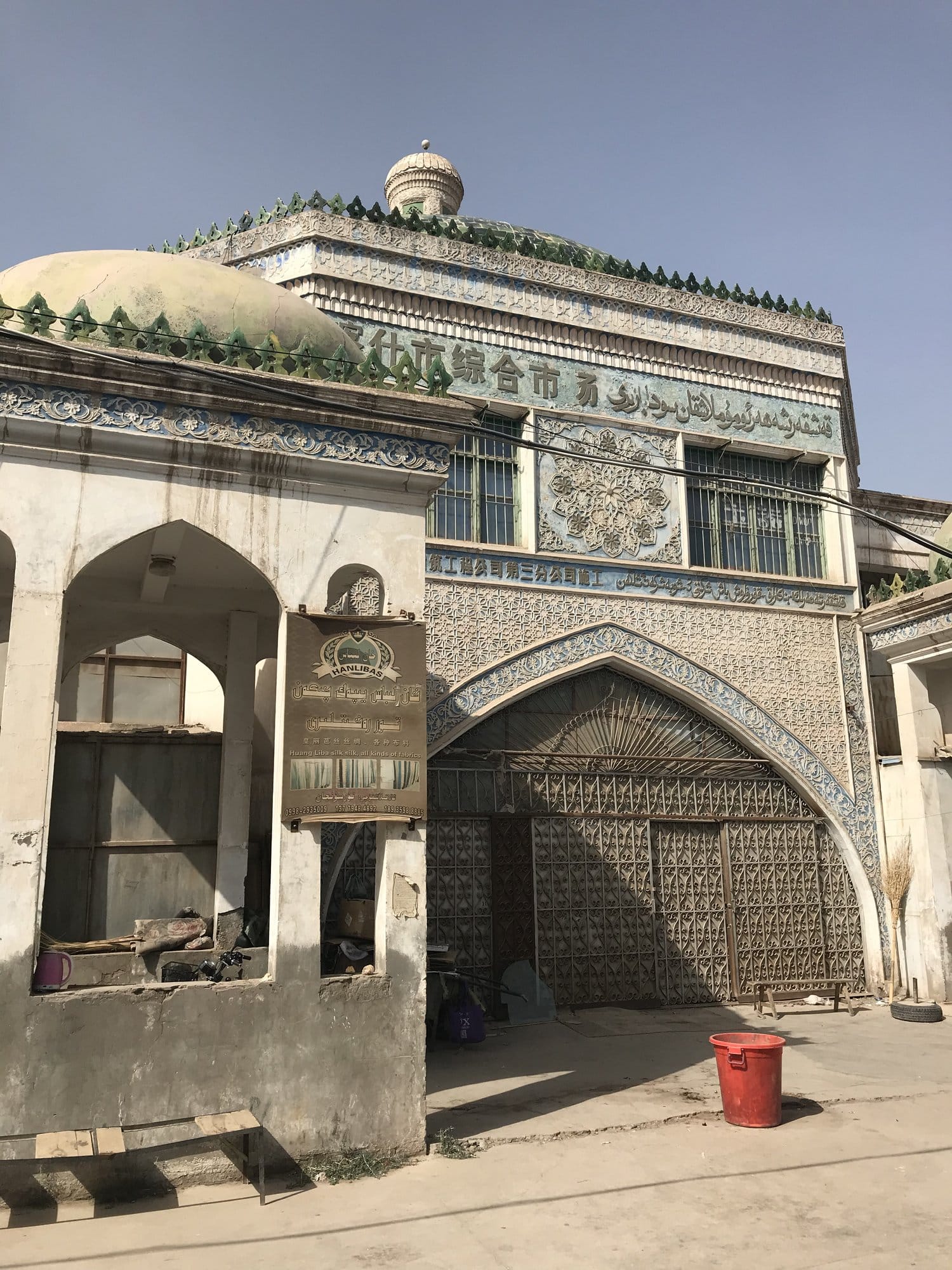
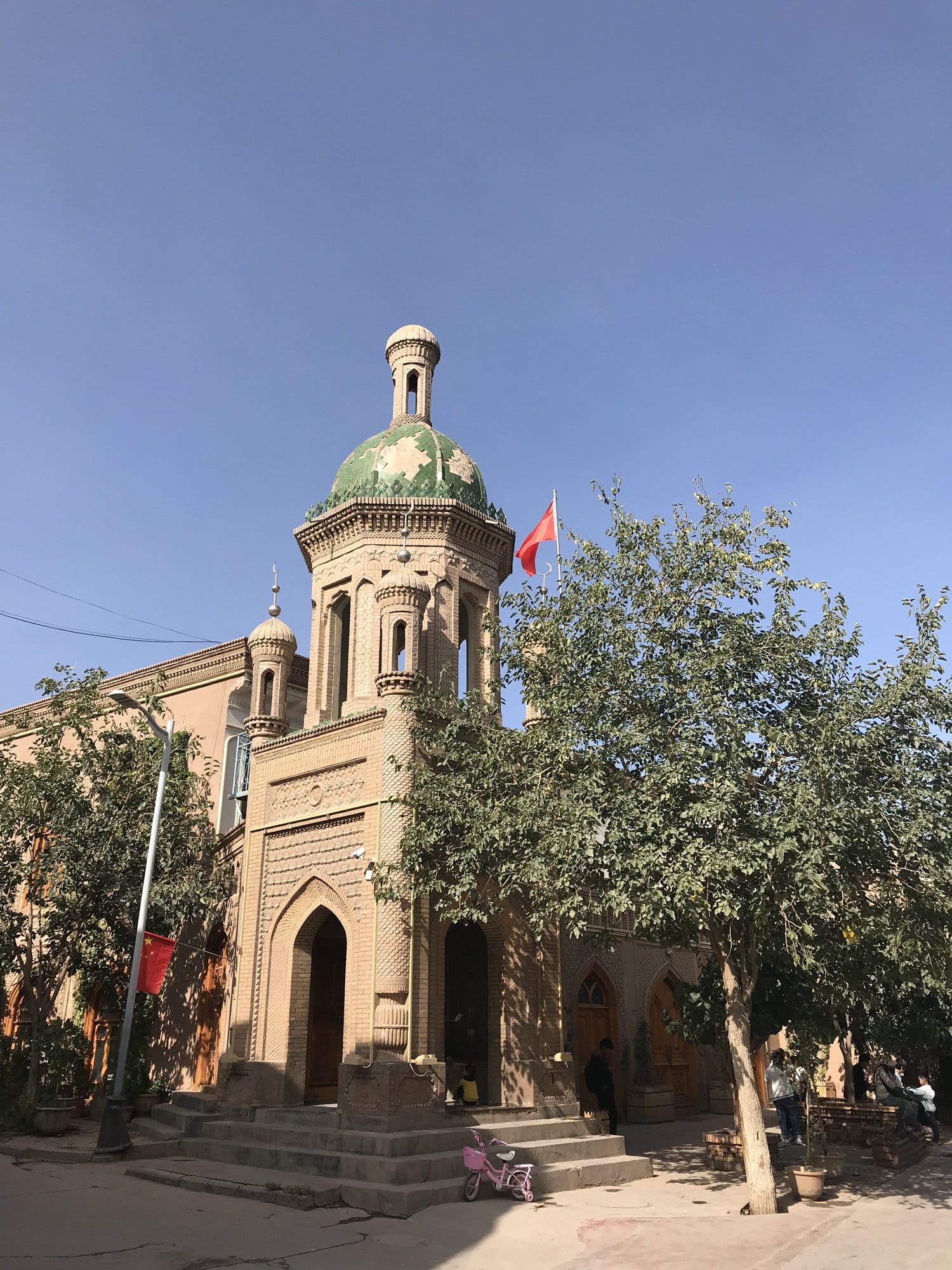
Xinjiang fruit has a reputation across China and, having eaten our way through several kilos of it, we understand why. Buy more melon than you think you can eat. The old market building is worth a look from outside even when the grilles are down: blue-green faience tiles, a small dome, a worked arch and a bilingual sign above it.
The Sunday Livestock Market
This is the one to plan around. The livestock market on the eastern edge of the city runs on Sundays — it always has, and it still does — and it is not a spectacle staged for visitors. It is a working market where animals change hands, and you are welcome as long as you stay out of the way.
We went on Sunday 6 October, our last morning. Pens of sheep packed tight. A rail with long-haired yaks tethered along it, shifting and stamping. Flanks felt, mouths opened to check teeth, and then negotiations conducted at length and clearly following rules we could not read. Dust, noise, poplars along the edge of the ground, and the smell of a great many animals in one place.
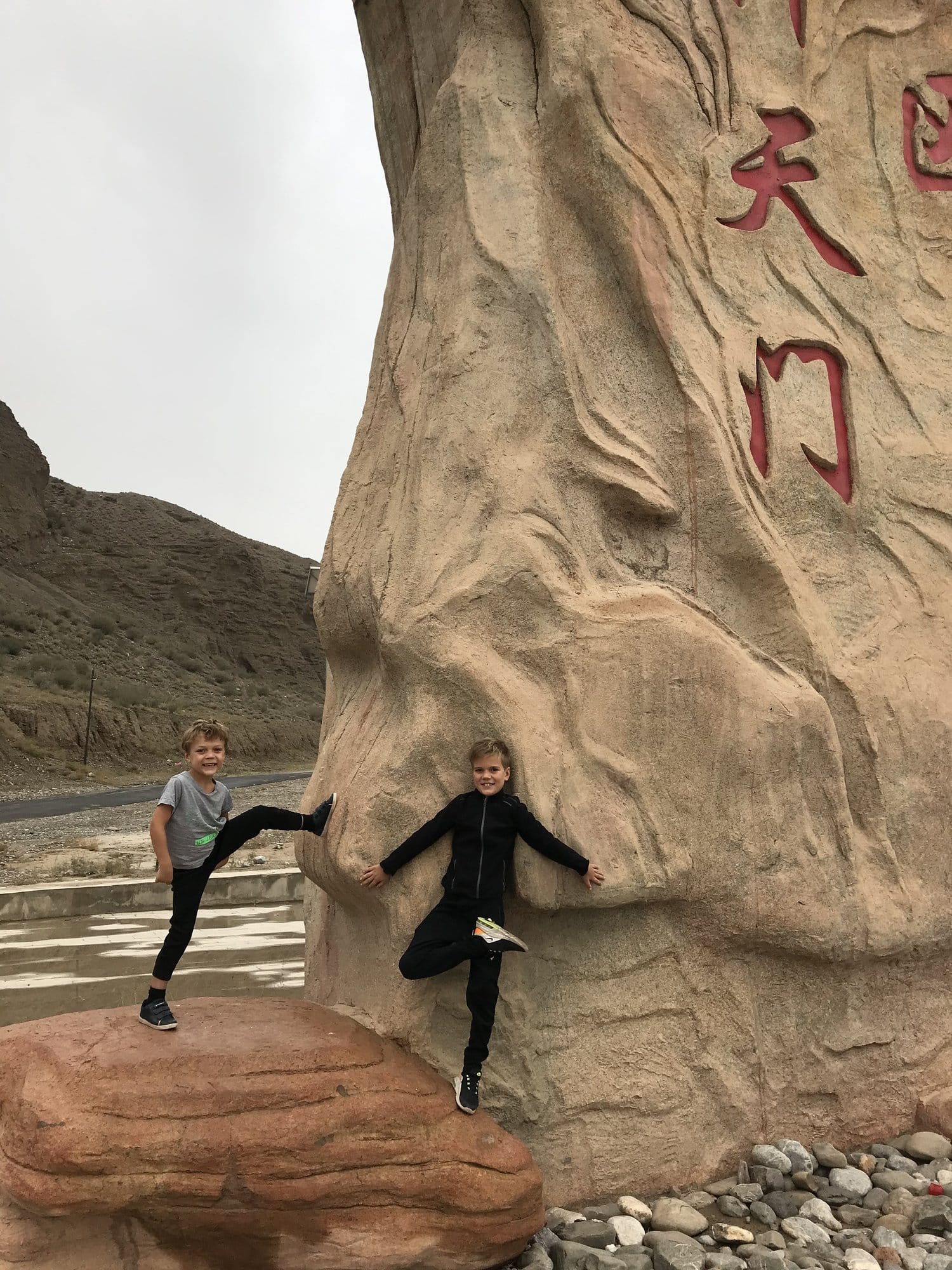
Our boys rated it the best hour of the nine days, which surprised nobody. Go early: the serious trading happens in the morning and thins out as the day goes on. Wear shoes you do not mind ruining.
Shipton's Arch
North-west of Kashgar, a day trip into the hills takes you to Shipton's Arch, or Tushuk Tash. The Chinese name is carved on a stone slab at the entrance: 天门, heaven's gate. Our boys spent a good ten minutes climbing that slab, which tells you how the day started.
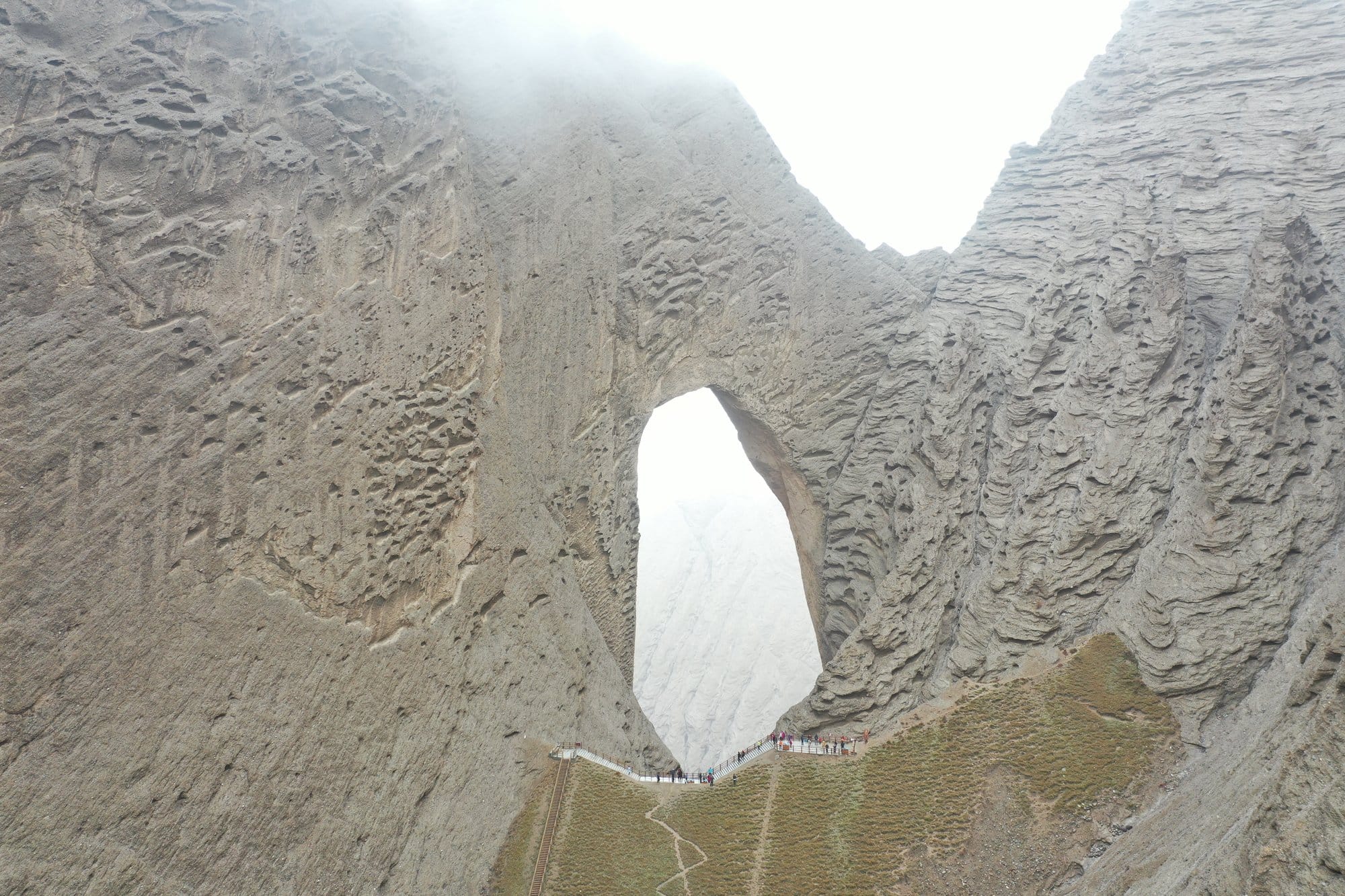
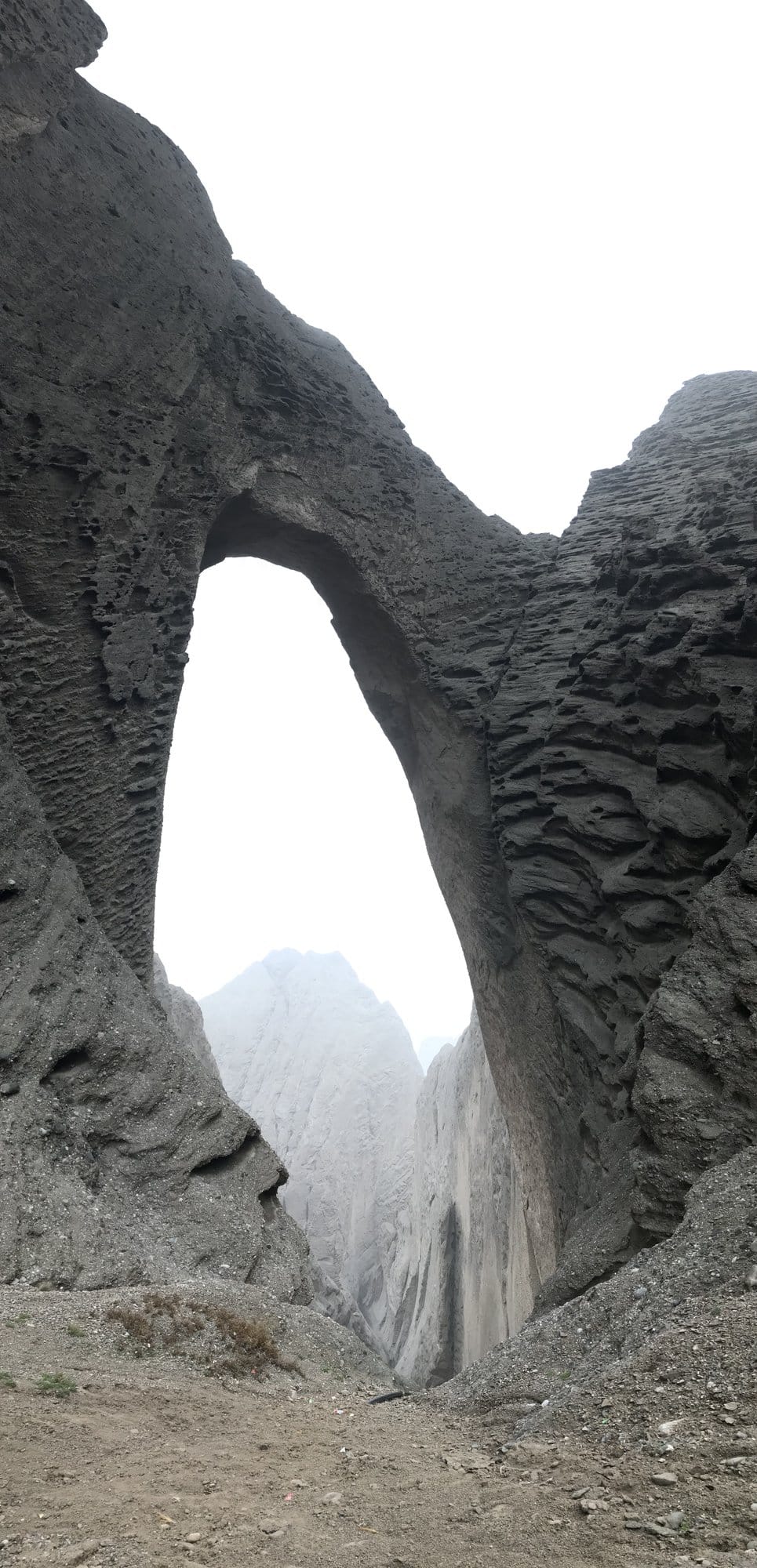
The arch itself is a vast span of grey conglomerate punched through the top of a narrow gorge, mist collecting in the corridor below it. It is often cited as one of the tallest natural arches on earth, and standing underneath it you do not feel inclined to argue. The approach has been built out with metal walkways and staircases up the gully, which makes it manageable with children and removes most of the route-finding that once made the place hard to reach. Allow most of a day.
Eating in Kashgar
Uyghur food barely overlaps with anything you will have eaten elsewhere in China. Flatbreads — nan — stacked in towers on the stalls, still warm and stamped in the middle. Skewers of grilled lamb. Hand-pulled noodles, stretched to order. Samsa baked against the wall of an oven. And fruit, constantly.
Then there was the polenta. Several times we were served something pale, dense and very slightly granular, sliced into rounds, and several times we ate it happily on the assumption that it was a local polenta. It was very good. It was, our guide eventually told us, goat lung — a lung stuffed with a flour-and-liquid batter, boiled and then sliced. The resemblance is genuine, and the discovery changed nothing except the story we tell about it. Order it. Ask afterwards.
When to Go, and the Week to Avoid
Late September and early October is the best window we can imagine for Kashgar: the heat has gone, the fruit season is at its peak, and the road south is still open. Spring works too; midsummer is brutal, and winter closes the high ground.
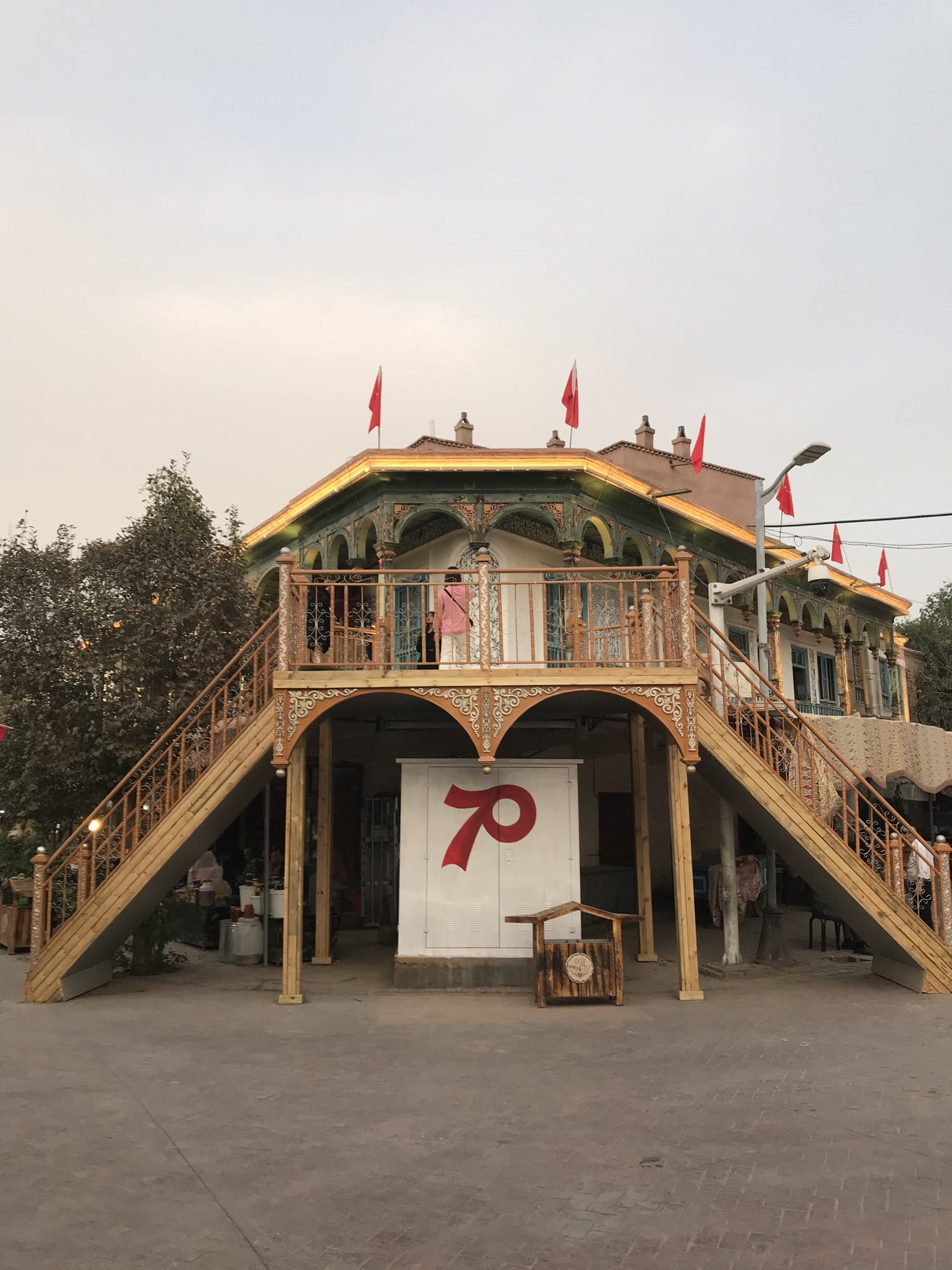
One caveat, and it is a calendar one. 1–7 October is China's National Day holiday, the busiest travel week of the year, and it is worth shifting your dates to miss it. We arrived on 2 October 2019, the day after the seventieth anniversary of the People's Republic, and the old town was still fully dressed for it — as many as ten flags on a single facade, and a large "70" sign near the wooden theatre house. That is not how the city normally looks, and it is not a week we would choose again: everything is fuller, and rooms and seats are harder to get.
Practical Information
Getting here. Kashgar has an airport with connections to Ürümqi and beyond, and the overnight train from Turpan is the classic approach. Let your agency handle the booking.
Getting around. The old town, the covered market and the mausoleum are close enough together for walking and short taxi hops; the livestock market and Shipton's Arch both need a vehicle.
How long. Two full days covers the city, three with Shipton's Arch — and make one of them a Sunday.
Context, and what to expect on the ground. Xinjiang is the subject of documented human rights concerns, set out in the assessment published by the UN Human Rights Office, and both the British and French foreign ministries give the region specific treatment in their travel advice. As a visitor you will meet frequent identity checks, airport-style screening at the entrances to markets and shopping centres, and a visible security presence. Carry your passport at all times, and do not photograph security installations, checkpoints or personnel — that instruction appears in official advice and is not one to test. We have set all of this out at length, including permits and where to stay, separately.
→ What to know before travelling to Xinjiang
Where this sits in the route. Kashgar follows Turpan, Tuyoq and the Flaming Mountains and comes immediately before the climb up the Karakoram Highway to Karakul and Tashkurgan — which is also where you come back to.
Frequently Asked Questions
Is the Kashgar Sunday livestock market still running?
Yes. The livestock market on the eastern edge of Kashgar is held every Sunday and remains a working animal market rather than a tourist attraction, with sheep, cattle and long-haired yaks traded through the morning. Arrive early, as trading slows by the middle of the day, and plan your stay in Kashgar so that a Sunday falls inside it.
What is Shipton's Arch and can you visit it from Kashgar?
Shipton's Arch, known locally as Tushuk Tash and in Chinese as 天门, is an enormous natural rock arch in the hills north-west of Kashgar, spanning the top of a narrow gorge. It is visited as a day trip from the city, and the final approach now uses metal walkways and staircases, which makes it feasible with children. Allow most of a day for the drive and the walk in.
How many days do you need in Kashgar?
Two full days is enough for the old town, the covered bazaar and the Afaq Khoja mausoleum at an unhurried pace. Add a third for Shipton's Arch, and time the stay so it includes a Sunday for the livestock market. Travellers continuing up the Karakoram Highway usually base themselves in Kashgar before and after that drive.
What should you eat in Kashgar?
Kashgar's food is Uyghur rather than Han Chinese: flatbreads called nan sold warm from stacked stalls, grilled lamb skewers, hand-pulled noodles, baked samsa pastries and exceptional local fruit, especially melons and grapes in autumn. Look out for a pale, dense sliced dish that tastes remarkably like polenta — ours was stuffed lung, and one of the best things we ate.
Do you need a guide or a permit for Kashgar?
Kashgar city itself can be visited with a standard Chinese visa, though foreign visitors face frequent identity checks and airport-style screening at markets and public buildings. The border areas south of the city — the Karakoram Highway, Karakul Lake and Tashkurgan — are different, and access there runs through a licensed agency, sometimes with a permit. Requirements change without notice, so confirm with an agency and your own government's travel advice shortly before you go.
When is the best time to visit Kashgar?
Late September and early October are close to ideal, with mild temperatures and the fruit harvest at its peak; late spring is the other good window. Midsummer is extremely hot and winter closes the high ground to the south. Avoid 1–7 October, China's National Day holiday, when domestic travel peaks and accommodation is hardest to find.
More to Explore
- Silk Road China: A 9-Day Itinerary from Dunhuang to the Pamirs - The Karakoram Highway: Ghez canyon, Karakul and Tashkurgan - Yunnan Itinerary: 11 Days from the Rice Terraces to Shangri-La — the other China we saw that year, nothing like this one - Tiger Leaping Gorge with Kids