
Turpan: Tuyoq, Bezeklik and the Flaming Mountains
Two days below sea level in the Turpan depression: a mud-brick village at the bottom of a gorge, Buddhist caves above a river, red-striped mountains, and a whole city built of packed earth.

The road east out of Turpan goes down. Not steeply, and not in any way you feel from inside a car, but the numbers keep falling and at some point they pass zero and keep going. We had come from the dunes of Dunhuang, at a little over 1,300 metres, and within a day we were standing below the level of the sea, looking at grapes.
The Turpan depression is one of the lowest places on earth and one of the hottest, and also, improbably, green in patches — an oasis basin ringed by bare red rock, fed by water that arrives underground. We gave it two days, on 30 September and 1 October 2019, four of us with two boys aged nine and six, and it produced four completely different landscapes in forty-eight hours. It is the second stage of our nine-day Silk Road itinerary across Gansu and Xinjiang, and the only one spent entirely below the sea.
Below Sea Level, and What That Actually Feels Like
Ayding Lake, at the bottom of the basin, sits at roughly 154 metres below sea level. We never reached the lowest point — our own photographs put us a little over thirty metres below, which is already a strange thing to read off a camera. There is no sensation attached to it: no pressure in the ears, no change in the light. The only tell is the heat, which is what Turpan is famous for. In late September it was warm rather than punishing. In July this would have been a shorter article.
The water is the interesting part. Turpan is irrigated by karez, underground channels that bring meltwater down from the mountains with almost nothing lost to evaporation. You do not see them from the road, which is the point, but you see what they do: vine trellises over entire streets, drying sheds with latticed brick walls, melons and peppers hanging in strings under the eaves. An oasis in this basin is not a happy accident. It is plumbing, and very old plumbing at that.
Tuyoq: A Mud-Brick Village at the Bottom of a Gorge
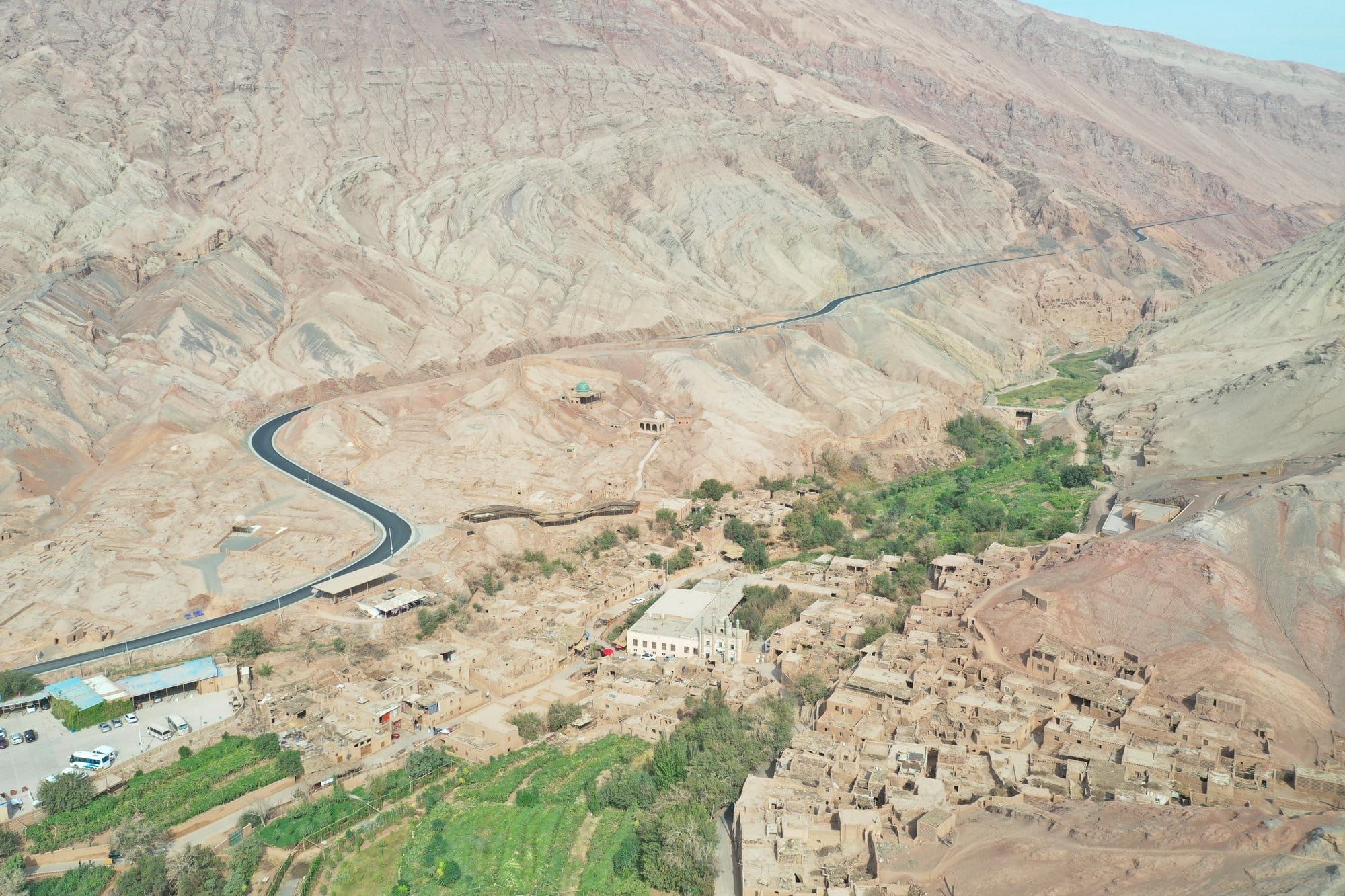
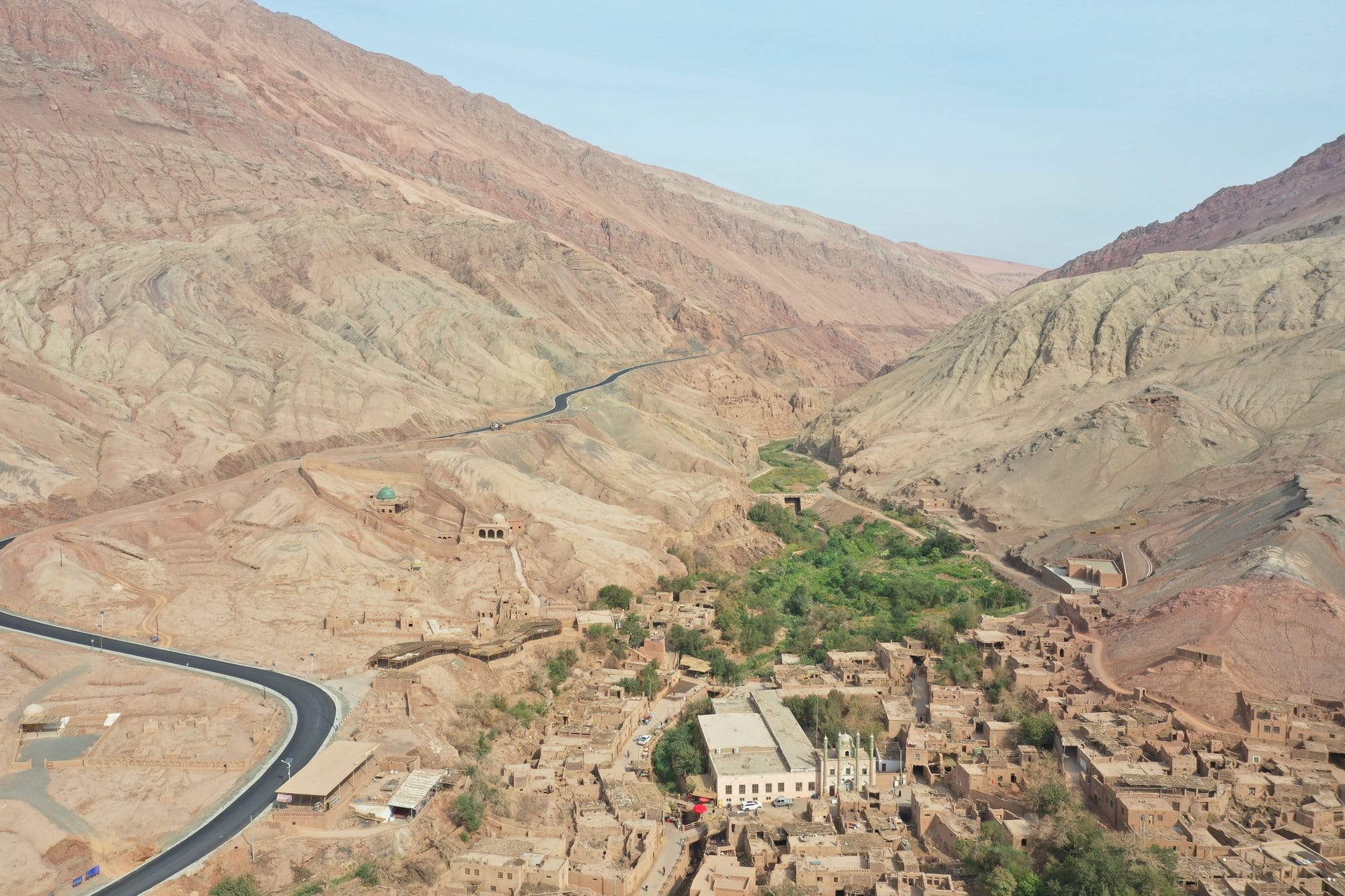
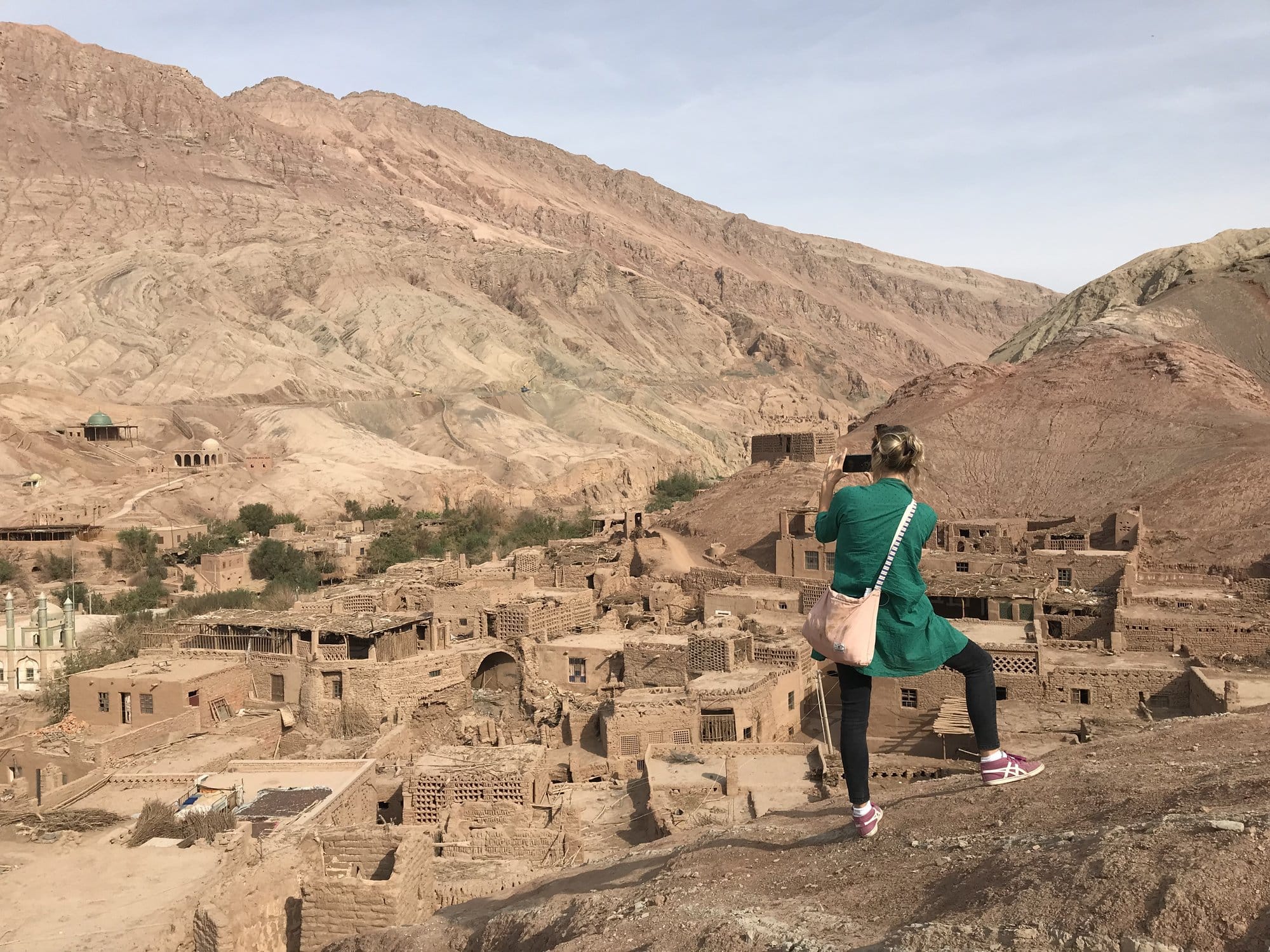
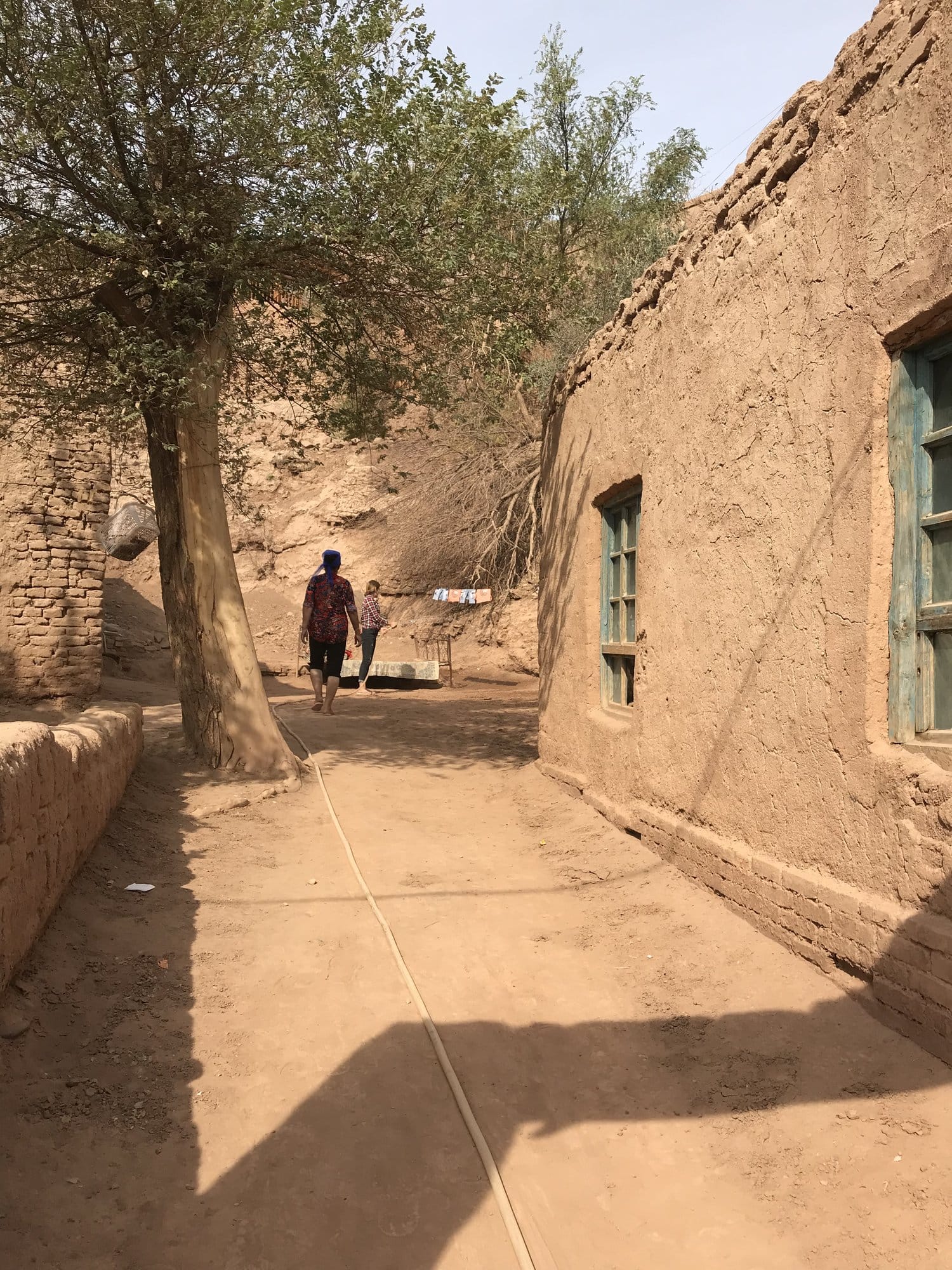
Tuyoq was the surprise of the whole stage. You approach it from above: the road comes over a ridge of eroded brown hills and switchbacks down in tight black loops towards a slot in the rock, and at the bottom of that slot is a village built almost entirely of mud brick, with a white mosque at its centre and a band of dense green running the length of the valley floor. From the air the contrast is absurd — ochre, a hard line, then green.
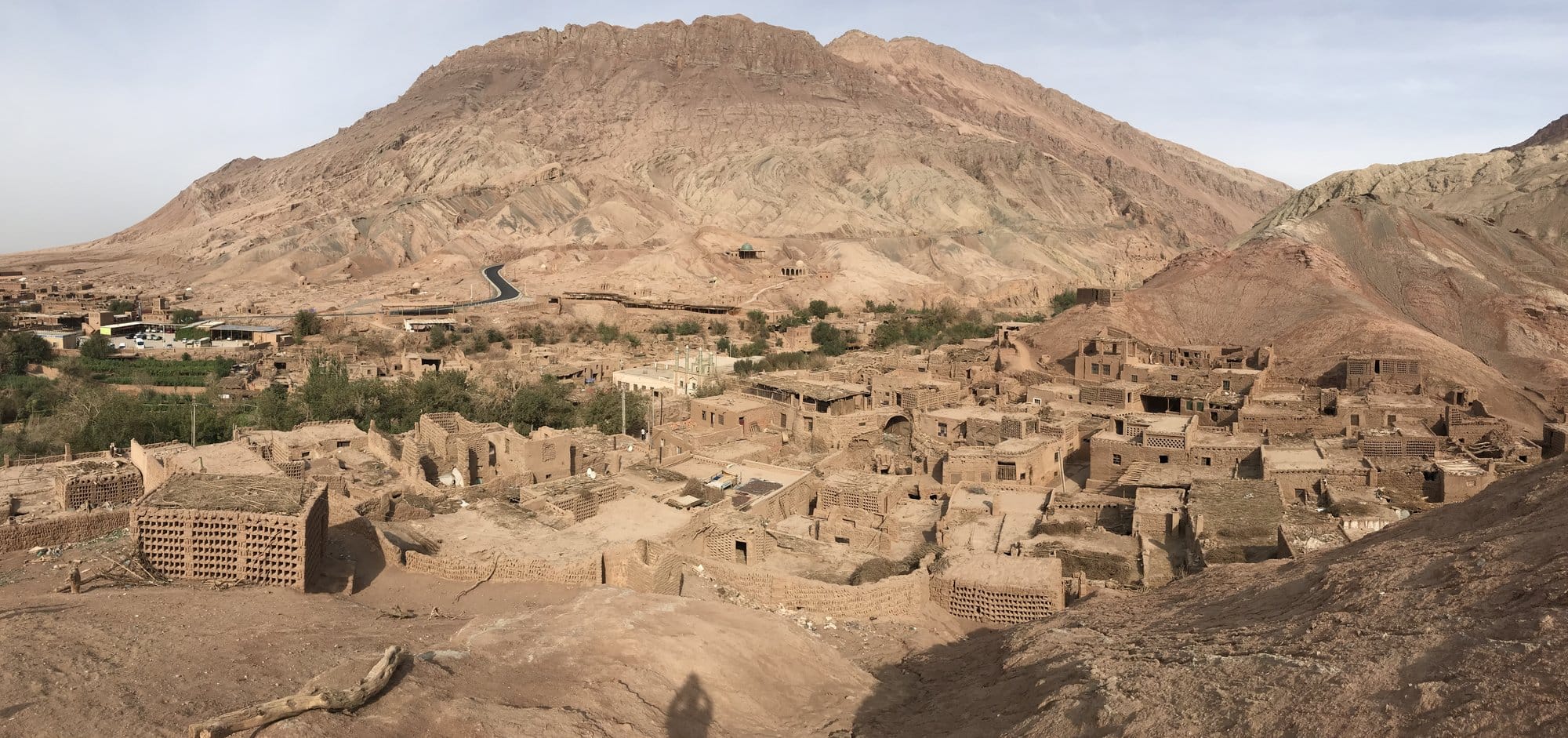
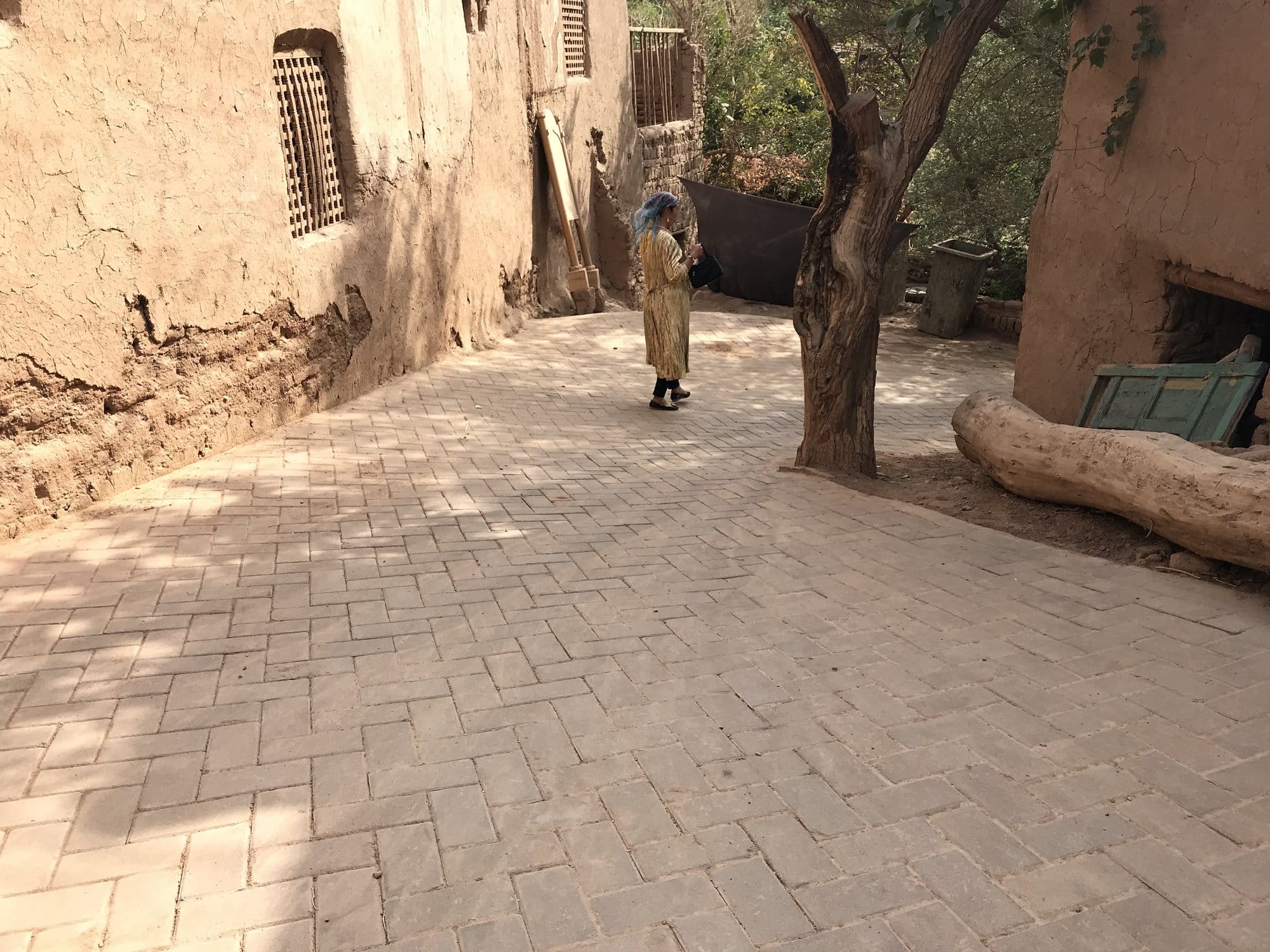
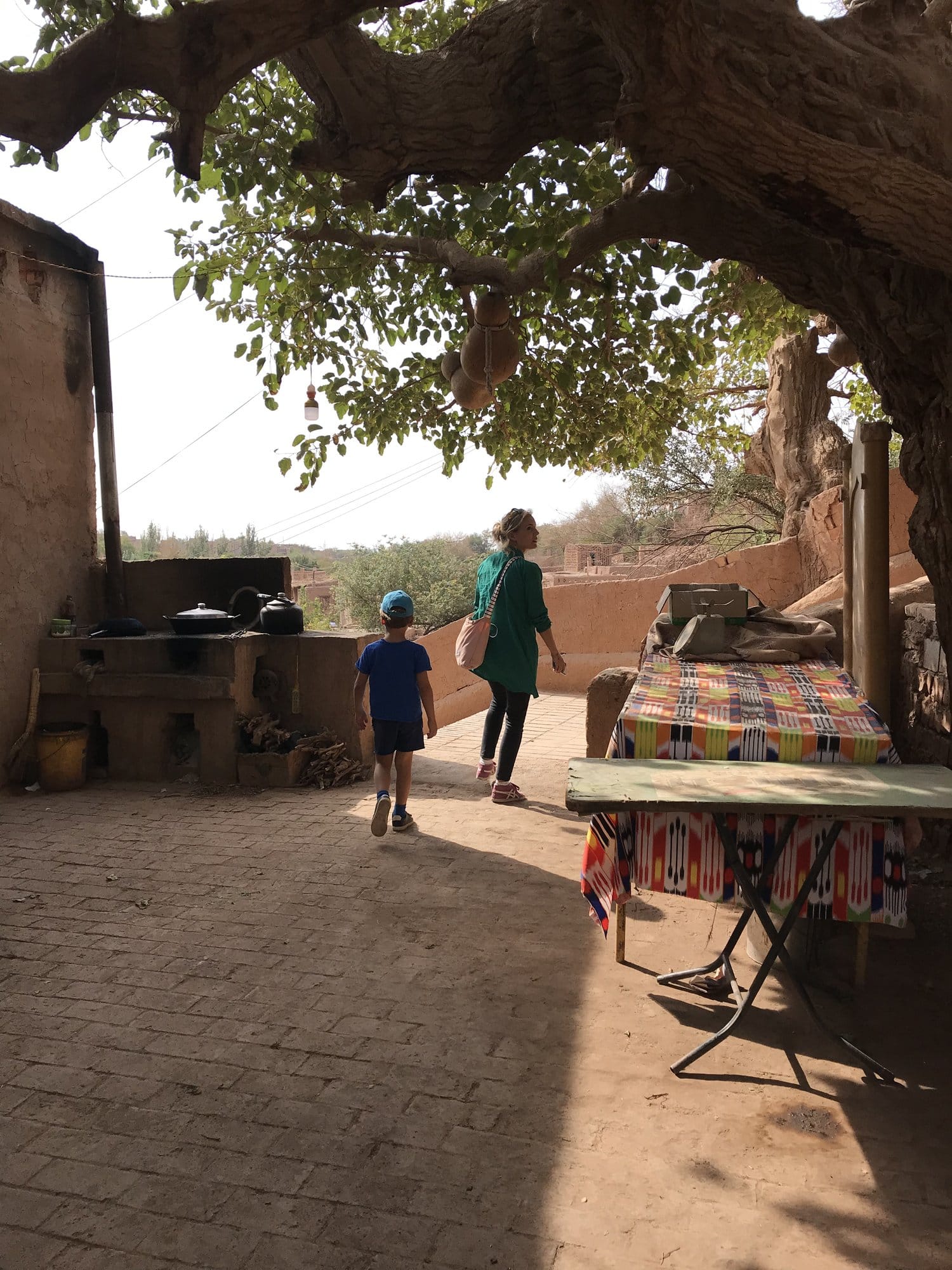
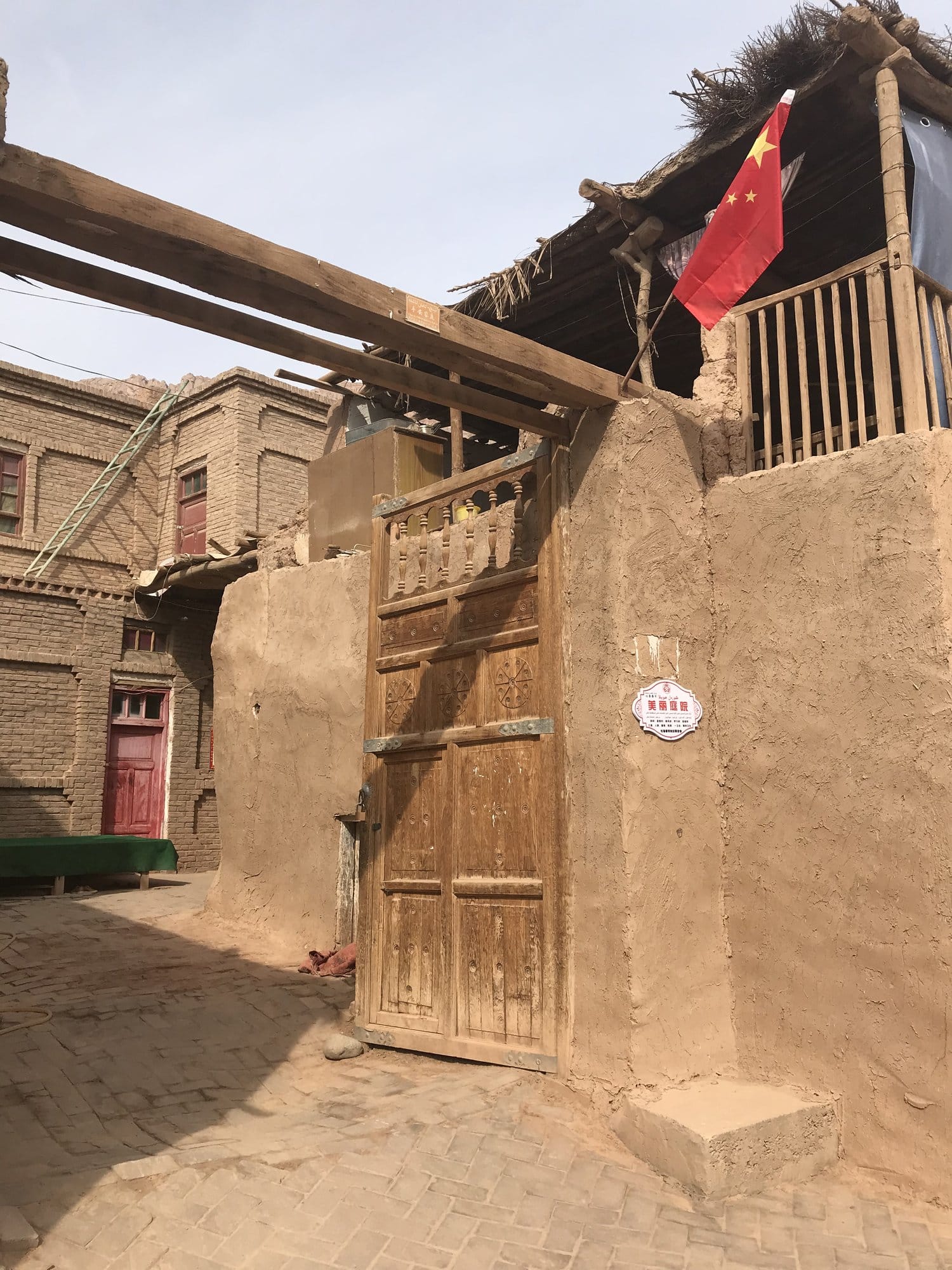
Down in it, the village is a maze of low earth walls, blue window frames, brick-paved lanes and big old trees, with courtyards opening off them where melons and vegetables dry under wooden awnings. Cave dwellings are cut into the pale cliff above. It is very quiet, and a working village rather than a museum — we kept our cameras on the architecture and the valley rather than on the people who live there.
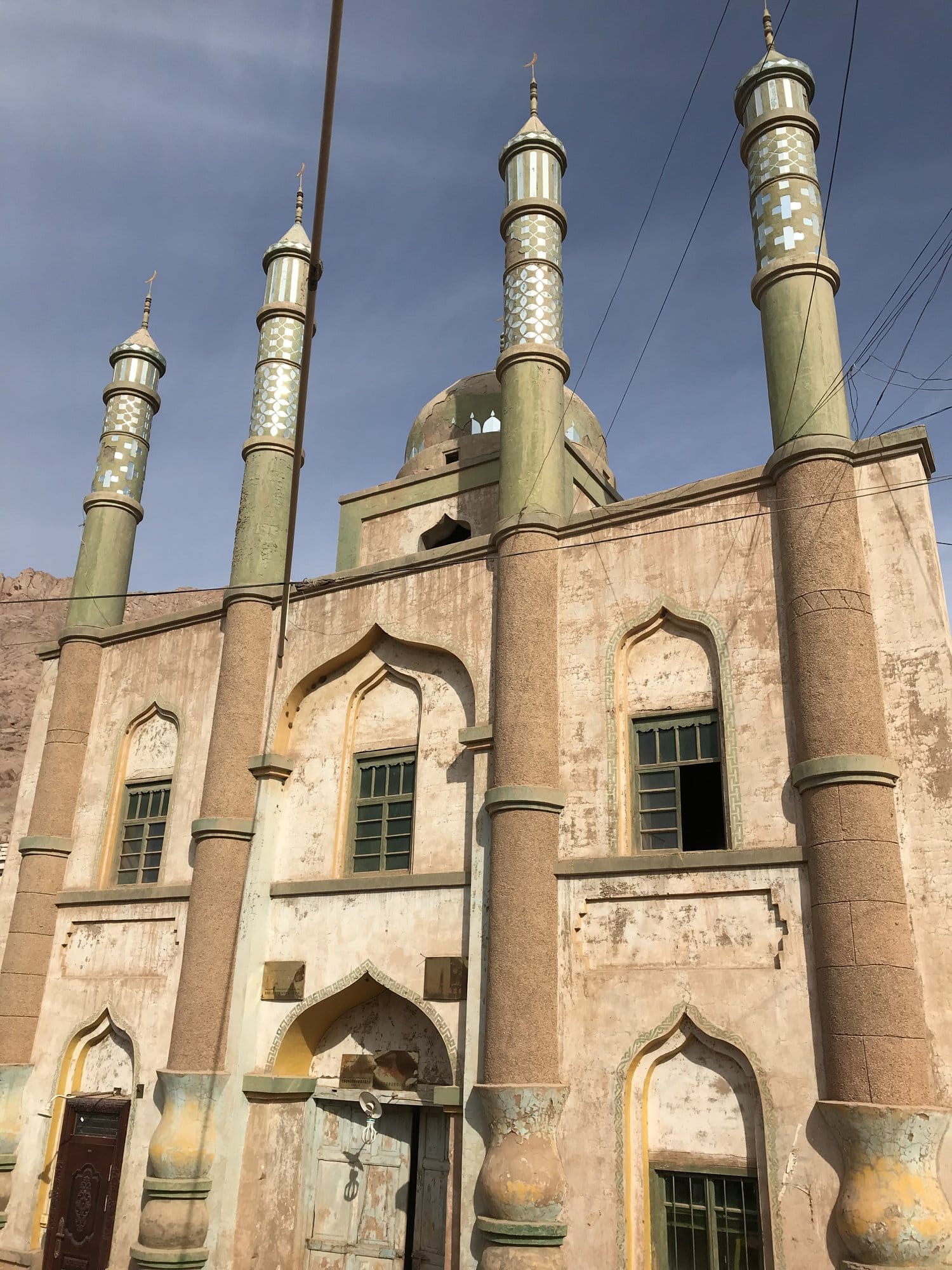
Give it longer than the schedule suggests. Tuyoq is usually sold as a stop between two bigger sites, and it was the place we would most have liked another hour in.
Bezeklik: Buddhist Caves Above a River
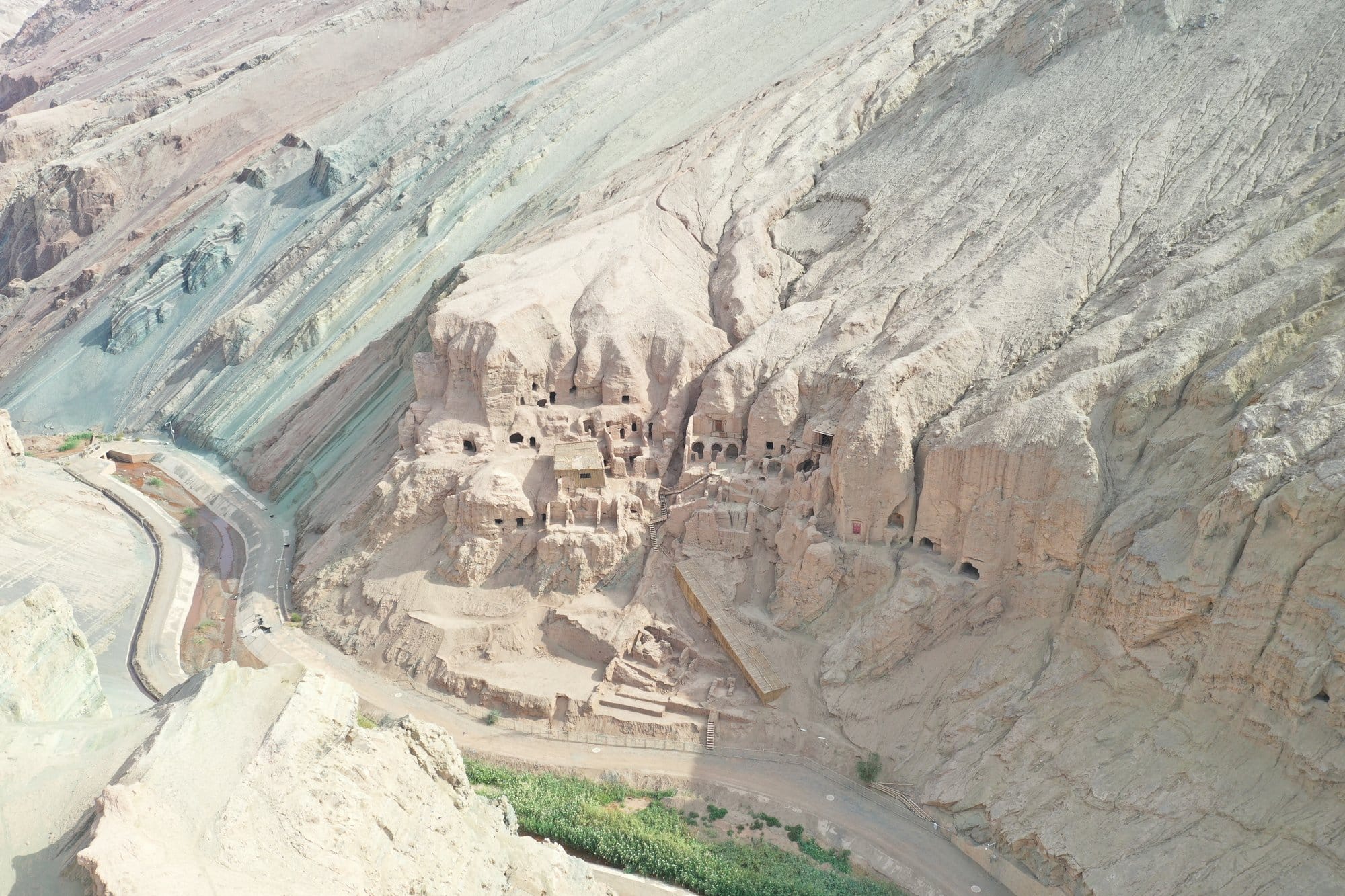
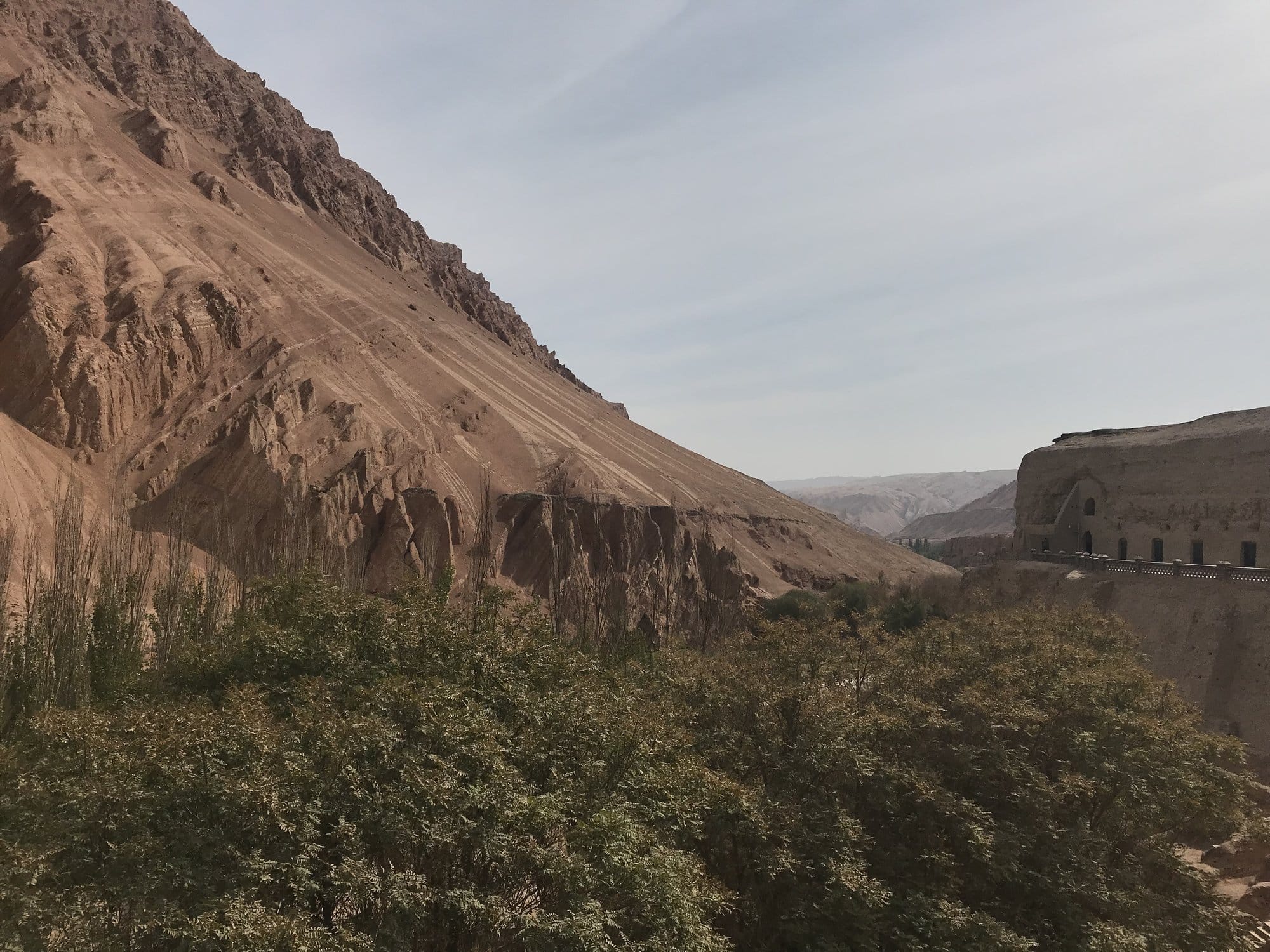
Bezeklik sits in a cliff face above a river valley, a line of doorways and terraces cut into pale rock with a ribbon of green far below. The setting alone justifies the detour: a walkway, the eroded ochre wall of the gorge behind you, water glinting at the bottom.
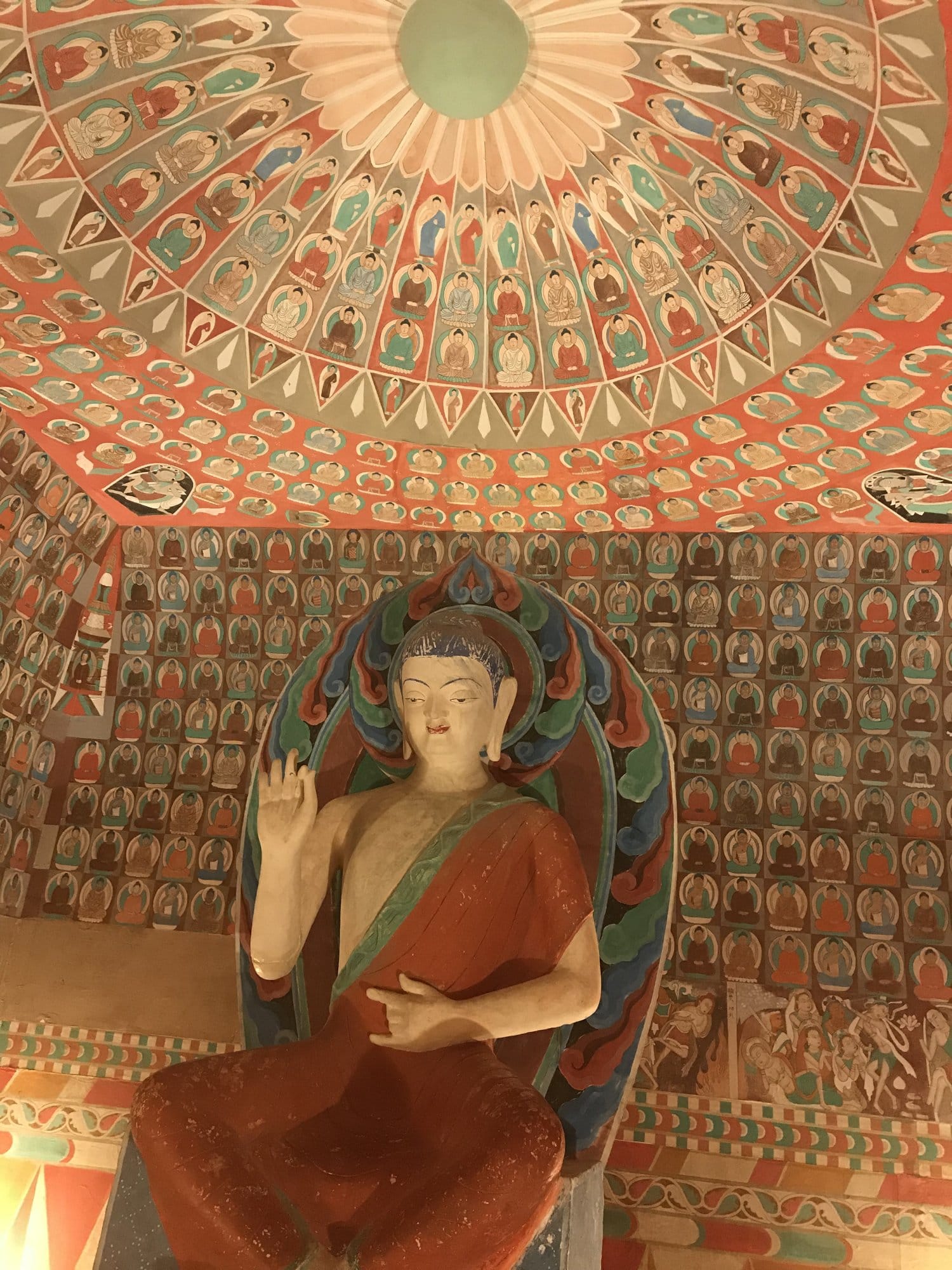
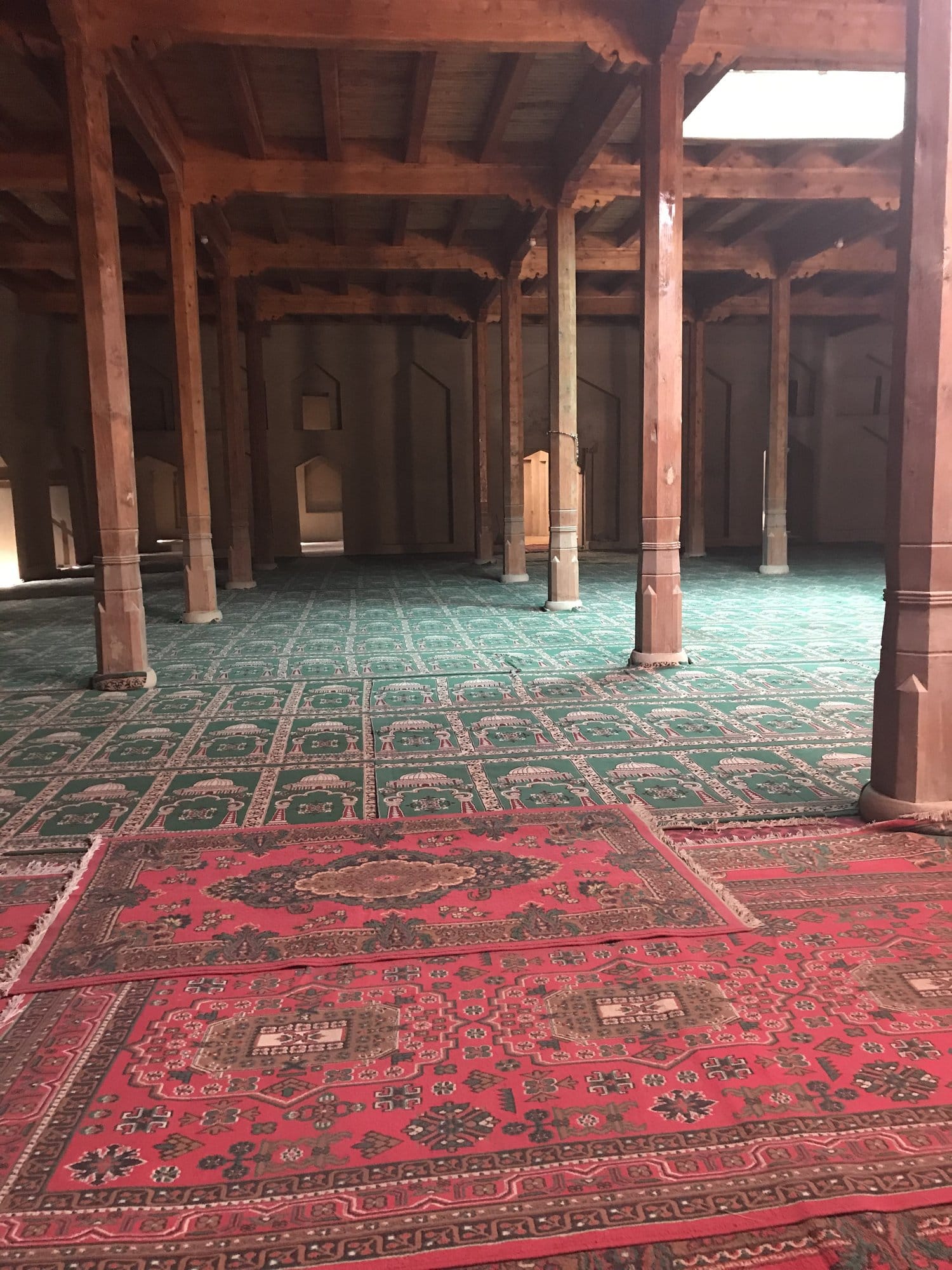
Inside, the caves are Buddhist, and they are damaged. Visibly, extensively, and in a way nobody tries to hide: cut edges where wall paintings were removed, faces scraped out, whole panels missing. What remains gives a very clear idea of what has gone. One chamber holds a seated Buddha under a domed ceiling painted with hundreds of small Buddhas repeated across the curve, remarkable and mournful in about equal measure. Explain to children beforehand that this is a place where things were taken, or the empty patches read as neglect rather than history. Ours spent the visit counting Buddhas on the ceiling.
The Flaming Mountains
The Flaming Mountains run along the northern edge of the basin, and the name is a description rather than a flourish. They are furrowed from top to bottom with vertical striations, the rock is a deep rust-red, and in low sun the range does genuinely look as though it is burning. From a viewpoint they are corrugations going on as far as you can see, with no vegetation at all to break them up.
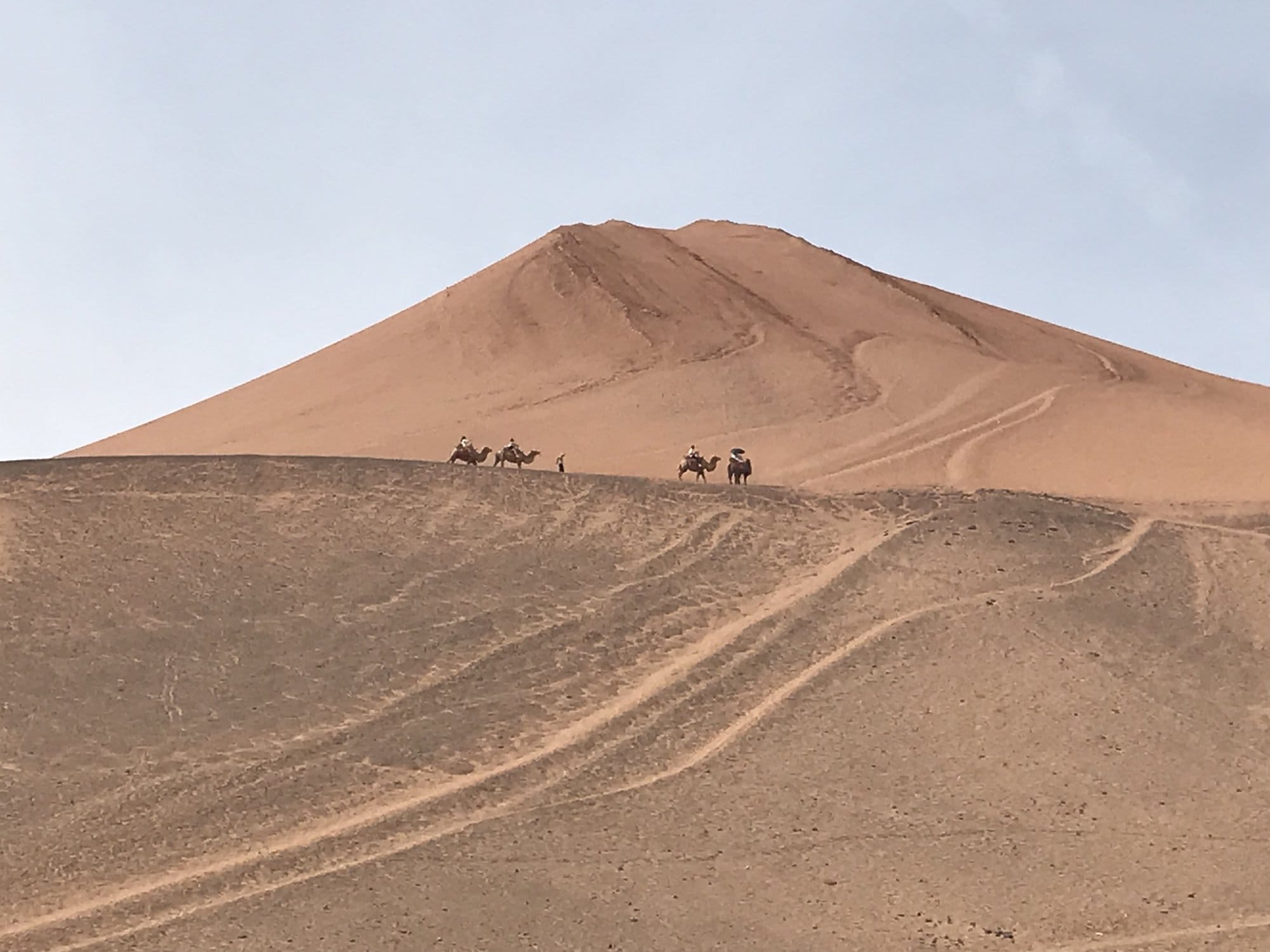
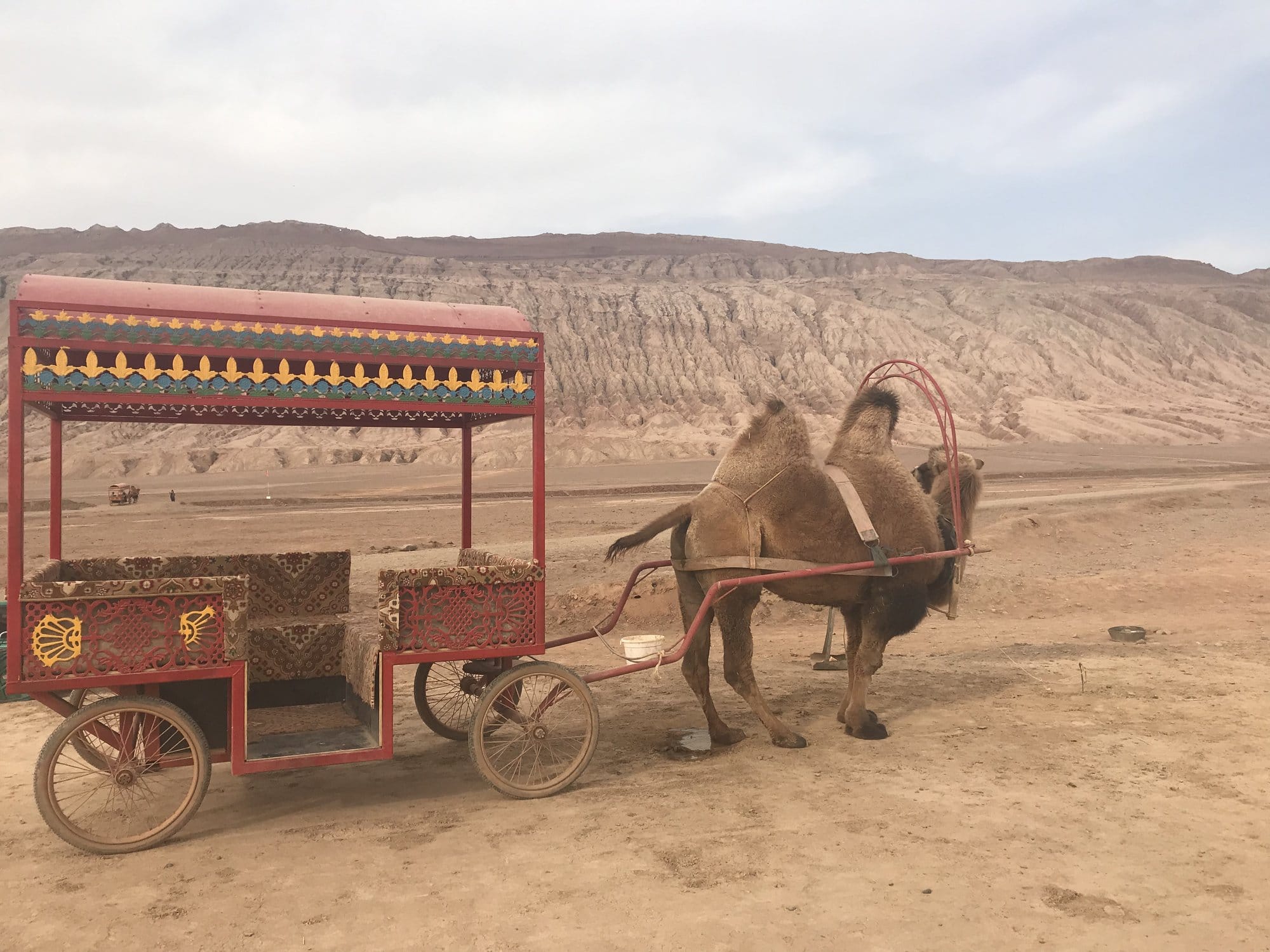
There is a visitor complex at the base with camels and a beautifully painted red cart harnessed to a Bactrian, and the boys wanted both. We watched a line of riders come over a sand crest with nothing behind them but sky. It is touristy in the way the Mingsha dunes near Dunhuang are touristy — organised, busy, and still worth it.
Jiaohe: An Entire City Built of Earth
We saved Jiaohe for our second morning, and it is the one that stayed with us.
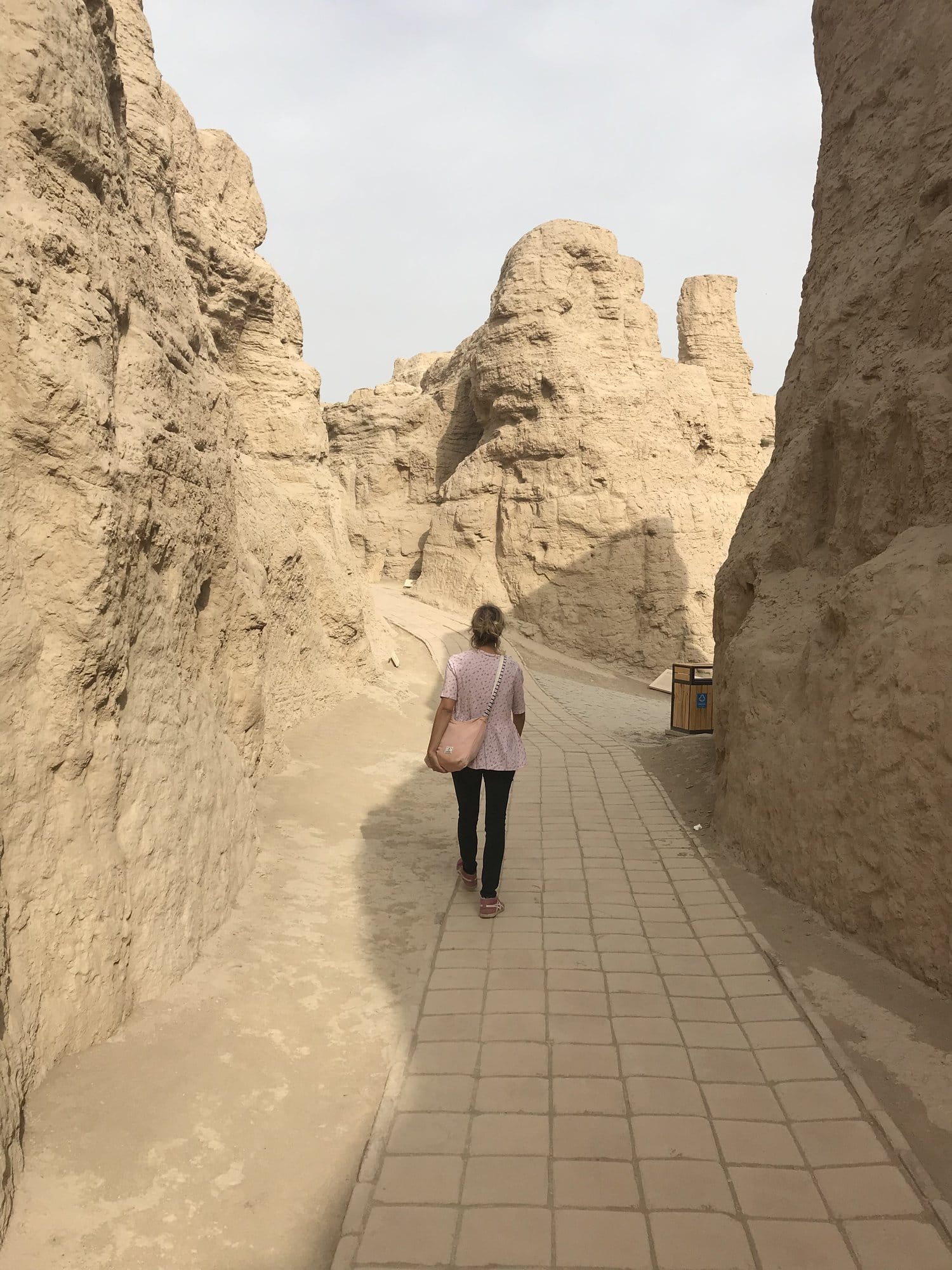
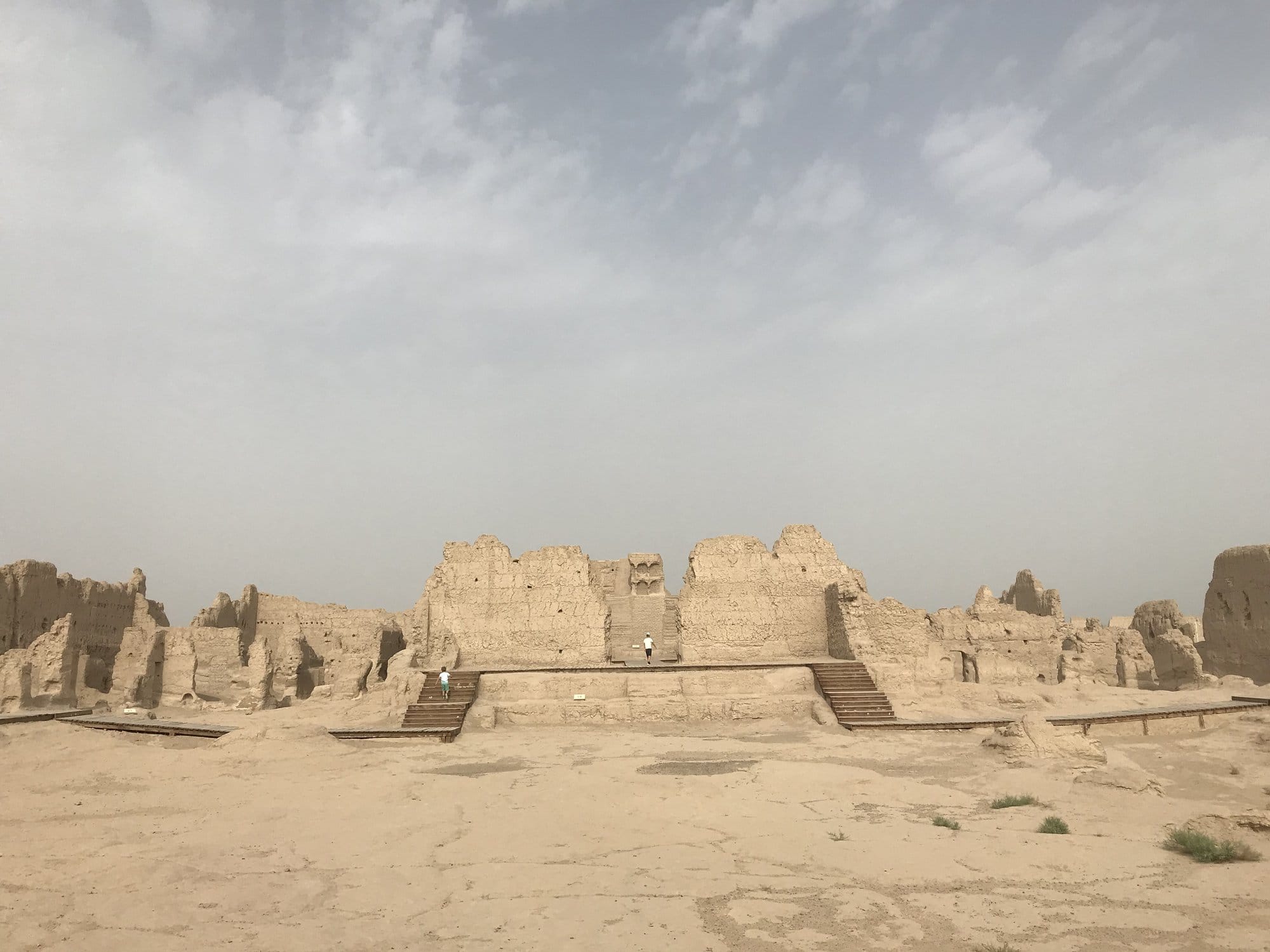
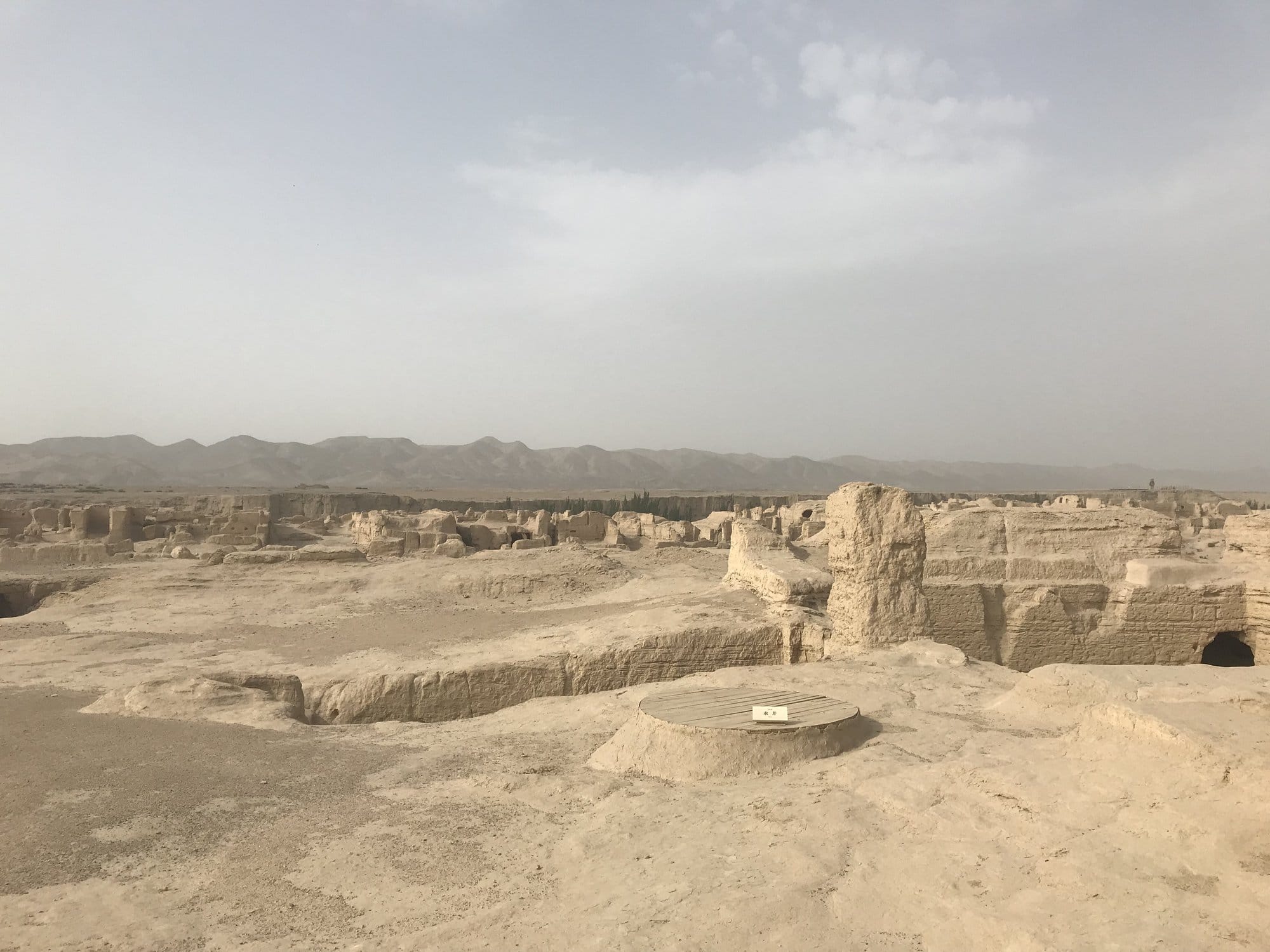
It occupies a long leaf-shaped plateau between two river channels, which is where the name comes from and also why nobody needed walls: the rivers cut the defences for them. What survives is not a few ruins in a field. It is a city — streets, courtyards, cisterns, a monastery, a central structure with steps up to it, room after room after room — almost all of it carved down into the ground or rammed up out of it rather than built from blocks. You walk sunken lanes between earth walls well over head height, mountains on the horizon at the end of every sightline.
Jiaohe was abandoned rather than sacked, which is the whole reason you can walk through it today. It is one of the best-preserved earthen cities anywhere, and entirely unshaded — go early.
Turpan with Children
This stage worked better with children than we expected, for a simple reason: everything is short. Tuyoq is a walk around a village, Bezeklik a walkway and a handful of chambers, the Flaming Mountains involve camels, and Jiaohe is a flat circuit with no climbing. Bring more water than seems sensible, and hats — there is no shade at Jiaohe or at the mountains, and outside the shoulder seasons these sites would be hard work for a six-year-old.
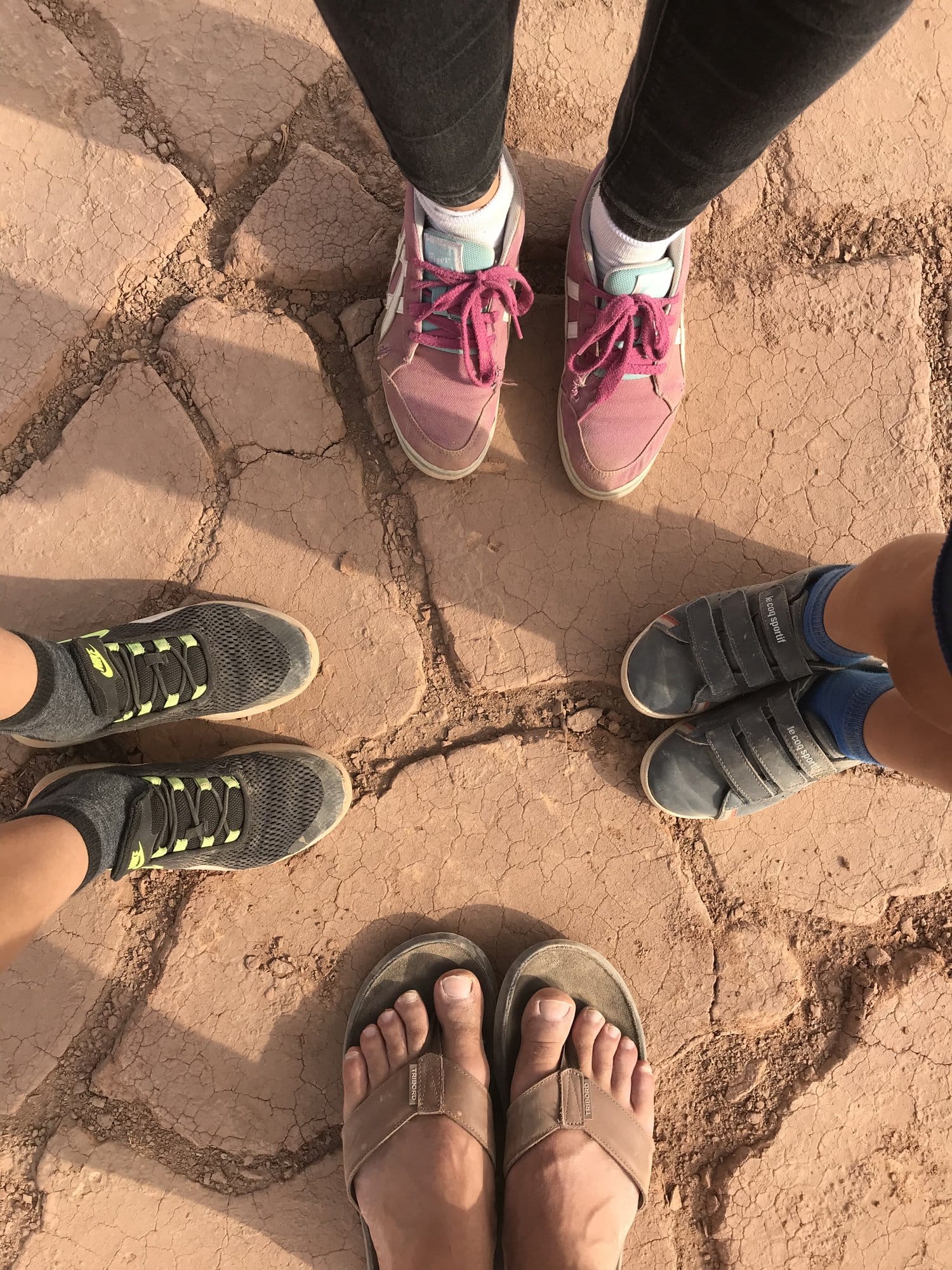
One of our favourite photographs from the whole trip is four pairs of feet in a circle on cracked earth, taken from above, somewhere below sea level. That was the day.
Practical Information
Getting there. Turpan is on the high-speed line west from the Hexi Corridor, which is how we arrived from Dunhuang. The sites are spread around the basin rather than concentrated in town, so you need a vehicle: Tuyoq and Bezeklik lie east, Jiaohe just west.
Leaving. The onward leg to Kashgar is roughly 1,400 kilometres, and the overnight train is far and away the best way to do it with a family. The children treated the bunks as a climbing frame and the distance disappeared while we slept. We would not do that leg any other way.
A guide. One travelled with us every day. His main function was not interpretation but getting us through checkpoints quickly, which he did.
When to go. Late September and early October are close to ideal: the heat has dropped to manageable and the fruit season is at its peak. Note that 1–7 October is the National Day holiday, when domestic travel peaks.
Context. Xinjiang is the subject of documented human rights concerns, and travellers will encounter frequent checkpoints and a visible security presence throughout the region. Carry your passport at all times, do not photograph security installations or personnel, and read your own government's current travel advice before booking. We have set out what this means in practice — checkpoints, permits, hotel restrictions and why an agency is involved at all — in a separate article.
→ What to know before travelling to Xinjiang
Frequently Asked Questions
Is Turpan below sea level?
Yes. The Turpan depression in eastern Xinjiang is one of the lowest places on earth, with Ayding Lake at its floor sitting at roughly 154 metres below sea level. The visitor sites around Turpan — Jiaohe, Bezeklik, the Flaming Mountains and Tuyoq — sit above the lake but at or below sea level. It is also one of the hottest parts of China in summer.
What is there to see in Tuyoq village?
Tuyoq is a mud-brick village at the bottom of a gorge in the hills east of Turpan, reached by a switchback road. The attraction is the village itself: earth-walled lanes, blue window frames, courtyards with melons and vegetables drying under awnings, a white mosque at the centre, and a green oasis strip along the valley floor between bare ochre hillsides. Cave dwellings are cut into the cliff above it.
Are the Bezeklik caves worth visiting if the frescoes are damaged?
Yes, with expectations set. The Bezeklik Thousand Buddha Caves near Turpan were stripped of large sections of their wall paintings, and the damage is obvious: cut edges, missing panels, defaced figures. What remains is still striking, particularly a seated Buddha beneath a dome painted with hundreds of small repeated Buddhas, and the cliff setting above the river gorge is worth the trip on its own.
Why are the Flaming Mountains in Turpan called that?
The Flaming Mountains are a bare, rust-red range along the northern edge of the Turpan basin, deeply furrowed with vertical ridges that catch the light. In low sun the striations appear to ripple and the range looks as though it is alight, which is where the name comes from. Nothing grows on them, and a visitor area at the base offers camel rides.
How long do you need in Turpan?
Two days is enough to cover the four main sights without rushing: Tuyoq, Bezeklik and the Flaming Mountains on one day, Jiaohe the next morning before moving on. Each site is short, so the constraint is driving time around the basin rather than time at any one of them. One very full day works if you must compress the itinerary.
What is Jiaohe ancient city?
Jiaohe is a ruined city near Turpan on a steep-sided plateau between two river channels that served as natural defences. It is built almost entirely from rammed earth, much of it carved downwards into the ground rather than raised up, and it includes streets, courtyards, cisterns and a monastery complex. Because it was abandoned rather than destroyed, it is among the best-preserved earthen cities in the world. It is entirely unshaded, so visit early.
More to Explore
- Kashgar: old town, bazaars and the Sunday livestock market — the next stage, an overnight train west - Dunhuang: Mingsha dunes, Crescent Lake and the Yangguan desert — the stage before, and the last in Gansu - Lijiang and Shangri-La: Old Town Roofs and the Tibetan Plateau — old towns and high plateau in Yunnan - Yunnan Itinerary: 11 Days from the Rice Terraces to Shangri-La — the other China we saw that year